
Ingredients
Dough
- 1 kgmarzipan, 60% almond
- 500 gicing sugar
- 3egg whites
Icing
- 1egg white
- 250 gicing sugar
- 1 tsplemon juice
To decorate
- small paper flags
- crackers or bonbons
Equipment
- kransekage ring moulds, or a template
Directions
- Use marzipan with a high almond content, at least 60 per cent. Cheap marzipan is mostly sugar and it slumps in the oven instead of holding its ring.
- Grate or break up the marzipan and work it with the icing sugar and egg whites into a firm, smooth paste.
- Knead it well, then wrap it and rest it overnight at room temperature.
- The overnight rest matters. It lets the paste hydrate evenly and stops the rings cracking as they bake.
- Roll the paste into ropes about 1.5 cm thick, keeping them even along their length.
- Roll them under flat palms, not fingers, or you get a lumpy rope and the finished ring shows every bump.
- Cut the ropes into lengths, each one about 2 cm longer than the last.
- Join each into a ring, pressing the ends together and smoothing the join.
- Work out your sizes first, from largest to smallest, either with proper ring moulds or a paper template.
- Consistency of thickness matters more than exact diameter. Uneven ropes give a tower that leans and eventually falls.
- Bake at 200°C (390°F) for 10 to 12 minutes, until pale gold with a slightly darker edge.
- Take them out while still soft in the middle. They firm as they cool, and a fully baked kransekage is rock hard rather than chewy.
- Cool the rings completely on the trays.
- Beat the icing to a stiff, pipeable royal icing and put it in a bag with a small plain nozzle.
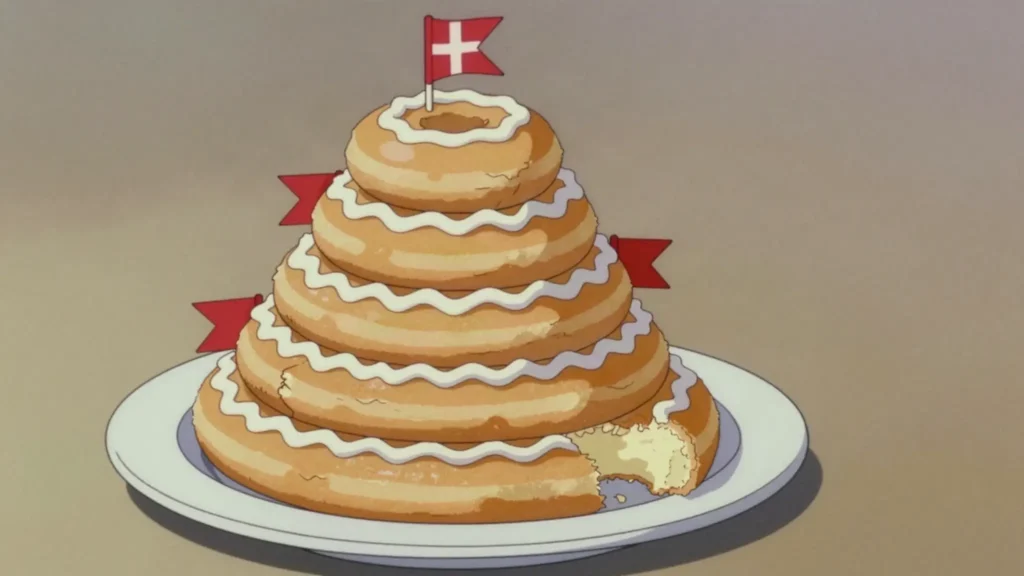
- Stack the rings largest to smallest, piping a zigzag of icing around each one as you go.
- The icing is the mortar as well as the decoration, so pipe it where the next ring will sit rather than only on the outer face.
- Decorate with small paper flags, which is not optional at a Danish celebration.
- At New Year it is broken open rather than sliced, and at weddings the couple lift the top and count the rings that come away.
- It is eaten by breaking off pieces of ring, and it keeps for weeks in a tin.
Technique
- The Norwegian kransekake is the same tower and the two countries dispute its origin amicably.
- The texture should be chewy and dense rather than crisp.
- A bottle of champagne is often hidden inside the completed tower.
Substitutions
- Homemade marzipan of ground almonds, icing sugar and egg white.
- Baking the rings free-form on a lined tray with a drawn template underneath.
Variations
- Made flat as a single large ring, as a smaller celebration cake.
- Overflødighedshorn, the horn of plenty shape.
- With a chocolate coating instead of icing.
History
A Danish celebration cake of almond rings stacked into a cone and dressed with flags and crackers.
Frequently asked questions
What is Kransekage?
Kransekage is a dessert from Denmark: tower of marzipan rings cracked open at New Year and weddings. A Danish celebration cake of almond rings stacked into a cone and dressed with flags and crackers.
How long does Kransekage take to make?
Kransekage takes 1 hr plus overnight resting of preparation and 15 min of cooking. The recipe makes 1 tower of about 18 rings. It is rated hard to make.
What can I substitute in Kransekage?
Yes, within limits. Homemade marzipan of ground almonds, icing sugar and egg white. Baking the rings free-form on a lined tray with a drawn template underneath.
What is the most important thing to get right in Kransekage?
Use marzipan with a high almond content, at least 60 per cent. Cheap marzipan is mostly sugar and it slumps in the oven instead of holding its ring.