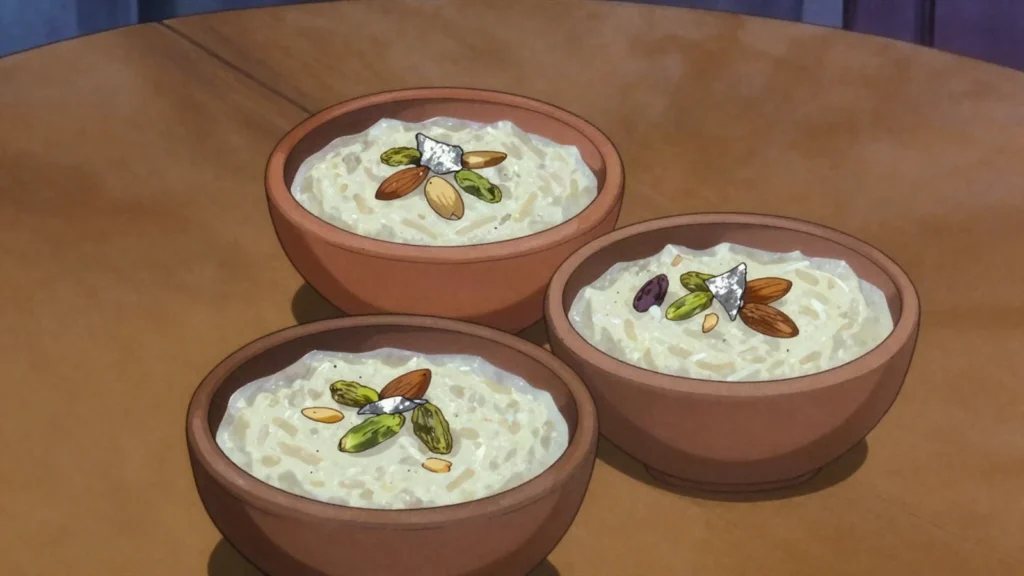

Ingredients
Base
- 2 litresfull-fat milk
- 100 gbasmati or short-grain rice
- 150 gsugar
Flavour
- 6green cardamom pods, crushed
- a pinch of saffron
- 1 tbsprose water or kewra
To finish
- 50 gslivered almonds
- 50 gslivered pistachios
- 2 tbspraisins
- silver leaf, optional
Directions
- Rinse the rice once and soak it for 20 minutes, then drain and crush it lightly between your fingers.
- Crushing the grains a little is a standard trick. Broken rice releases far more starch and thickens the milk without needing an extra half hour.
- Bring the milk to the boil in a heavy pan, then reduce it to a low simmer.
- Use the heaviest pan you own. Milk catches on a thin base within minutes, and scorched milk taints the entire batch beyond rescue.
- Add the drained rice and simmer, uncovered, for 1 hour to 1 hour 15 minutes.
- Stir every few minutes and scrape the bottom and the sides as you go.
- Scrape the skin that forms on the sides back into the pan rather than discarding it. That reduced milk solid is where the flavour concentrates.
- The milk should reduce by about half and turn a pale cream colour as the lactose caramelises very slightly.
- Add the sugar only once the rice is completely soft.
- Sugar added early slows the rice from softening and it stays chalky in the middle however long you cook it.
- Stir in the crushed cardamom and the saffron, steeped first in a spoonful of warm milk.
- Simmer 10 minutes more, then take it off the heat and stir in the rose water and most of the nuts.
- Take it off while it still looks looser than you want, because it thickens considerably as it cools.
- Serve warm or chilled, scattered with the remaining nuts and raisins.
- It is made for Eid, for weddings and for almost every celebration across Pakistan and northern India, and it is one of the oldest recorded dishes in the subcontinent.
Technique
- There is no shortcut to the long slow reduction, which is where the flavour comes from.
- Condensed or evaporated milk speeds it up and gives a noticeably different, flatter result.
- It keeps three or four days and is eaten cold straight from the fridge.
Substitutions
- Broken basmati, or short-grain pudding rice.
- Khoya stirred in at the end, which enriches it considerably.
Variations
- Firni, made with ground rice and set in clay bowls.
- Made with vermicelli, as sheer khurma.
- With grated carrot or bottle gourd in place of some of the rice.
History
A rice pudding, cooked slowly in milk and sweetened with sugar, flavoured with cardamom and often garnished with nuts, documented in South Asian cooking for many centuries, with roots reaching back through ancient Indian subcontinental cooking traditions predating any specific written record, since milk-and-rice preparations are found across a very wide span of South Asian history and religious ritual practice. It carries significant ceremonial and religious weight across Pakistan and the wider subcontinent, commonly prepared for religious festivals, weddings and as an offering in various Hindu, Muslim and Sikh traditions, reflecting the dish’s status as a food considered appropriate for both celebration and devotional purposes across multiple South Asian religious communities. Regional and household variations exist in exact rice type, thickness and specific garnish used.
Frequently asked questions
What is Kheer?
Kheer is a dessert from Pakistan: slow-cooked rice pudding with cardamom, nuts and reduced milk. A rice pudding, cooked slowly in milk and sweetened with sugar, flavoured with cardamom and often garnished with nuts, documented in South Asian cooking for many centuries, with roots reaching back through ancient Indian subcontinental cooking traditions predating any specific written record, since milk-and-rice preparations are found across a very wide span of South Asian history and religious ritual practice. It carries significant ceremonial and religious weight across Pakistan and the wider subcontinent, commonly prepared for religious festivals, weddings and as an offering in various Hindu, Muslim and Sikh traditions, reflecting the dish’s status as a food considered appropriate for both celebration and devotional purposes across multiple South Asian religious communities. Regional and household variations exist in exact rice type, thickness and specific garnish used.
How long does Kheer take to make?
Kheer takes 10 min of preparation and 1 hr 30 min of cooking. The recipe makes 6 servings. It is rated easy to make.
What can I substitute in Kheer?
Yes, within limits. Broken basmati, or short-grain pudding rice. Khoya stirred in at the end, which enriches it considerably.
What is the most important thing to get right in Kheer?
Use the heaviest pan you own. Milk catches on a thin base within minutes, and scorched milk taints the entire batch beyond rescue.