
Ingredients
Meju (soybean bricks)
- 3 kgdried whole soybeans, soaked 12 hr
- water, for boiling
- rice straw, for wrapping and hanging
Brine
- 18 litresunchlorinated water
- 3.6 kgcoarse sun-dried sea salt (about 20 percent brine)
- 1raw egg, for testing the brine
- 6dried red chillies
- 3lumps of charcoal, burned red hot
Equipment
- 1large onggi (glazed earthenware crock), scalded and dried
- 1cotton cloth and a lid
- a sunny rooftop or terrace
Directions
- Boil the soaked soybeans in plenty of water for 4–5 hours, until a bean crushes to a paste between finger and thumb with no resistance. Drain, reserving a little cooking water.
- Pound or mash the hot beans coarsely, then press them firmly into bricks of about 1 kg, roughly 20 by 12 by 6 cm. Compact them hard: air pockets go mouldy in the wrong way.
- Dry the bricks on straw in a warm airy place for 3–5 days until the outsides are hard and crusted, then tie them in straw and hang them in a cool room at 10–15°C (50–60°F) for 4–8 weeks. The straw carries the Bacillus subtilis and wild moulds that colonise the meju; it will develop a white and yellow-green bloom and smell powerfully of ammonia and cheese. This is correct.
- Wash the finished meju bricks quickly under cold water with a brush, dry them in the sun for a day, and break off anything black or slimy.
- Mix the brine and test it: a fresh egg should float with a coin-sized disc of shell showing above the surface, which is roughly 18–20 percent salt. This concentration is the safety mechanism of the whole process.
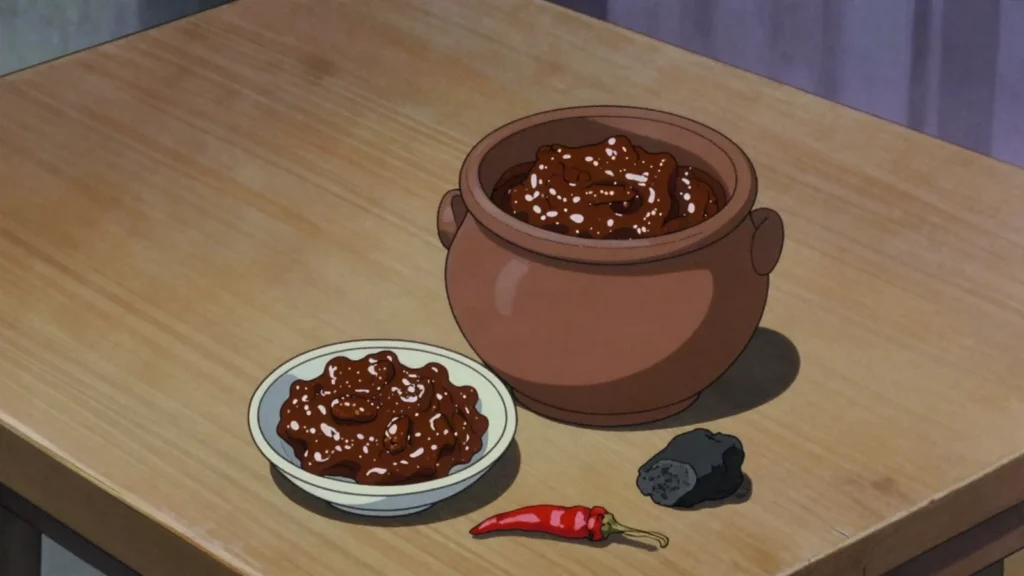
- Pack the meju into the onggi, pour the brine over to cover, and float the dried chillies. Plunge the red-hot charcoal in for a moment to sterilise the surface, then cover with cloth.
- Stand the crock in full sun on a rooftop or terrace, lid open on dry days and closed at night and in rain, for 40 to 60 days. Skim any surface film daily.
- Strain: the dark liquid is joseon ganjang, boiled and bottled as soup soy sauce. Crush the drained solids, pack them into a clean smaller onggi, smooth the surface, sprinkle with salt and age a further 6 to 12 months. Finished doenjang is dark brown, chunky, deeply savoury and slightly gritty.
Technique
- Doenjang and ganjang are made in one process from the same crock, which is why traditional Korean households never bought either separately.
- Food safety: the 18–20 percent brine is what keeps everything but the desired microbes out. Do not reduce the salt, do not use chlorinated water, and never let the solids sit uncovered by brine during the sun stage. Discard the batch if it smells putrid rather than sharp and savoury.
- Unlike Japanese miso, doenjang is made without added koji rice culture: the fermentation is wild, driven by whatever colonises the meju from the straw and the air, which is why it tastes coarser and funkier.
Substitutions
- No onggi: use a large glass jar or a food-grade plastic crock, though the porous earthenware breathes and gives a better result.
- If you cannot make meju, dried meju bricks are sold by Korean grocers and can be brined directly at step five.
- Japanese red miso is the nearest shop-bought stand-in, but expect it to be sweeter, smoother and much less pungent.
Variations
- Ssamjang, made by mixing doenjang with gochujang, sesame oil, garlic and spring onion for wrapping.
- Cheonggukjang, a fast three-day version fermented at 40°C (105°F), stringy and famously pungent.
- Makjang or jip-doenjang, the everyday household style with barley or rice flour added to soften it.
History
Made from meju blocks fermented over winter, a technique recorded in Korea since the Three Kingdoms period.
Frequently asked questions
What is Doenjang?
Doenjang is a fermented & pickled from North Korea: salty soybean paste aged in earthenware; base of stews and dipping sauces. Made from meju blocks fermented over winter, a technique recorded in Korea since the Three Kingdoms period.
How long does Doenjang take to make?
Doenjang takes 3 hr active work, spread over months of preparation and 6 to 12 months fermenting of cooking. The recipe makes about 3 kg doenjang plus 2 litres soy sauce. It is rated hard to make.
What can I substitute in Doenjang?
Yes, within limits. No onggi: use a large glass jar or a food-grade plastic crock, though the porous earthenware breathes and gives a better result. If you cannot make meju, dried meju bricks are sold by Korean grocers and can be brined directly at step five. Japanese red miso is the nearest shop-bought stand-in, but expect it to be sweeter, smoother and much less pungent.
What is the most important thing to get right in Doenjang?
Mix the brine and test it: a fresh egg should float with a coin-sized disc of shell showing above the surface, which is roughly 18–20 percent salt. This concentration is the safety mechanism of the whole process.