
Ingredients
Goiabada
- 1.5 kgripe guavas
- sugar, equal in weight to the cooked pulp
- juice of 1 lemon
To serve
- 400 gqueijo Minas frescal, or a mild fresh white cheese
Also
- a shallow tin, lined
Or
- 500 gready-made goiabada, which is what most people use
Directions
- Wash the guavas, top and tail them, and chop them roughly with skins and seeds left in. Leave the skins and seeds in for the cooking, because that is where most of the pectin is and pectin is what makes it set.
- Cover with water and simmer for 30 minutes until completely soft. Sieve it rather than blending it. Discard the seeds and skins and weigh the pulp. Equal weights of pulp and sugar is the traditional ratio and it is what makes the paste keep for months at room temperature.
- Return the pulp and sugar to a heavy pan with the lemon juice. Cook over a low heat, stirring constantly, for an hour to an hour and a half.
- Stir it without stopping and use a long spoon. It thickens into a volcanic paste that spits scalding blobs, and it catches on the base within seconds if left.
- Keep your face well back from the pan. It is ready when it pulls away from the sides of the pan in a single mass and a spoon drawn across the base leaves a trail that stays open for a second.
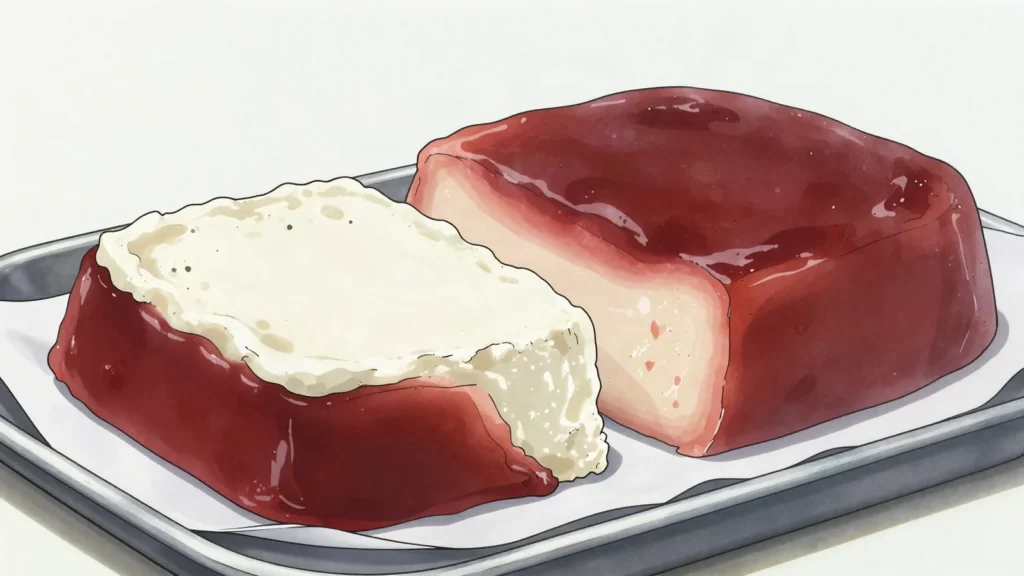
- Pour it into a lined shallow tin and level the surface. Leave it uncovered at room temperature overnight to set. Let it set uncovered, because the surface needs to dry slightly, and never in the fridge. Cut the set goiabada into slices about 1 cm thick.
- Cut the cheese into slices of the same thickness and the same size. Equal thickness of each is the point, so that neither dominates and the salt of the cheese cuts the sweetness of the fruit. Serve them together at room temperature rather than fridge-cold, which flattens both.
Technique
- Ready-made goiabada is sold in blocks and tins everywhere in Brazil.
- Queijo Minas is sold in Brazilian shops, and a mild fresh cheese or a young Gouda stands in.
- The paste keeps for months wrapped and improves in the first weeks.
Substitutions
- Shop-bought goiabada, which is what most Brazilians use.
- Any mild fresh white cheese, or a mild Cheshire.
Variations
- Goiabada cascão, with pieces of guava left in.
- Baked together in a pastry as a tart.
- Martín Fierro, the quince and cheese version from the River Plate.
History
Named for Shakespeare’s lovers; the goiabada descends from Portuguese quince marmelada, remade with guava in colonial Brazil.
Frequently asked questions
What is Romeu e Julieta?
Romeu e Julieta is a dessert from Brazil: slab of guava paste eaten with a slice of fresh Minas cheese. Named for Shakespeare’s lovers; the goiabada descends from Portuguese quince marmelada, remade with guava in colonial Brazil.
How long does Romeu e Julieta take to make?
Romeu e Julieta takes 20 min plus overnight setting of preparation and 1 hr 30 min of cooking. The recipe makes 6 servings. It is rated medium to make.
What can I substitute in Romeu e Julieta?
Yes, within limits. Shop-bought goiabada, which is what most Brazilians use. Any mild fresh white cheese, or a mild Cheshire.
What is the most important thing to get right in Romeu e Julieta?
Cover with water and simmer for 30 minutes until completely soft. Sieve it rather than blending it. Discard the seeds and skins and weigh the pulp. Equal weights of pulp and sugar is the traditional ratio and it is what makes the paste keep for months at room temperature.