
Ingredients
Cassava
- 4 kgbitter cassava root
- 1 tspsalt
Optional filling
- 200 ggrated coconut with 100 g sugar
- or salt fish, soaked and flaked
Equipment
- a matapi, or a strong cloth and weight
- a flat iron griddle
Directions
- Peel the cassava and grate it finely on a board grater, the way it is still done in the Kalinago Territory.
- Pack the wet mash into a matapi, the woven tube press, and hang it with a weight on the lower end. The tube narrows as it is stretched and squeezes the liquid out steadily over several hours.
- If you have no matapi, wrap the mash in a strong cloth and press it under a heavy weight for at least two hours, pouring off the liquid as it collects.
- The liquid pressed out is toxic and must be thrown away. Bitter cassava is not edible until this is done, and it is why the technique survived from before European contact rather than being simplified over time.
- Sieve the pressed mash into a dry flour and mix the salt through it.
- Heat a flat iron griddle over a wood fire or a moderate flame, completely dry.
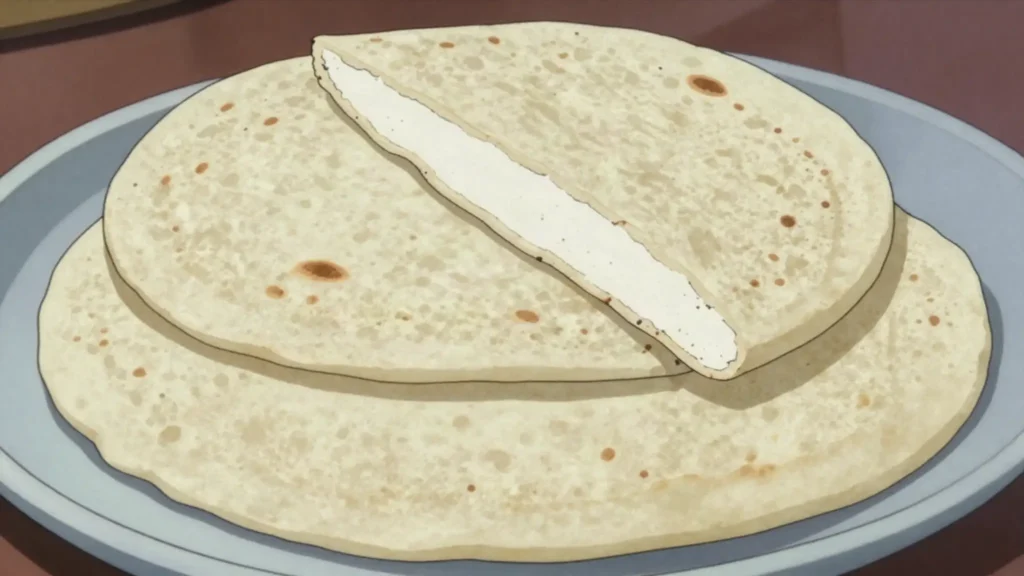
- Spread the flour over the griddle in a round about 20 cm across and 1 cm thick, noticeably thicker than a Dominican casabe, and press it down firmly with a flat board.
- For a filled loaf, spread half the flour first, scatter the sweetened coconut or the flaked salt fish across it, then cover with the remaining flour before pressing.
- Cook for about 5 minutes a side, pressing occasionally, until the loaf holds together and both faces are dry and speckled.
- Cool on a rack. It is softer and more bread-like than casabe and is meant to be eaten the same day or the next.
- Serve with fish, alongside stews, or on its own with butter.
Technique
- Thicker and softer than casabe, and made to be eaten fresh rather than stored, which is the main difference between the two breads.
- The matapi is a remarkable piece of engineering: a woven tube that tightens as it lengthens, doing the work of a press with no moving parts.
- Grate finely. Coarse mash will not bind into a loaf on the griddle.
Substitutions
- A cloth and a heavy weight in place of a matapi.
- A heavy cast iron pan if you have no flat griddle.
Variations
- Sweet, with coconut and sugar through the middle.
- Savoury, with flaked salt fish.
- Plain, which is how it is most often made for everyday eating.
History
A flatbread made from grated, pressed cassava root, developed by Indigenous Caribbean peoples, including the Kalinago, who remain present in Dominica today with one of the largest surviving Indigenous Caribbean communities, well before European colonization introduced other grains and baking traditions to the region beginning in the late 1400s and 1500s. Cassava requires careful processing to remove naturally occurring toxic compounds before it is safe to eat, and the specific technique for grating, pressing and baking it into a thin, dry, long-storing bread reflects generations of Indigenous Caribbean food-safety knowledge predating colonization. Its long shelf life once fully dried made cassava bread a particularly practical staple for storage and travel, and it remains produced and eaten across several Caribbean islands with surviving Indigenous culinary influence, including Dominica, Guyana and Saint Lucia.
Frequently asked questions
What is Cassava bread?
Cassava bread is a bread & pastry from Dominica: kalinago flat cassava loaves baked on griddles. A flatbread made from grated, pressed cassava root, developed by Indigenous Caribbean peoples, including the Kalinago, who remain present in Dominica today with one of the largest surviving Indigenous Caribbean communities, well before European colonization introduced other grains and baking traditions to the region beginning in the late 1400s and 1500s. Cassava requires careful processing to remove naturally occurring toxic compounds before it is safe to eat, and the specific technique for grating, pressing and baking it into a thin, dry, long-storing bread reflects generations of Indigenous Caribbean food-safety knowledge predating colonization. Its long shelf life once fully dried made cassava bread a particularly practical staple for storage and travel, and it remains produced and eaten across several Caribbean islands with surviving Indigenous culinary influence, including Dominica, Guyana and Saint Lucia.
How long does Cassava bread take to make?
Cassava bread takes 3 hr of preparation and 1 hr of cooking. The recipe makes 6 loaves. It is rated hard to make.
What can I substitute in Cassava bread?
Yes, within limits. A cloth and a heavy weight in place of a matapi. A heavy cast iron pan if you have no flat griddle.
What is the most important thing to get right in Cassava bread?
The liquid pressed out is toxic and must be thrown away. Bitter cassava is not edible until this is done, and it is why the technique survived from before European contact rather than being simplified over time.