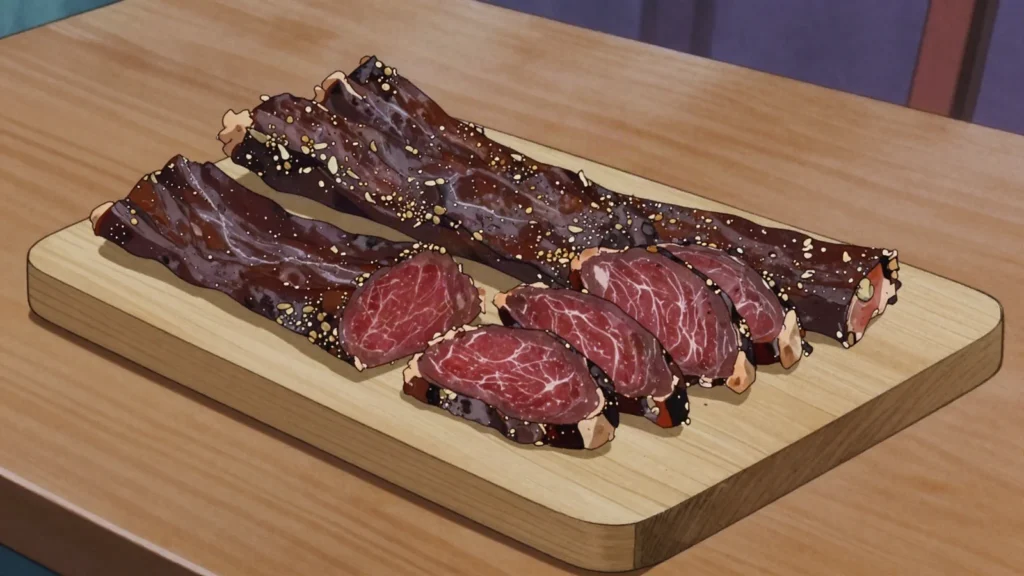

Ingredients
Meat
- 1.5 kgbeef silverside, topside or rump, in one piece with the grain running lengthways
Cure
- 30 gcoarse sea salt (2 percent of the meat weight)
- 15 gbrown sugar
- 3 tbspcoriander seeds, toasted and coarsely crushed
- 1 tbspcoarsely cracked black pepper
- 1 tspbicarbonate of soda (optional, for tenderness)
- 120 mlbrown spirit vinegar
- 60 mlWorcestershire sauce (optional)
Drying
- a biltong box or a drying cabinet with a low fan
- butcher’s hooks or paperclips
- 1muslin cloth, if drying in open air
Directions
- Trim off all silverskin and any soft external fat, then cut the meat with the grain into strips 2–3 cm thick and 15–20 cm long. Cutting with the grain is essential: it is what lets biltong be sliced across into tender shavings later.
- Toast the coriander seeds in a dry pan for 90 seconds until fragrant, then crush them coarsely in a mortar and winnow off the husks. Coriander is the defining South African spice here, not an optional extra.
- Splash the strips with the vinegar and Worcestershire and rub it in; the acid drops the surface pH and is the first line of preservation.
- Mix the salt, sugar, coriander, pepper and bicarbonate and rub firmly over every surface of every strip.
- Pack the strips into a non-reactive dish, cover and cure in the fridge for 4 hours for thin strips, up to 12 for thick ones. They will darken and weep liquid.
- Rinse briefly in a weak vinegar solution (1 part vinegar to 4 parts water) to remove surface salt, then pat completely dry.
- Hang the strips so that no two touch, in a box with a 40 W bulb or a small fan pulling air past them at 20–25°C (70–75°F) and low humidity.
- Dry 4–5 days for wet, ruby-centred biltong and up to 7–8 days for dry. It is ready when the outside is firm and dark, the strip springs back only slightly and a cut face shows a deep red centre. Slice thinly across the grain to serve.
Technique
- Biltong is air-dried, not smoked and not cooked, which is what separates it from jerky. The preservation comes from salt, vinegar and steady airflow.
- Food safety: airflow matters more than heat. Stagnant, humid air grows mould instead of drying the meat. Discard any strip with fuzzy green or black growth; a light white bloom on a dry strip is harmless salt.
- The technique descends from Khoikhoi meat preservation and the Voortrekkers’ need to carry protein on the move, which is why the spicing is so plain and so dependent on coriander and vinegar.
Substitutions
- No biltong box: hang the strips in front of a fan in a dry, well-ventilated room, or use a dehydrator on its lowest setting (under 35°C (95°F)) with the door propped open.
- Game biltong from kudu, springbok or ostrich is made identically and dries faster because it is leaner.
- Malt vinegar can replace brown spirit vinegar, though it leaves a sweeter finish.
Variations
- Droëwors, the same cure applied to thin coils of boerewors mince and dried in the same box.
- Chilli biltong, rubbed with dried chilli flakes alongside the coriander.
- Fatty biltong, made from rump with the fat cap left on, prized for its richness.
History
Air-dried, cured strips of meat, most often beef but traditionally made from game, developed by Southern African communities, including Khoikhoi and later Voortrekker Dutch settler populations, as a way to preserve meat for long periods without refrigeration, particularly useful on extended treks or hunting trips across the region’s dry interior. The name comes from Dutch and Afrikaans, combining bil, meaning rump, and tong, meaning strip or tongue-shaped piece, describing the cut and shape of the dried meat rather than its flavour. Vinegar, salt, coriander and black pepper are the traditional core seasoning before drying, and the technique spread with Afrikaner and other settler populations across what is now South Africa, Namibia, Botswana and Zimbabwe.
Frequently asked questions
What is Biltong?
Biltong is a charcuterie & cured from Namibia: air-dried spiced meat, often from kudu, oryx or springbok. Air-dried, cured strips of meat, most often beef but traditionally made from game, developed by Southern African communities, including Khoikhoi and later Voortrekker Dutch settler populations, as a way to preserve meat for long periods without refrigeration, particularly useful on extended treks or hunting trips across the region’s dry interior. The name comes from Dutch and Afrikaans, combining bil, meaning rump, and tong, meaning strip or tongue-shaped piece, describing the cut and shape of the dried meat rather than its flavour. Vinegar, salt, coriander and black pepper are the traditional core seasoning before drying, and the technique spread with Afrikaner and other settler populations across what is now South Africa, Namibia, Botswana and Zimbabwe.
How long does Biltong take to make?
Biltong takes 30 min of preparation and 4 hr curing plus 4–7 days drying of cooking. The recipe makes about 500 g dried biltong (from 1.5 kg wet meat). It is rated medium to make.
What can I substitute in Biltong?
Yes, within limits. No biltong box: hang the strips in front of a fan in a dry, well-ventilated room, or use a dehydrator on its lowest setting (under 35°C (95°F)) with the door propped open. Game biltong from kudu, springbok or ostrich is made identically and dries faster because it is leaner. Malt vinegar can replace brown spirit vinegar, though it leaves a sweeter finish.
What is the most important thing to get right in Biltong?
Food safety: airflow matters more than heat. Stagnant, humid air grows mould instead of drying the meat. Discard any strip with fuzzy green or black growth; a light white bloom on a dry strip is harmless salt.