
Ingredients
Cheese
- 2 litreswhole goat’s milk, or cow’s milk, unhomogenised if you can get it
- 8 dropsmicrobial rennet at standard strength, about 0.4 ml
- 2 tbspcool unchlorinated water, for diluting the rennet
To serve
- 4 tbspmountain honey, rosemary or heather
- 40 gshelled walnuts, lightly toasted
Directions
- Warm the milk slowly in a heavy pan, stirring, to exactly 35°C (95°F). Above 38°C (100°F) the curd turns rubbery and squeaks.
- Dilute the rennet in the cool water, pour it over the surface and stir with ten slow strokes from top to bottom, then bring the milk completely to rest; movement tears a setting curd.
- Cover and leave undisturbed at room temperature for 40–50 minutes. It is set when a knife slipped in at an angle and lifted gives a clean break with clear whey in the split.
- Cut the curd into 2 cm cubes with a long knife and let it settle for 10 minutes so the pieces firm at the edges.
- Ladle the curd gently, without crushing it, into perforated moulds or a colander lined with damp muslin.
- Drain 1–2 hours at cool room temperature. Do not press or weight it; mato should stay soft and slightly grainy, holding its shape only just.
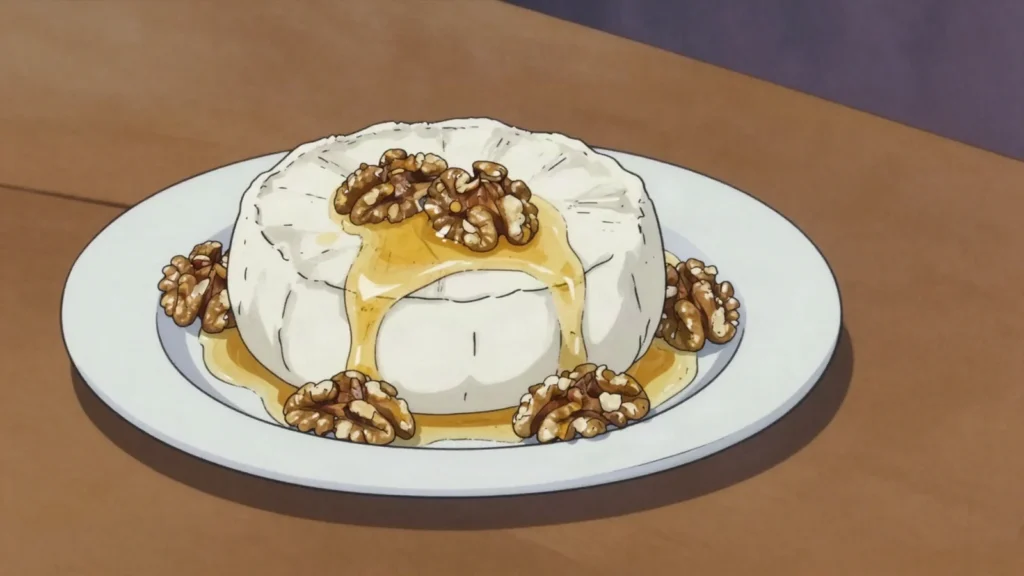
- Turn out onto a plate and serve at room temperature, pouring honey over the top and scattering the toasted walnuts.
- Keep any leftovers at 4°C (40°F) and eat within two days.
Technique
- Mato carries no salt at all, which is why it is always eaten with honey as mel i mato, and why it has no keeping power; unsalted fresh curd spoils fast.
- Real mato is rennet-set, not acid-set. The lemon-juice version in many recipe books is closer to ricotta: grainier, tangy and quite different on the palate.
- In parts of Catalonia and the Pyrenees the coagulant was the milky latex of the fig tree. Microbial rennet gives the same clean, sweet set and keeps the cheese suitable for vegetarians.
Substitutions
- No rennet at all: heat the milk to 85°C (185°F), stir in 60 ml of lemon juice, rest 15 minutes and drain. It is not true mato, but it is what most home kitchens manage.
- Goat’s milk gives the classic chalk-white, faintly tangy curd; cow’s milk is milder and sets a little softer, so drain it 30 minutes longer.
Variations
- Mel i mato, the standard Catalan dessert, with honey and walnuts.
- Served with quince paste (codonyat) and a glass of sweet mistela instead of honey.
- Spooned over toasted coca with a dusting of cinnamon.
History
A Catalan and Pyrenean fresh cheese, long served with honey as mel i mató, a pairing recorded in Catalan cooking for centuries.
Frequently asked questions
What is Mató?
Mató is a cheese & dairy from Andorra: fresh unsalted curd cheese eaten with honey. A Catalan and Pyrenean fresh cheese, long served with honey as mel i mató, a pairing recorded in Catalan cooking for centuries.
How long does Mató take to make?
Mató takes 20 min of preparation and 2 hr 30 min setting and draining of cooking. The recipe makes about 400 g, 4 servings. It is rated easy to make.
What can I substitute in Mató?
Yes, within limits. No rennet at all: heat the milk to 85°C (185°F), stir in 60 ml of lemon juice, rest 15 minutes and drain. It is not true mato, but it is what most home kitchens manage. Goat’s milk gives the classic chalk-white, faintly tangy curd; cow’s milk is milder and sets a little softer, so drain it 30 minutes longer.
What is the most important thing to get right in Mató?
Drain 1–2 hours at cool room temperature. Do not press or weight it; mato should stay soft and slightly grainy, holding its shape only just.