
Ingredients
Batter
- 800 gfine teff flour, ivory or brown
- 1.4 litreslukewarm water, plus extra to adjust
- 150 mlersho, the sour liquid saved from a previous batch, or 2 tbsp lively sourdough starter for a first batch
- 1 tspfine salt
For the griddle
- 1 tspvegetable oil on a cloth, or half an onion on a fork, for wiping
Directions
- Whisk the teff flour with 1.2 litres of the water and the ersho into a lump-free batter the thickness of single cream, beating hard for 5 minutes; the aeration gets the ferment going.
- Cover with a cloth and leave at 22–26°C (70–80°F) for two to three days, up to four in a cold kitchen. It will separate, bubble and smell sharply sour, like yoghurt turning to vinegar.
- Each day pour off and discard the dark grey water that rises to the top, but on the final day keep 150 ml of the sour liquid as the ersho for next time.
- Make the absit: whisk about 250 ml of the fermented batter with 250 ml water in a pan and cook over medium heat, stirring, for 3–5 minutes until it thickens into a glossy paste.
- Whisk the hot absit back into the main batter with the salt, loosening with water until it pours like thin cream, then rest 30–60 minutes until the surface freckles with bubbles.
- Heat a mitad, or the widest non-stick pan you own, over medium heat until a droplet of water skitters, and wipe it very lightly with oil.
- Pour the batter in a thin unbroken spiral from the outer edge inwards, working fast, then tilt the pan to close any gaps. It should be a single continuous sheet.
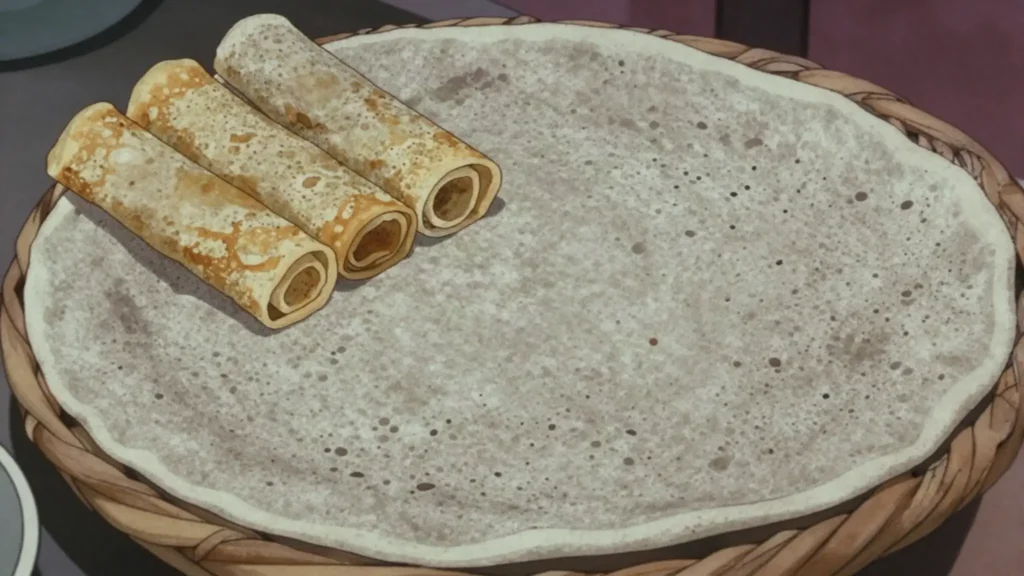
- Within 30 seconds the surface fills with tiny craters, the injera’s eyes. Cover with a domed lid and steam 2–3 minutes until the top is matte, set and dry to the touch and the edges lift away.
- Slide it out onto a cloth or a woven mesela basket. Never flip it and never stack it hot; cool flat 5 minutes, then pile. Serve at room temperature, torn and used as plate, spoon and bread all at once.
Technique
- The eyes are the test. Batter that is too thick, or a griddle that is too hot, gives a solid pancake with no eyes and no absorbency.
- Absit is the step home cooks skip and then wonder why their injera tears; the cooked starch is what gives the sheet its stretch and its keeping quality.
- Keep the ersho alive from batch to batch. Both the sourness and the reliability of the ferment improve after two or three rounds.
- Injera is never turned and never browned. A browned underside means the pan was too hot and the bread will be leathery.
Substitutions
- Pure teff is standard in Addis Ababa but expensive and slack elsewhere. A blend of 70 percent teff with 30 percent barley, sorghum or wheat flour is common and much easier to handle, giving a paler, less bitter, slightly less springy bread.
Variations
- Eritrean taita is often built on a sorghum, millet or barley blend and cooked a shade thicker.
- Firfir, yesterday’s injera torn up and tossed hot in spiced butter and berbere, is the standard breakfast use for leftovers.
History
A spongy, sour flatbread whose sourness comes from natural fermentation of teff flour batter over several days, a technique that predates any written record in the Horn of Africa and is shared, not separately invented, across the region that is now Ethiopia and Eritrea. Teff itself, a tiny, nutrient-dense grain, is native to the Ethiopian highlands and has been cultivated there for thousands of years, though injera can also be made from sorghum, corn or wheat where teff is scarce or expensive. The bread’s distinctive bubbled surface comes specifically from the fermentation gases escaping as it cooks on a flat clay or metal griddle, and it functions as both food and utensil, torn by hand to scoop up the stews served on top of it.
Frequently asked questions
What is Injera?
Injera is a bread & pastry from Eritrea: spongy sourdough flatbread, called taita; foundation and utensil of every meal. A spongy, sour flatbread whose sourness comes from natural fermentation of teff flour batter over several days, a technique that predates any written record in the Horn of Africa and is shared, not separately invented, across the region that is now Ethiopia and Eritrea. Teff itself, a tiny, nutrient-dense grain, is native to the Ethiopian highlands and has been cultivated there for thousands of years, though injera can also be made from sorghum, corn or wheat where teff is scarce or expensive. The bread’s distinctive bubbled surface comes specifically from the fermentation gases escaping as it cooks on a flat clay or metal griddle, and it functions as both food and utensil, torn by hand to scoop up the stews served on top of it.
How long does Injera take to make?
Injera takes 20 min of preparation and 2–4 days ferment + 3 min each of cooking. The recipe makes 8–10 injera, 30 cm across. It is rated hard to make.
What can I substitute in Injera?
Yes, within limits. Pure teff is standard in Addis Ababa but expensive and slack elsewhere. A blend of 70 percent teff with 30 percent barley, sorghum or wheat flour is common and much easier to handle, giving a paler, less bitter, slightly less springy bread.
What is the most important thing to get right in Injera?
Slide it out onto a cloth or a woven mesela basket. Never flip it and never stack it hot; cool flat 5 minutes, then pile. Serve at room temperature, torn and used as plate, spoon and bread all at once.