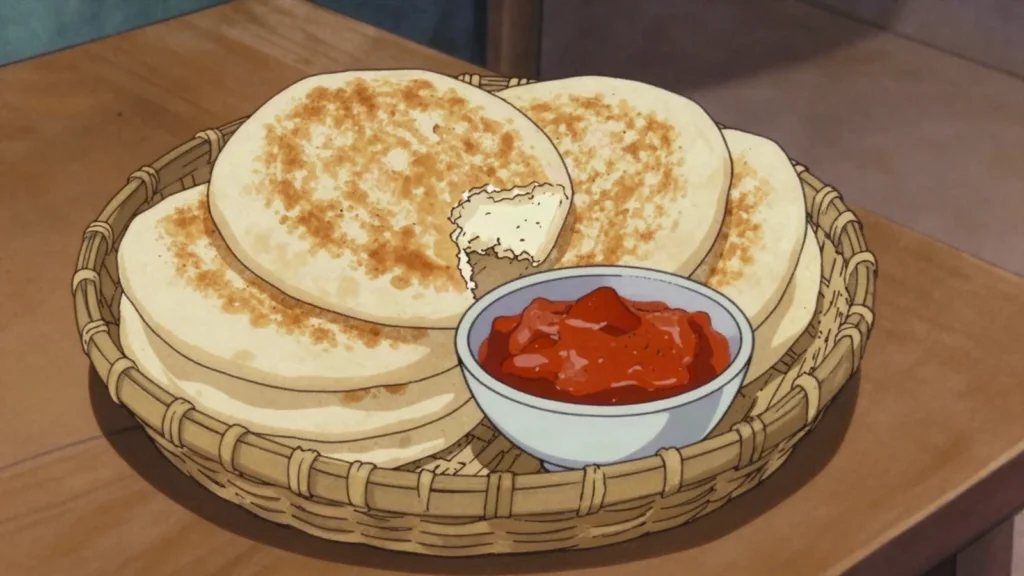

Ingredients
Batter
- 500 gplain flour
- 7 ginstant yeast
- 1 tspsugar
- 1 tspsalt
- 400 mlwarm water
To cook
- a little oil, for the plate
To serve
- a stew, or miyan kuka
- sugar and tea
Directions
- Whisk the flour, yeast, sugar and salt together, then beat in the warm water to a thick, sticky batter rather than a dough.
- It is a batter, not a bread dough. Gurasa is poured and spread rather than kneaded and rolled, and a stiff dough gives you a dense flatbread instead of the soft open one.
- Beat it hard for 5 minutes with your hand or a spoon, lifting and slapping it, to develop some strength in it.
- Cover and leave it somewhere warm for 1 hour 30 minutes to 2 hours, until bubbly and nearly doubled.
- Heat a clay plate, a heavy cast iron pan or a thick griddle over a medium heat and rub it very lightly with oil.
- The clay disc is the traditional cooker and it holds a steady even heat, which is exactly what a thick flatbread needs; a thin pan scorches the base long before the middle sets.
- Pour a ladleful of batter onto the hot plate and spread it into a round about 1.5 cm thick with the back of the ladle.
- Cover it with a lid or an upturned bowl and cook for 5 to 7 minutes.
- Keep it covered. The top surface cooks in trapped steam rather than by direct heat, which is why gurasa stays soft and needs no turning until it is almost set.
- Turn it once the top has lost its shine and the base is golden with dark spots, then cook for 3 minutes more.
- Stack the finished breads under a cloth as you go, which keeps them soft.
- Serve them torn into pieces with a stew, or with miyan kuka, or simply with sugar and tea.
- It is a Hausa town bread of wheat rather than millet, sold in stacks at markets across Niger and northern Nigeria.
Technique
- Wheat rather than millet is what makes it a town bread; the villages eat millet.
- It should be thick and pillowy, closer to a crumpet than to a chapati.
- Best on the day it is made, and revived by a moment back on the griddle after that.
Substitutions
- A heavy cast iron pan in place of the clay plate.
- Half wholemeal flour for a nuttier, denser bread.
Variations
- Brushed with melted butter as it comes off the plate.
- With black pepper and chopped onion beaten into the batter.
- Smaller and thicker, closer to masa.
History
A Hausa town bread of wheat rather than millet, cooked on a heated clay disc and sold in stacks at markets in Niger and northern Nigeria.
Frequently asked questions
What is Gurasa?
Gurasa is a bread & pastry from Niger: thick soft wheat flatbread baked on a clay plate, torn into stews. A Hausa town bread of wheat rather than millet, cooked on a heated clay disc and sold in stacks at markets in Niger and northern Nigeria.
How long does Gurasa take to make?
Gurasa takes 10 min plus 2 hr rising of preparation and 40 min of cooking. The recipe makes 6 breads. It is rated easy to make.
What can I substitute in Gurasa?
Yes, within limits. A heavy cast iron pan in place of the clay plate. Half wholemeal flour for a nuttier, denser bread.
What is the most important thing to get right in Gurasa?
Whisk the flour, yeast, sugar and salt together, then beat in the warm water to a thick, sticky batter rather than a dough.