
Ingredients
The beans
- 300 gdried small fava beans
- ful hammam, the brown ones
- soaked overnight
- or 2 tins cooked ful medames
- drained, liquid kept
- read the safety note first
Sometimes added
- 100 gdried split chickpeas
- or a handful of red lentils
- for body
- 1 teaspoonbicarbonate of soda
- in the soak, optional
The dressing
- 6 tablespoonsgood olive oil
- plus more to finish
- juice of 2 lemons
- or more, to taste
- 4 clovesgarlic, crushed
- 1 teaspoonground cumin
- toasted and ground
- 1 teaspoonsalt
- or to taste
- half a teaspoon chilli flakes
- optional
To finish
- 2tomatoes, diced
- 1small onion, finely chopped
- or spring onions
- a large handful of parsley
- chopped
- a few mint leaves, optional
- extra lemon wedges
To serve
- flatbread, khubz
- olives
- pickled turnips or cucumbers
- tomatoes and cucumber
- sweet tea
- hard-boiled eggs, optional
Directions
- Cover them with plenty of cold water. Soak them overnight, at least twelve hours. Soak them in the refrigerator in warm weather. Too much gives a soapy taste and mushy beans. Rinse them well after soaking. Drain and rinse the soaked beans. Cover them with fresh water in a heavy pot. Bring them to a boil and skim the foam.
- Simmer them for about two hours. Old beans can take three or more. Add hot water as needed to keep them covered. Do not salt them until they are nearly tender. Salt added early can toughen the skins. They should be completely soft. Mash some of the beans against the pot with a spoon.
- Leave plenty of whole beans. Add some of the cooking liquid to loosen it. Heat it gently in a pan with a little of its liquid. Mash some of it and leave the rest whole. That takes ten minutes rather than two hours. Crush the garlic with a little salt. Use plenty of it. Toast whole cumin seeds in a dry pan. Give them a minute until fragrant.
- Grind them in a mortar. Use a great deal of lemon juice. The dish should taste clearly sour. Taste and keep adding until it lifts. Use good olive oil and use plenty of it. Stir some in and pour more over at the end. Stir the garlic, cumin, salt and lemon into the hot beans.
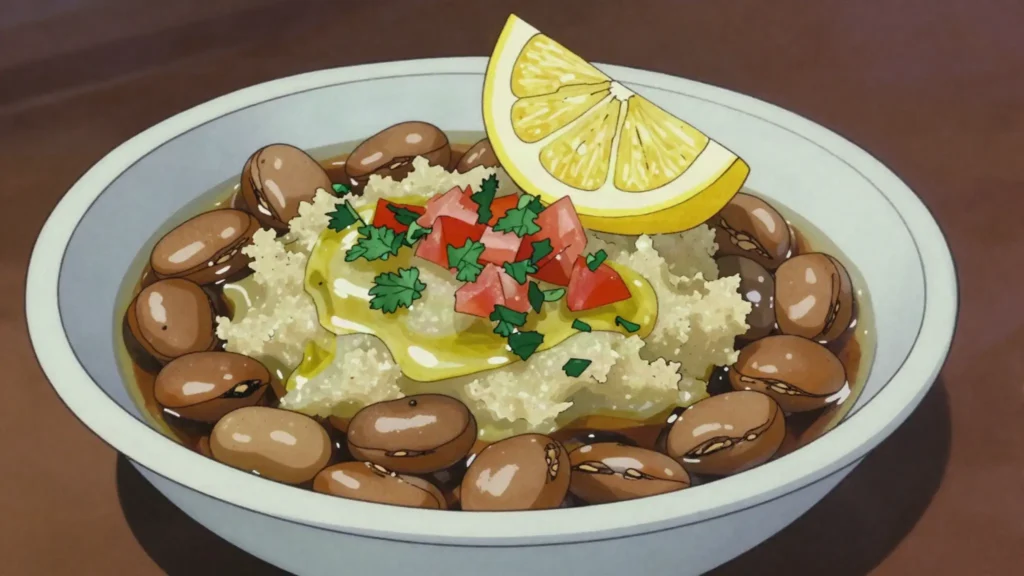
- Stir in most of the olive oil. Taste it carefully. Adjust the salt and the lemon. It should be thick and spoonable. Spoon it into a wide shallow bowl. Make a hollow in the centre with the back of a spoon.
- Pour olive oil into that hollow. Scatter diced tomato over. Scatter chopped onion or spring onion. Scatter a great deal of chopped parsley. Add mint if you like. Add chilli flakes for heat. Put lemon wedges on the table. Tear a piece and use it to scoop. Serve olives alongside. Serve pickled turnips or cucumbers.
- Serve fresh tomato and cucumber. It keeps people going through a long fasting day. Add fresh lemon and oil after reheating. Freeze the plain cooked beans rather than the dressed dish.
Technique
- Fava beans can trigger favism in people with G6PD deficiency — a severe destruction of red blood cells causing anaemia, jaundice and dark urine, which can require hospital treatment. The deficiency is common in parts of the Mediterranean, Middle East, Africa and Asia, more common in men, and many who have it do not know. A reaction can happen the first time someone eats them, including a child.
- Anyone with known G6PD deficiency must avoid fava beans entirely; anyone with a family history should ask a doctor first; and anyone who becomes unwell after eating them should seek medical help and say what they ate, since it changes the diagnosis. The atlas gives no advice beyond that. It also records that fava beans are eaten daily by many millions and are simply food for most people — neither fact alone would be honest.
- Be generous with lemon. Two lemons is a starting point, not a limit; the beans are mild and under-lemoned ful tastes heavy and flat. Keep tasting and adding until it lifts.
- Crush the garlic to a paste with salt in a mortar rather than chopping it. It distributes properly through the beans, and raw garlic is the character of the dish.
- Toast and grind whole cumin. It is the defining spice here and pre-ground is noticeably weaker.
- Partly mash, do not purée. Some beans whole, some broken down — that mixture is the texture of the dish, and a smooth purée is something else.
- Use good olive oil and plenty of it, stirred through and poured into a hollow on top at the end. It is a flavour here, not a cooking fat, and the pool of oil is correct rather than excessive.
- Buy small brown fava beans, sold as ful hammam or ful medames, not large green broad beans, which cook and taste differently.
- Tinned ful medames is entirely normal and what a great many households use — ten minutes instead of two hours, and the atlas records that without disapproval.
- Freeze the plain cooked beans rather than the dressed dish and dress them fresh. Garlic, lemon and oil all dull overnight, and the difference is large.
- It is eaten with bread rather than a spoon — a piece torn and used to scoop. Flatbread is part of the dish, not an accompaniment to it.
- Egyptian ful is often smoother and plainer; Levantine versions carry more garlic and parsley and often tahini or chickpeas. The atlas records the differences rather than flattening them.
Substitutions
- Tinned ful medames replaces dried beans entirely and cuts the cooking to ten minutes.
- Split chickpeas or red lentils cooked alongside add body and are traditional in some versions.
- Tahini stirred through gives the Lebanese and Palestinian treatment.
- Lime replaces lemon at a pinch, though lemon is what is used.
- Bicarbonate of soda in the soak softens the skins and shortens cooking; it is optional.
- Spring onions replace raw onion for a milder finish.
Variations
- Ful with tahini stirred through is standard in Lebanon and Palestine.
- Egyptian ful iskandarani adds tomato, pepper and more spice.
- Ful with chickpeas, sometimes called ful bi hummus, is common across the Levant.
- Ta’amiya and falafel, made from the same bean and from chickpeas, are the fried relatives.
- Bissara in Morocco and Egypt purées dried fava beans into a thick soup.
- A version topped with a fried or hard-boiled egg is common at breakfast.
History
Slow-cooked fava beans, mashed and seasoned with olive oil, lemon, garlic and cumin, documented across Lebanon and the wider Levant region for many centuries as an essential breakfast dish, closely related to the ful medames tradition found across Egypt and the broader Middle East and North Africa, reflecting shared culinary influence across the region carried through historic trade and cultural exchange. Its slow-cooking method, allowing the beans to soften fully into a hearty, satisfying dish, reflects a broader regional tradition of transforming affordable, shelf-stable legumes into a nourishing, protein-rich breakfast. Foul mdammas remains a staple breakfast dish across Lebanon, commonly eaten with fresh flatbread.
Frequently asked questions
What is Foul mdammas?
Foul mdammas is a breakfast from Lebanon: stewed fava beans with lemon, garlic and olive oil. Slow-cooked fava beans, mashed and seasoned with olive oil, lemon, garlic and cumin, documented across Lebanon and the wider Levant region for many centuries as an essential breakfast dish, closely related to the ful medames tradition found across Egypt and the broader Middle East and North Africa, reflecting shared culinary influence across the region carried through historic trade and cultural exchange. Its slow-cooking method, allowing the beans to soften fully into a hearty, satisfying dish, reflects a broader regional tradition of transforming affordable, shelf-stable legumes into a nourishing, protein-rich breakfast. Foul mdammas remains a staple breakfast dish across Lebanon, commonly eaten with fresh flatbread.
How long does Foul mdammas take to make?
Foul mdammas takes 15 minutes plus overnight soaking of preparation and 2 hours, or 10 minutes with tins of cooking. The recipe makes serves 4. It is rated easy to make.
What can I substitute in Foul mdammas?
Yes, within limits. Tinned ful medames replaces dried beans entirely and cuts the cooking to ten minutes. Split chickpeas or red lentils cooked alongside add body and are traditional in some versions. Tahini stirred through gives the Lebanese and Palestinian treatment. Lime replaces lemon at a pinch, though lemon is what is used. Bicarbonate of soda in the soak softens the skins and shortens cooking; it is optional. Spring onions replace raw onion for a milder finish.
What is the most important thing to get right in Foul mdammas?
Simmer them for about two hours. Old beans can take three or more. Add hot water as needed to keep them covered. Do not salt them until they are nearly tender. Salt added early can toughen the skins. They should be completely soft. Mash some of the beans against the pot with a spoon.