
Ingredients
Batter
- 4eggs
- 140 gcaster sugar
- 2 tbsphoney
- 1 tbspmirin
- 200 gplain flour
- 1 tspbaking powder
- 60 mlwater
- oil, for the pan
Filling
- 400 gsweet azuki paste
Directions
- Whisk the eggs, sugar, honey and mirin together for 3 minutes, until pale and slightly thickened.
- Sift in the flour and baking powder and fold until smooth, then cover and rest the batter for 30 minutes.
- Add the water at the very end, after resting, to bring it to a thick pouring consistency.
- Rest the batter and adjust it afterwards. Resting relaxes the gluten so the pancakes stay tender, and thinning it at the end is what lets it spread into an even round.
- Heat a flat non-stick pan over a low to medium heat, oil it, then wipe it almost completely dry with kitchen paper.
- Wipe the pan nearly dry. Visible oil gives a mottled, freckled surface, and a dorayaki should be an even glossy brown like a drum skin.
- Pour a ladleful of batter from a few centimetres above the centre of the pan and let it spread into a circle by itself. Do not push it out with the ladle.
- Cook until the surface is covered in bubbles and the edges look dry, about 2 minutes, then flip it and give it a minute more.
- Cool the pancakes under a damp cloth, which keeps them soft and pliable rather than letting them dry at the edges.
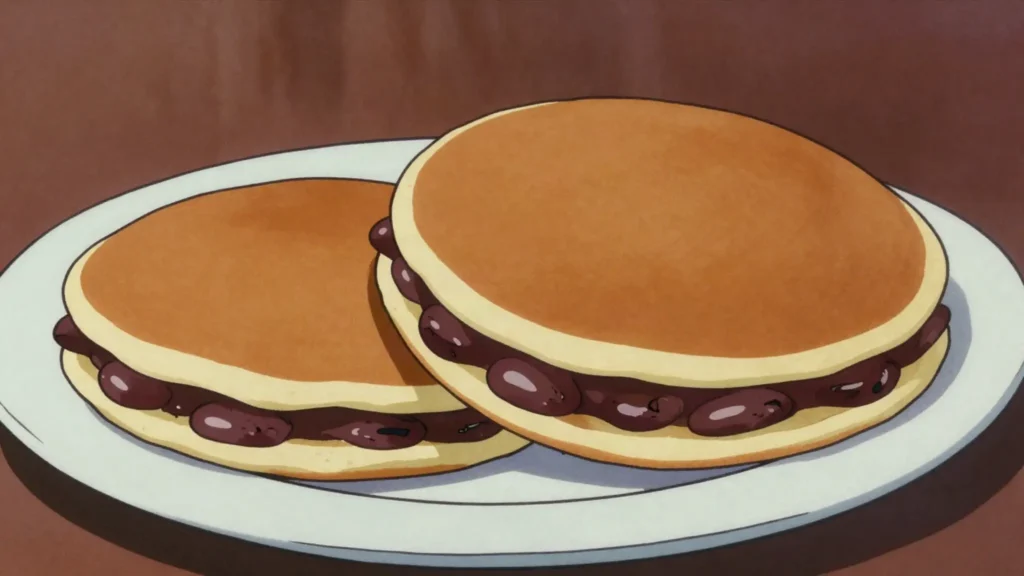
- Sandwich a generous mound of azuki paste between two pancakes, doming it in the centre and leaving a clear border all round.
- Press the edges gently to seal and wrap each one in cling film for an hour, which lets it settle into its shape.
- The two-pancake form was created in 1914 by Usagiya in Tokyo’s Ueno; earlier versions folded a single pancake over the bean paste.
Technique
- Honey and mirin together are what give dorayaki their particular moistness and their gloss. Neither is optional.
- The name comes from dora, a gong, which the shape resembles.
- Wrapped, they keep two days and stay soft, which is why they travel in lunchboxes.
Substitutions
- Golden syrup in place of honey, with a slight loss of flavour.
- Shop-bought anko, which is what most Japanese households use.
Variations
- Filled with matcha or chestnut cream.
- With a slice of butter tucked in alongside the bean paste.
- Made small, as bite-size dorayaki for children.
History
Two small, round pancakes, sandwiched together around a filling of sweet red bean paste, documented across Japan as a popular traditional confection, its name derived from dora, the Japanese word for gong, reflecting one popular though not fully verified legend that the pancake’s round shape and cooking method were inspired by a samurai warrior who once used a gong to cook the dish after leaving it behind at a farmer’s house. Its soft, slightly sweet pancake exterior wrapped around a rich red bean filling reflects a broader Japanese confectionery tradition built around anko, sweetened red bean paste, found across numerous other traditional Japanese sweets. Dorayaki remains a widely beloved traditional Japanese sweet, gaining additional popularity internationally through its association with the well-known Japanese cartoon character Doraemon.
Frequently asked questions
What is Dorayaki?
Dorayaki is a dessert from Japan: two honeyed pancakes sandwiching sweet azuki bean paste. Two small, round pancakes, sandwiched together around a filling of sweet red bean paste, documented across Japan as a popular traditional confection, its name derived from dora, the Japanese word for gong, reflecting one popular though not fully verified legend that the pancake’s round shape and cooking method were inspired by a samurai warrior who once used a gong to cook the dish after leaving it behind at a farmer’s house. Its soft, slightly sweet pancake exterior wrapped around a rich red bean filling reflects a broader Japanese confectionery tradition built around anko, sweetened red bean paste, found across numerous other traditional Japanese sweets. Dorayaki remains a widely beloved traditional Japanese sweet, gaining additional popularity internationally through its association with the well-known Japanese cartoon character Doraemon.
How long does Dorayaki take to make?
Dorayaki takes 20 min plus 30 min resting of preparation and 30 min of cooking. The recipe makes 10 dorayaki. It is rated easy to make.
What can I substitute in Dorayaki?
Yes, within limits. Golden syrup in place of honey, with a slight loss of flavour. Shop-bought anko, which is what most Japanese households use.
What is the most important thing to get right in Dorayaki?
Pour a ladleful of batter from a few centimetres above the centre of the pan and let it spread into a circle by itself. Do not push it out with the ladle.