
Ingredients
Cassava
- 3 kgfresh cassava root
- clean water, for soaking and rinsing
Wrapping
- banana leaves or marantaceae leaves, cut into large rectangles
- raffia strips or kitchen string
Directions
- Peel the cassava thoroughly, taking off both the brown outer bark and the pink layer beneath it, and cut out the woody cord that runs down the centre of each root.
- Cut the flesh into chunks, put it in a plastic or earthenware vessel, cover it completely with cold water and leave it at room temperature for 3 to 5 days, until a piece crushes easily between finger and thumb. This soak is not a shortcut to softness and it is not optional: it is how the cyanogenic compounds in cassava are broken down and washed away, and it is why cassava is never eaten raw anywhere it is grown.
- Pour off and discard all the soaking water, then rinse the softened cassava in three or four changes of clean water. Never cook in the soaking water and never reuse it.
- Pound or mash the drained cassava to a paste, working it until no lumps remain.
- Press the paste through a sieve, or wring it through a clean cloth, to take out the tough fibres. Sieving is what separates bobolo from a rough mash, and skipping it leaves stringy threads through every slice.
- Knead the sieved paste briefly until it is smooth and holds together, then divide it into six equal portions.
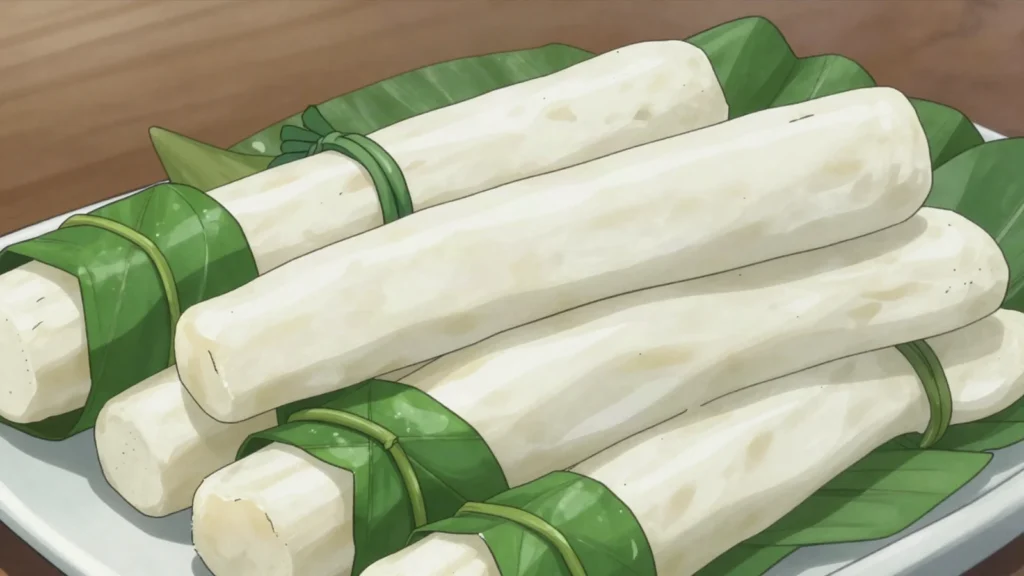
- Soften the leaves by passing them briefly over a flame or dipping them in boiling water, then roll each portion into a baton about 20 cm long and 5 cm across, wrapping it tightly in two layers of leaf.
- Tie each baton at both ends and around the middle so it holds its shape and no water gets into it.
- Lower the batons into a large pot of boiling water, keep them fully submerged, and boil steadily for 2 hours.
- Lift them out and leave them to cool completely in their wrappers, where they firm into a dense, sliceable loaf. Serve sliced, with grilled fish, ndolé or pepper soup.
Technique
- Bitter cassava varieties carry far more cyanogenic glycoside than sweet ones, and the traditional soak, ferment and boil sequence exists precisely to deal with them. Do not compress it.
- The paste should smell distinctly sour before it is wrapped. That sourness is the fermentation having done its work.
- Wrapped batons keep for several days at room temperature, and were the travelling food of Cameroon’s forest south long before refrigeration.
Substitutions
- Baking parchment inside foil if leaves cannot be found, at the cost of the leaf scent that is half the character.
- Ready-made cassava paste from an African grocer, already soaked and sieved, which removes the four-day wait.
Variations
- Miondo, rolled much thinner and boiled for less time.
- Chikwangue, the same preparation across the border in Congo and the DRC.
- Water fufu, the unwrapped version eaten straight from the pot.
History
Cassava fermented, pounded and wrapped in leaf batons that keep for days, the travelling bread of Cameroon’s forest south.
Frequently asked questions
What is Bobolo?
Bobolo is a salad & side from Cameroon: fermented cassava sticks wrapped in leaves. Cassava fermented, pounded and wrapped in leaf batons that keep for days, the travelling bread of Cameroon’s forest south.
How long does Bobolo take to make?
Bobolo takes 1 hr plus 4 days soaking of preparation and 2 hr of cooking. The recipe makes 6 batons. It is rated hard to make.
What can I substitute in Bobolo?
Yes, within limits. Baking parchment inside foil if leaves cannot be found, at the cost of the leaf scent that is half the character. Ready-made cassava paste from an African grocer, already soaked and sieved, which removes the four-day wait.
What is the most important thing to get right in Bobolo?
Cut the flesh into chunks, put it in a plastic or earthenware vessel, cover it completely with cold water and leave it at room temperature for 3 to 5 days, until a piece crushes easily between finger and thumb. This soak is not a shortcut to softness and it is not optional: it is how the cyanogenic compounds in cassava are broken down and washed away, and it is why cassava is never eaten raw anywhere it is grown.