
Ingredients
Pepper
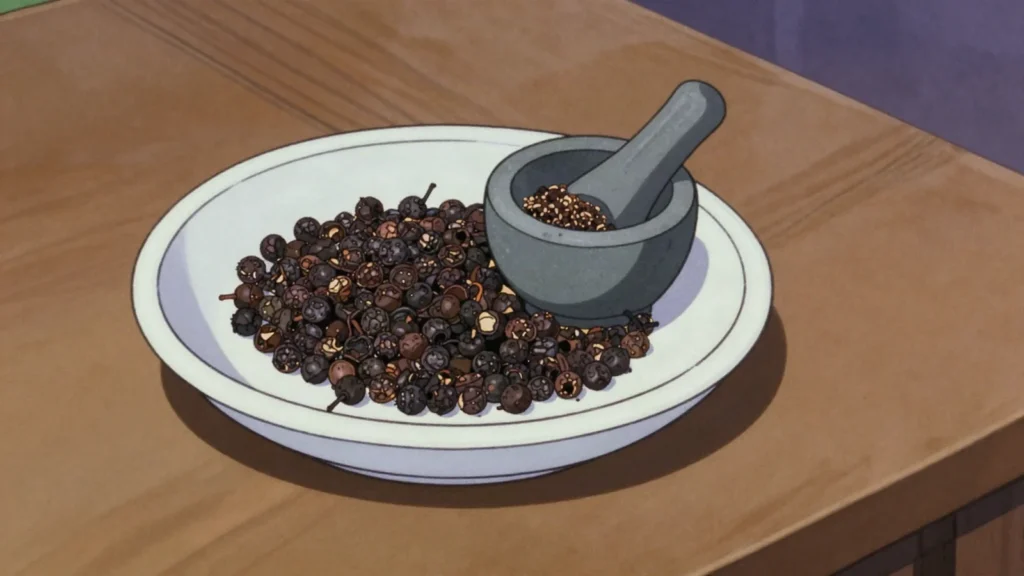
- whole voatsiperifery peppercorns, with their small tails
Equipment
- a mortar and pestle, or a dedicated pepper mill
- an airtight jar
To use on
- grilled fish and seafood
- duck and game
- foie gras
- strawberries and chocolate
- goat’s cheese
Directions
- Voatsiperifery is a tiny tailed wild pepper from Madagascar with a floral, resinous heat, and it grows on lianas in the eastern rainforest.
- It is Piper borbonense, and the vines climb high into the canopy, which is why it is harvested by hand from the wild rather than farmed.
- The name comes from Malagasy: voa meaning fruit and tsiperifery being the local name for the vine.
- Now the thing that makes it distinctive to look at.
- Each peppercorn has a small stalk or tail still attached, which is where it gets its shape.
- It is smaller and more irregular than black pepper, and the tails are left on because the berries are picked in clusters and dried whole.
- Now the flavour, which is genuinely different from ordinary pepper.
- It is warm and peppery but also floral and resinous, with notes people describe as citrus, pine and juniper.
- The heat arrives later and lingers, and it is less sharply pungent than black pepper.
- It is a finishing pepper rather than a workhorse, and it is used sparingly.
- Now the honest position on supply, which is worth stating.
- There is no commercial cultivation of any consequence: it is gathered from wild vines in the forest, often high up, and the harvest is dangerous and labour-intensive.
- That keeps supply small and prices very high, and it also creates real pressure on the wild population.
- Overharvesting and forest loss are genuine concerns, and there have been efforts to establish cultivation and to certify sustainable collection.
- It is worth buying from a supplier who can say something about where it came from, and it is worth using it as the expensive thing it is.
- Now buying it, which needs care.
- Buy it whole, and never ground.
- Its whole appeal is volatile aromatic compounds, and ground pepper of any kind loses most of them within weeks. Ground voatsiperifery is a waste of money.
- It should smell strongly and complexly when you open the jar, and the tails should be intact.
- Store it in an airtight jar away from light and heat.
- Now using it, and the rule is the same as for any fine pepper.
- Grind it at the last moment, over the finished dish.
- Adding it early to a long-cooked dish drives off exactly the aromatics you paid for, and it should go on at the table or just before serving.
- A mortar gives a coarser, more uneven grind than a mill, which many people prefer here.
- Some cooks crush it lightly rather than grinding it, so you get occasional bursts.
- Now the quantity, which should be small.
- Use noticeably less than you would black pepper.
- It is strong and it is expensive, and a few turns are enough. Over-peppering a dish with it wastes it and overwhelms whatever it is on.
- Now what it goes with particularly well.
- It is very good on grilled fish, scallops and prawns, where its floral quality works with sweet seafood.
- It suits duck, game and foie gras, which is how French restaurants first popularised it.
- It is also used on fruit and in desserts, particularly strawberries, pineapple and chocolate.
- That last use is worth trying. The resinous floral quality works with fruit in a way that ordinary pepper does not, and pepper on strawberries is an old idea that this variety is especially suited to.
- It is also infused into cream, into syrups and into spirits.
- For an infusion, crush a few corns and steep them in warm cream or syrup for 20 minutes, then strain.
- Do not boil an infusion hard, which turns it harsh and bitter.
- Madagascar produces a great many spices, and voatsiperifery sits alongside its vanilla and its cloves as an export the island is known for.
- Cubeb and other tailed peppers are related in appearance though not closely in flavour.
Technique
- It is gathered from wild forest lianas rather than cultivated.
- Overharvesting and forest loss are genuine concerns.
- It works unusually well with fruit and chocolate.
Substitutions
- Cubeb pepper, which is also tailed but tastes quite different.
- A good black pepper, accepting that it is not the same thing.
Variations
- Infused into cream for a dessert.
- Crushed coarsely as a finishing pepper.
- Used on strawberries or pineapple.
History
Piper borbonense grows on lianas in Madagascar’s eastern rainforest and is harvested by hand from the wild, which keeps supply small and prices high.
Frequently asked questions
What is Voatsiperifery?
Voatsiperifery is a sauce & condiment from Madagascar: tiny tailed wild pepper with a floral, resinous heat, gathered from forest vines. Piper borbonense grows on lianas in Madagascar’s eastern rainforest and is harvested by hand from the wild, which keeps supply small and prices high.
How long does Voatsiperifery take to make?
Voatsiperifery takes 5 min of preparation and no cooking at all. The recipe makes a small jar, used a pinch at a time. It is rated easy to make.
What can I substitute in Voatsiperifery?
Yes, within limits. Cubeb pepper, which is also tailed but tastes quite different. A good black pepper, accepting that it is not the same thing.
What is the most important thing to get right in Voatsiperifery?
It is Piper borbonense, and the vines climb high into the canopy, which is why it is harvested by hand from the wild rather than farmed.