
Ingredients
Turrón duro, hard Alicante
- 300 gwhole blanched almonds, Marcona
- 250 ghoney
- 100 gsugar
- 1egg white
- 2 sheetsobleas, edible wafer paper
Turrón blando, soft Jijona
- the same, plus the almonds ground to a paste
- 50 mlalmond or olive oil, if needed
Equipment
- a sugar thermometer
- a heavy pan
- wooden moulds or a lined tin
- a mortar or powerful grinder
To serve
- at Christmas, in thin slices
Directions
- Toast them lightly in a low oven until fragrant but barely coloured, and keep them warm. Warm almonds fold into hot nougat far more easily than cold ones, which seize the mixture immediately. Now the honey, which should be good. Use a strong flavoured honey, since it is a main ingredient rather than a sweetener.
- Heat the honey gently in a heavy pan and let it bubble for 10 to 15 minutes to drive off water. Honey used straight contains too much water and the turrón stays sticky. Stir it and watch it, since honey scorches easily and burnt honey ruins the batch. Meanwhile whisk the egg white to firm peaks.
- Add it gradually and beat hard. Keep it over a very low heat and keep beating. Use a thermometer. Pour the sugar syrup into the honey mixture in a thin stream, beating continuously.
- Keep the mixture over the lowest heat and beat it continuously for 30 to 45 minutes. The mixture must lose its moisture gradually while being aerated, and traditional workshops use mechanical beaters for exactly this reason.
- Work quickly, since the mixture stiffens fast. Line a mould or tin with obleas, the edible wafer paper, and press the mixture in. Press it down very firmly with an oiled board or the back of a spoon. Press it hard to remove air pockets, which would make the bar crumble when cut. Lay another sheet of obleas on top and weight it down.
- Grind the toasted almonds to a smooth oily paste before folding them in. Traditionally this is done by grinding the finished hard turrón again with the almonds and warming the whole mass, which releases the almond oil and makes it soft.
- Warm the mixture gently as you work it, which helps the oil come out. Press it into the lined mould in the same way. Now let both set at room temperature for at least 24 hours, and several days is better.
- Turn it out and cut it with a heavy sharp knife. Cut the hard version with a firm decisive stroke or it shatters, and warm the blade for the soft one. Serve it in thin slices at Christmas. It is intensely rich and a thin slice is a portion.
Technique
- Jijona and Alicante both hold protected geographical status.
- Obleas, edible wafer paper, are traditional and are eaten with the bar.
- Marcona almonds are oilier and sweeter than ordinary almonds.
Substitutions
- Any good blanched almond, accepting a drier result.
- A strong honey such as rosemary or orange blossom.
Variations
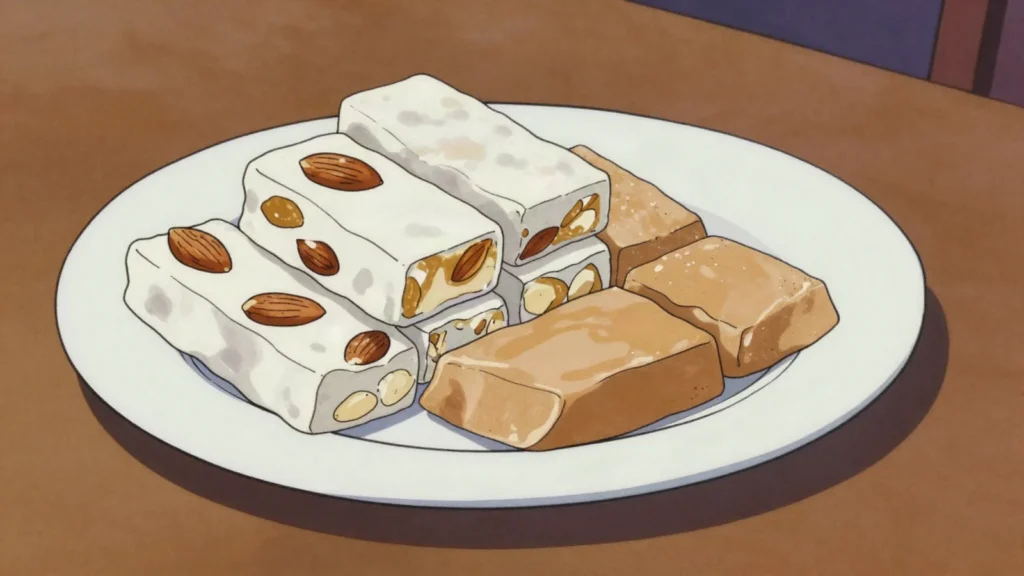
- Turrón de Jijona, soft and ground.
- Turrón de Alicante, hard with whole almonds.
- Turrón de yema, with egg yolk, which is a later variety.
History
Almond-and-honey nougat from Jijona and Alicante, made since at least the sixteenth century and carried across the Spanish empire at Christmas.
Frequently asked questions
What is Turrón?
Turrón is a dessert from Spain: almond and honey nougat eaten at Christmas. Almond-and-honey nougat from Jijona and Alicante, made since at least the sixteenth century and carried across the Spanish empire at Christmas.
How long does Turrón take to make?
Turrón takes 30 min plus setting of preparation and 1 hr of cooking. The recipe makes 2 bars. It is rated hard to make.
What can I substitute in Turrón?
Yes, within limits. Any good blanched almond, accepting a drier result. A strong honey such as rosemary or orange blossom.
What is the most important thing to get right in Turrón?
Toast them lightly in a low oven until fragrant but barely coloured, and keep them warm. Warm almonds fold into hot nougat far more easily than cold ones, which seize the mixture immediately. Now the honey, which should be good. Use a strong flavoured honey, since it is a main ingredient rather than a sweetener.