
Ingredients
The mushrooms
- 400 gpine mushrooms
- songi, matsutake
- Tricholoma matsutake
- firm and unblemished
- wiped, never washed
To grill
- a little sesame oil
- or nothing at all
- coarse sea salt
- a hot grill or pan
The dipping salt
- 1 tablespooncoarse salt
- 1 teaspoonsesame oil
- black pepper
- mixed in a small dish
Sometimes with
- thin slices of beef
- grilled alongside
- a squeeze of lemon
- steamed rice
Directions
- Trim only the very base of the stem. Salt is essentially the only seasoning used. Nothing else should go near it at all. Use songi as soon as you possibly can. Wrap it in paper rather than in plastic. Work gently so you do not bruise the flesh. Take real care with each one of them. Trim only the very base of each stem.
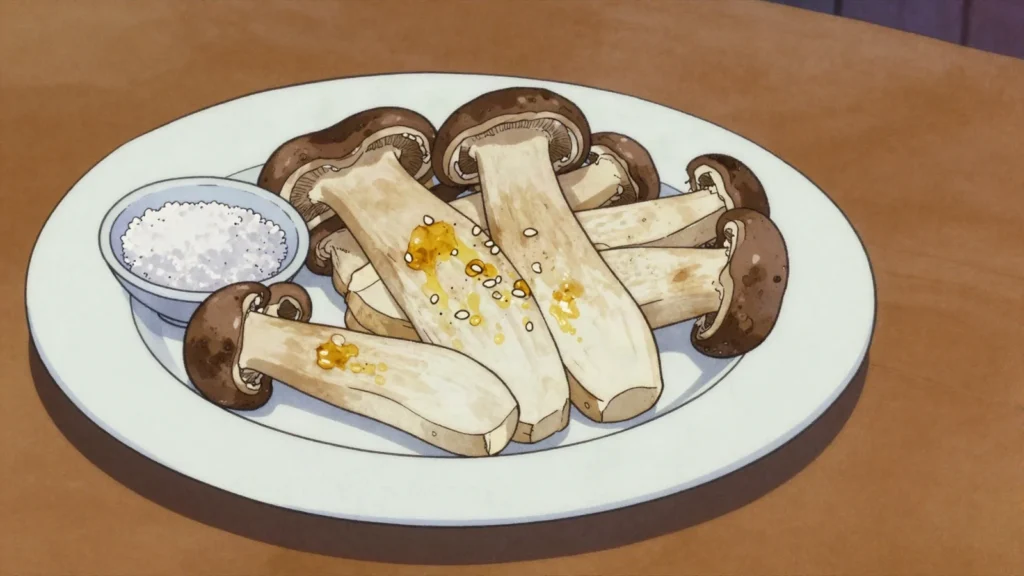
- Cut off as little as you possibly can. Songi is far too expensive to waste any of it. Tear the mushrooms lengthways into thick pieces. Tear from the stem end upward through the cap. Make each piece about a centimetre thick.
- Cut them lengthways rather than across. That keeps the characteristic shape visible. Mix coarse salt with a little sesame oil. Add a grind of black pepper to it.
- Mix it in a small dish for the table. That is the only condiment this dish needs. Keep it genuinely simple rather than elaborate. Heat a grill or a heavy pan until genuinely hot. The heat must be high rather than moderate.
- Use very little oil or none at all. Songi is grilled almost dry in Korea. Lay the pieces on the hot grill in one layer. Do not crowd the grill with too many at once.
- Work in batches if you need to. Leave space between each piece. Give them about ninety seconds on each side. Take them off the moment that happens. Sprinkle a little coarse salt over them. Salt them as they come off the heat. A light sprinkle is quite enough.
- Serve the mushrooms immediately while hot. It fades noticeably within a few minutes. Bring them straight to the table. Do not try to keep them warm at all. Serve them plainly on a simple plate. No garnish or sauce should cover them. Use it as soon as you possibly can.
Technique
- Never eat a wild mushroom you have not certainly identified. Misidentification genuinely kills people, several deadly species resemble edible ones closely, and there is no reliable folk test for edibility. Some deadly mushrooms cause no symptoms for many hours, by which time liver failure is already underway. Matsutake has lookalikes — some Amanita species among them — that have caused documented poisonings, so this is not a beginner’s foraging mushroom. Buy from a reputable supplier rather than foraging, never rely on a photograph or an app, and if there is any doubt at all, do not eat it.
- Never wash songi under running water: water strips the aroma directly from the surface and makes the flesh soggy. Wipe it with a barely damp cloth, scrape dirt from the stem with a knife, and trim only the very base.
- The best songi are eaten raw in thin slices, which preserves the aroma most completely. Eating any mushroom raw is not risk free — it must be genuinely fresh and correctly identified, and some people find raw mushroom hard to digest. The atlas records the practice without recommending it.
Substitutions
- Songi is Tricholoma matsutake, the pine mushroom, which grows in symbiosis with pine roots and cannot be cultivated commercially at all — every one sold is wild harvested, which is what drives the price. Mount Chilbo in North Hamgyong is a particularly prized source.
- North Korea has sent songi to South Korean presidents after several inter-Korean summits, several tonnes on some occasions; those gift events are genuinely documented, and their value makes them a real diplomatic mark. The atlas records them as facts without commenting on the politics around them.
Variations
- The aroma is the entire point and it is fragile: heavy cooking drives it off and strong seasonings mask it. Salt is essentially the only seasoning, with at most a brush of sesame oil — garlic, soy and chilli all overwhelm it completely.
- Grill it hot and fast, about ninety seconds a side, until lightly marked but still firm in the centre and smelling overwhelmingly of pine. A cool pan stews it in its own water; overcooked songi goes limp, loses its aroma and becomes an ordinary mushroom — a genuinely expensive mistake, so err on the side of undercooking.
- Salt it only as it comes off the heat, since salting earlier draws water out and stews it on the grill. Choose firm mushrooms with closed or barely open caps, which are younger and most aromatic, and smell them before buying — a faint smell means a poor specimen. Serve immediately, since the aroma peaks straight off the heat and fades within minutes.
History
Harvested on Mount Chilbo, they have repeatedly been sent to South Korean presidents as state gifts, including several tonnes after inter-Korean summits.
Frequently asked questions
What is Songi Mushrooms?
Songi Mushrooms is a main from North Korea: wild pine mushrooms grilled or sliced raw, prized for their perfume. Harvested on Mount Chilbo, they have repeatedly been sent to South Korean presidents as state gifts, including several tonnes after inter-Korean summits.
How long does Songi Mushrooms take to make?
Songi Mushrooms takes 15 minutes of preparation and 10 minutes of cooking. The recipe makes serves 4. It is rated easy to make.
What can I substitute in Songi Mushrooms?
Yes, within limits. Songi is Tricholoma matsutake, the pine mushroom, which grows in symbiosis with pine roots and cannot be cultivated commercially at all — every one sold is wild harvested, which is what drives the price. Mount Chilbo in North Hamgyong is a particularly prized source. North Korea has sent songi to South Korean presidents after several inter-Korean summits, several tonnes on some occasions; those gift events are genuinely documented, and their value makes them a real diplomatic mark. The atlas records them as facts without commenting on the politics around them.
What is the most important thing to get right in Songi Mushrooms?
Trim only the very base of the stem. Salt is essentially the only seasoning used. Nothing else should go near it at all. Use songi as soon as you possibly can. Wrap it in paper rather than in plastic. Work gently so you do not bruise the flesh. Take real care with each one of them. Trim only the very base of each stem.