
Ingredients
Raw materials
- Malted barley (peated or unpeated), for single malt
- Water from the distillery’s own source
- Distiller’s yeast
- Wheat or maize, for grain whisky in blends
- Oak casks, usually ex-bourbon American oak or ex-sherry European oak
To serve a dram
- 35–50 mlScotch whisky
- A few drops to 1 tsp of still, room-temperature water
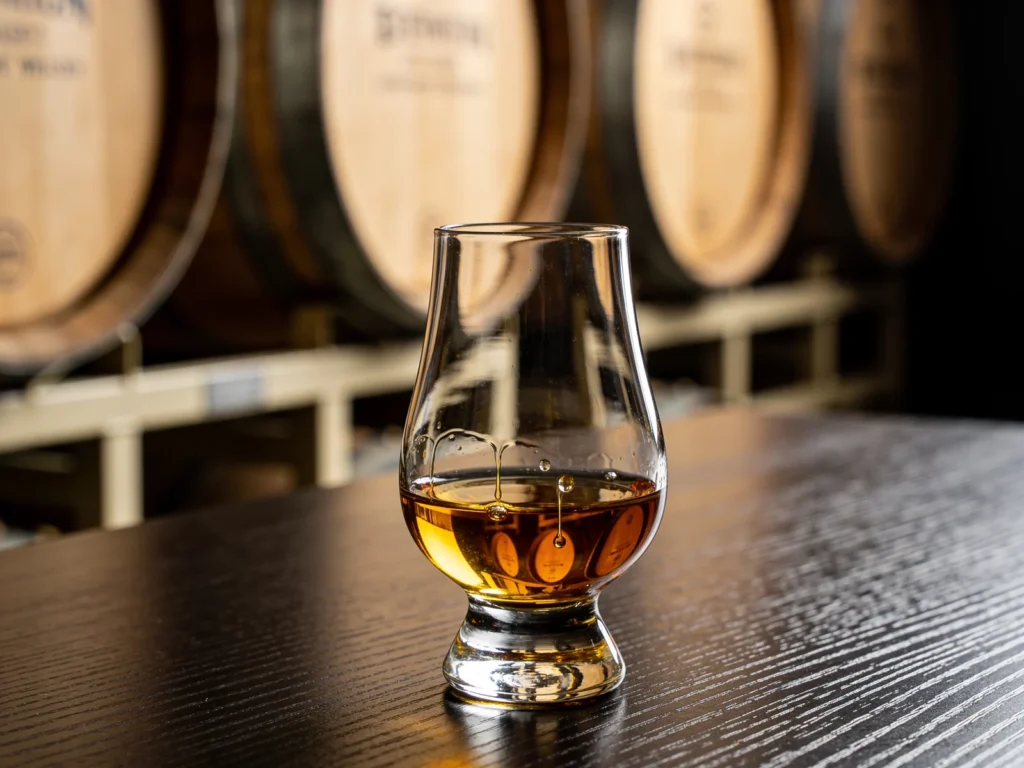
- 1Glencairn glass or a tulip-shaped copita
Directions
- Barley is steeped and germinated for several days, then kiln-dried to stop it. Where peat is burned in the kiln, as on Islay, the smoke phenols bind to the grain and carry all the way to the glass.
- The dried malt is milled into grist and mashed with hot water at rising temperatures of about 64, 72 and 85°C (185°F) in a mash tun, converting starch to fermentable sugar and drawing off a sweet wort.
- The cooled wort is fermented with yeast in washbacks for 48–72 hours to a beer-like wash of 7–9% abv. Long fermentations build fruity esters.
- The wash is distilled twice in copper pot stills: the wash still takes it to about 21%, and the spirit still to about 70%. The stillman cuts the heart of the second run, sending the foreshots and feints back to be redistilled.
- The new-make spirit is reduced to about 63.5% and filled into oak casks. By law it must mature in Scotland in oak of no more than 700 litres for a minimum of three years.
- The cask does most of the work: vanilla, coconut and spice from ex-bourbon oak, dried fruit and nut from ex-sherry butts, plus the slow oxidation and the 2% a year lost to the angels’ share.
- The whisky is then either bottled as a single malt from one distillery, or blended with grain whisky, and reduced to at least 40% abv. Only water and caramel colouring may be added.
- To drink it, pour 35 ml into a tulip glass, nose it with your mouth slightly open, then add a few drops of water to break the surface tension and release the aroma. Never chill a good malt with ice.
Technique
- The age on the label is the age of the youngest whisky in the bottle, and the clock stops the moment it leaves the cask. A 12 year old bottled in 1990 is still a 12 year old.
- Peat is a regional style, not a mark of quality. Islay malts are heavily peated; Speyside malts are typically not peated at all.
- Home distilling is illegal in the UK without an HMRC licence and cannot be recommended; the only home stage is choosing, opening and serving the bottle well.
Substitutions
- Cannot find single malt? A good blended Scotch such as an aged blend behaves the same in a highball and costs far less.
- For a long drink, top 40 ml Scotch with 120 ml soda water over ice, the Japanese-style highball, which suits lighter Speyside malts.
Variations
- Single malt, from one distillery and malted barley only.
- Blended Scotch, malt married with lighter column-still grain whisky, which is 90% of what the world drinks.
- Cask strength and single cask bottlings, undiluted and often 55–60% abv.
History
The 1494 Exchequer Rolls record malt sent to Friar John Cor to make aqua vitae; 2009 regulations fix five protected regions.
Frequently asked questions
What is Scotch whisky?
Scotch whisky is a wine & spirit from United Kingdom: malt or grain whisky matured at least three years in oak casks. The 1494 Exchequer Rolls record malt sent to Friar John Cor to make aqua vitae; 2009 regulations fix five protected regions.
How long does Scotch whisky take to make?
Scotch whisky takes 5 min of preparation and Minimum 3 years cask maturation of cooking. The recipe makes describes a commercial spirit; serves 1 as a dram. It is rated hard to make.
What can I substitute in Scotch whisky?
Yes, within limits. Cannot find single malt? A good blended Scotch such as an aged blend behaves the same in a highball and costs far less. For a long drink, top 40 ml Scotch with 120 ml soda water over ice, the Japanese-style highball, which suits lighter Speyside malts.
What is the most important thing to get right in Scotch whisky?
The new-make spirit is reduced to about 63.5% and filled into oak casks. By law it must mature in Scotland in oak of no more than 700 litres for a minimum of three years.