
Ingredients
Dough
- 500 gstrong white flour, German Type 550 if available
- 260 mlcold water
- 10 gfine salt
- 7 gfresh yeast, or 3 g instant yeast
- 25 gsoft butter
- 1 tspbarley malt extract or sugar
Lye bath
- 1 litrecold water
- 40 gfood-grade sodium hydroxide (lye) pearls, for a 4 per cent solution
- Rubber gloves and eye protection
- A stainless steel or plastic bowl, never aluminium
To finish
- Coarse pretzel salt
- Optional: grated Emmental, or pumpkin and sunflower seeds
Directions
- Mix flour, water, salt, yeast, butter and malt and knead 10 minutes to a very firm, smooth dough, stiffer than bread dough. Rest it 30 minutes at room temperature only; a long warm prove makes the pretzel too airy.
- Divide into 8 pieces of about 100 g, roll each into a short cylinder and rest 10 minutes under a cloth.
- Roll each piece into a rope 50–60 cm long, thick and fat in the middle, tapering to thin tips. Roll on an unfloured bench so it grips.
- Make a wide U, cross the two tips over each other twice, then flip the twist down onto the fat belly and press the ends on firmly.
- Lay the pretzels on lined trays and chill uncovered in the fridge for at least 8 hours or overnight, until the surface is dry and papery to the touch. A dry skin is what lets the lye bite evenly.
- Wearing gloves and goggles, in a well-ventilated kitchen, add the lye pearls to the cold water, never water to lye. Use a steel or plastic bowl; lye attacks aluminium.
- Heat the oven to 220°C (425°F) with a heavy tray inside. Dip each cold pretzel in the lye for 20–30 seconds with a slotted spoon, drain and set on a lined tray.
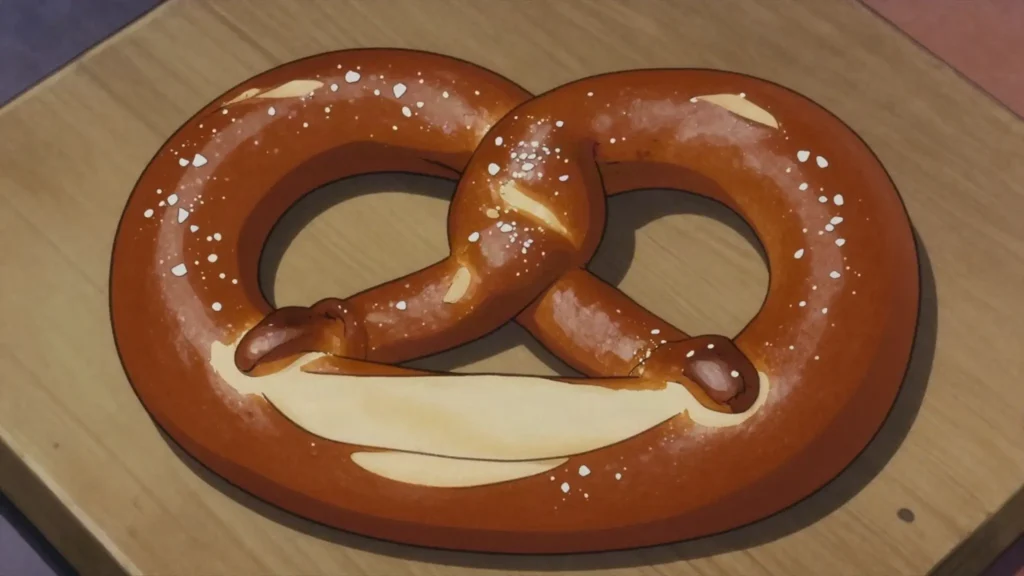
- Slash the fat belly with a sharp blade or a razor at a shallow angle, cutting a single clean 1 cm-deep line, and scatter with coarse salt.
- Bake 14–16 minutes until deep mahogany, almost chestnut, with a pale burst along the slash. Underbaked pretzels taste soapy.
- Cool 10 minutes on a rack and eat the same day, split with cold butter, or with Obatzda and a Maß in a beer garden.
Technique
- Lye is caustic and will burn skin and eyes. Wear gloves and goggles, keep vinegar nearby to neutralise splashes, and never let children near the bath. Once baked, the lye is chemically converted and the pretzel is entirely safe.
- The dark colour is not caramel; it is the Maillard reaction accelerated by the alkaline surface, which is also where the distinctive lye tang comes from.
- The classic shape has thin arms that bake crisp and a fat belly that stays soft; rolling an even rope gives a dull, uniform pretzel.
- Bavarian Brezn are fat-bellied and soft; Swabian Brezeln have thinner arms and a broader slashed belly. Both are correct in their own region.
Substitutions
- No lye: bake 60 g bicarbonate of soda on a tray at 150°C (300°F) for an hour to make sodium carbonate, dissolve in 1 litre of simmering water and dip for 30 seconds. Colour and flavour are close but never fully authentic.
- No pretzel salt: crush rock salt coarsely; flaky sea salt dissolves into the crust and disappears.
Variations
- Butterbrezel, split and filled with a thick slab of cold butter.
- Käsebrezel, blanketed in grated cheese before baking.
- Laugenstangen and Laugenbrötchen, the same dough and bath shaped as sticks and rolls.
History
Its twisted knot shape is most commonly explained, in a story that cannot be fully verified, as representing arms crossed in prayer, created by monks in early medieval Europe, possibly in what is now Italy, France or Germany, as a reward given to children for reciting their prayers correctly. What is more solidly documented is that pretzels were established enough in southern German and Austrian baking guilds by the Middle Ages that a pretzel became the standard heraldic symbol of the baker’s trade across German-speaking Europe, appearing on guild signs and coats of arms. The distinctive dark, shiny crust of a proper pretzel comes from briefly dipping the shaped dough in a lye solution before baking, a technique documented in Bavarian baking since at least the 1800s.
Frequently asked questions
What is Pretzel?
Pretzel is a bread & pastry from Germany: lye-glazed knotted bread with coarse salt, beer-garden essential. Its twisted knot shape is most commonly explained, in a story that cannot be fully verified, as representing arms crossed in prayer, created by monks in early medieval Europe, possibly in what is now Italy, France or Germany, as a reward given to children for reciting their prayers correctly. What is more solidly documented is that pretzels were established enough in southern German and Austrian baking guilds by the Middle Ages that a pretzel became the standard heraldic symbol of the baker’s trade across German-speaking Europe, appearing on guild signs and coats of arms. The distinctive dark, shiny crust of a proper pretzel comes from briefly dipping the shaped dough in a lye solution before baking, a technique documented in Bavarian baking since at least the 1800s.
How long does Pretzel take to make?
Pretzel takes 40 min of preparation and 1 hr, plus overnight chilling of cooking. The recipe makes 8 pretzels. It is rated hard to make.
What can I substitute in Pretzel?
Yes, within limits. No lye: bake 60 g bicarbonate of soda on a tray at 150°C (300°F) for an hour to make sodium carbonate, dissolve in 1 litre of simmering water and dip for 30 seconds. Colour and flavour are close but never fully authentic. No pretzel salt: crush rock salt coarsely; flaky sea salt dissolves into the crust and disappears.
What is the most important thing to get right in Pretzel?
Wearing gloves and goggles, in a well-ventilated kitchen, add the lye pearls to the cold water, never water to lye. Use a steel or plastic bowl; lye attacks aluminium.