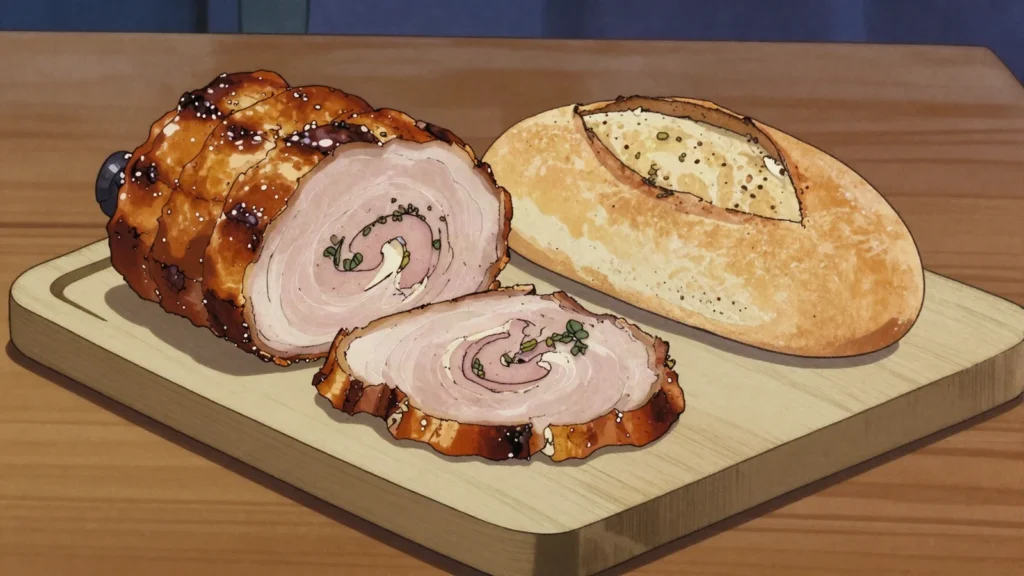

Ingredients
Pork
- 4 kgpork belly with the skin on, in one piece
- 1.5 kgpork loin, trimmed to fit the belly
Cure and stuffing
- 60 gsalt
- 2 tbspcoarsely ground black pepper
- 1whole head garlic, crushed
- 6 tbspwild fennel fronds and seed, or 3 tbsp fennel seed
- 2 tbsprosemary, chopped
To finish
- coarse salt, for the skin
- butcher’s string
To serve
- crusty rosetta rolls
- nothing else
Directions
- Lay the belly skin-side down and score the meat in a shallow diamond pattern so the seasoning gets in.
- Rub the salt, pepper, garlic, fennel and rosemary all over the meat side, then lay the loin along the middle.
- Roll it up tightly and tie firmly with string at 3 cm intervals along the whole length. Tight is important — gaps between the layers cook into hollow grey channels.
- Prick the skin all over with a needle but do not pierce the meat beneath.
- Rub the skin with coarse salt and leave the tied joint uncovered in the fridge for 24 hours.
- Those 24 hours of dry, cold air are what give crackling. A skin that goes into the oven damp will never crisp, whatever the temperature.
- Wipe off the salt and any moisture, then roast at 160°C (325°F) for about three hours.
- Cook to 75°C (167°F) in the centre. This is a rolled joint of belly and loin, so it wants to be fully cooked and tender rather than pink.
- Turn the oven up to 230°C (450°F) for the last 20 to 30 minutes to blister the skin, watching it closely.
- Rest for 30 minutes before carving. Cut in thick slices and eat in a crusty roll with the crackling — no sauce, no salad, nothing else. That is how it is sold from the vans in the Castelli Romani and it is how it should be eaten.
Technique
- Twenty-four hours uncovered in the fridge. That is the crackling.
- Tie tightly at 3 cm intervals.
- Cook to 75°C (167°F), then blast the heat for the skin.
Substitutions
- A whole boned suckling pig for the full Ariccia version, if you have an oven that takes it.
- Belly alone without the loin, which is simpler and fattier.
- Wild fennel is the PGI-specified herb and is what makes it taste of Ariccia; cultivated fennel seed is the substitute.
Variations
- Porchetta di Ariccia has held PGI status since 2011 and is sold by the slice at fairs across Lazio.
- The Umbrian and Tuscan porchette use rosemary and garlic more heavily and less fennel.
History
From Ariccia in the Castelli Romani south of Rome, PGI protected since 2011 and sold at fairs and from roadside vans.
Frequently asked questions
What is Porchetta di Ariccia?
Porchetta di Ariccia is a charcuterie & cured from Vatican City: whole boned pig roasted with herbs, sliced into bread rolls. From Ariccia in the Castelli Romani south of Rome, PGI protected since 2011 and sold at fairs and from roadside vans.
How long does Porchetta di Ariccia take to make?
Porchetta di Ariccia takes 1 hour plus 24 hours salting of preparation and 3 hours 30 minutes of cooking. The recipe makes serves 12. It is rated medium to make.
What can I substitute in Porchetta di Ariccia?
Yes, within limits. A whole boned suckling pig for the full Ariccia version, if you have an oven that takes it. Belly alone without the loin, which is simpler and fattier. Wild fennel is the PGI-specified herb and is what makes it taste of Ariccia; cultivated fennel seed is the substitute.
What is the most important thing to get right in Porchetta di Ariccia?
Roll it up tightly and tie firmly with string at 3 cm intervals along the whole length. Tight is important — gaps between the layers cook into hollow grey channels.