
Ingredients
The tea
- 4 tablespoonsloose black tea
- Iranian, or a Ceylon blend
- 1 litrewater
- for the pot
Sometimes added
- a few cardamom pods
- crushed
- a small piece of cinnamon
- a few dried rose petals
The equipment
- a samovar
- or a kettle and a small teapot
- estekan glasses
- with saucers
To serve
- sugar cubes
- or nabat, rock sugar
- dates or sweets
- on the side
Directions
- Mix every glass from both of them. It should be clear amber to deep red. Bring a full kettle to the boil. Fresh cold water boiled once is best.
- Fill the kettle fresh each time. Pour a little boiling water into the pot. Swirl it round and pour it away. A cold pot drops the brewing temperature.
- Put the loose tea into the warm pot. Use far more tea than you would normally.
- Add crushed cardamom to the pot. Pour boiling water over the tea. Use only enough to cover the leaves well. Fill the pot about a third full.
- Set the pot over the hot samovar. Or set it somewhere warm instead. Keep it hot rather than boiling. Judging it takes a careful look. Pour a little concentrate into a glass.
- Top the glass up with hot water. About one part tea to three of water. Adjust it for each of the drinkers.
- Pour through a small strainer. Serving it is done on a saucer. Set each glass on a small saucer. Put the sugar cubes on the side. Sugar is never put in the glass. Make it fresh through the day.
Technique
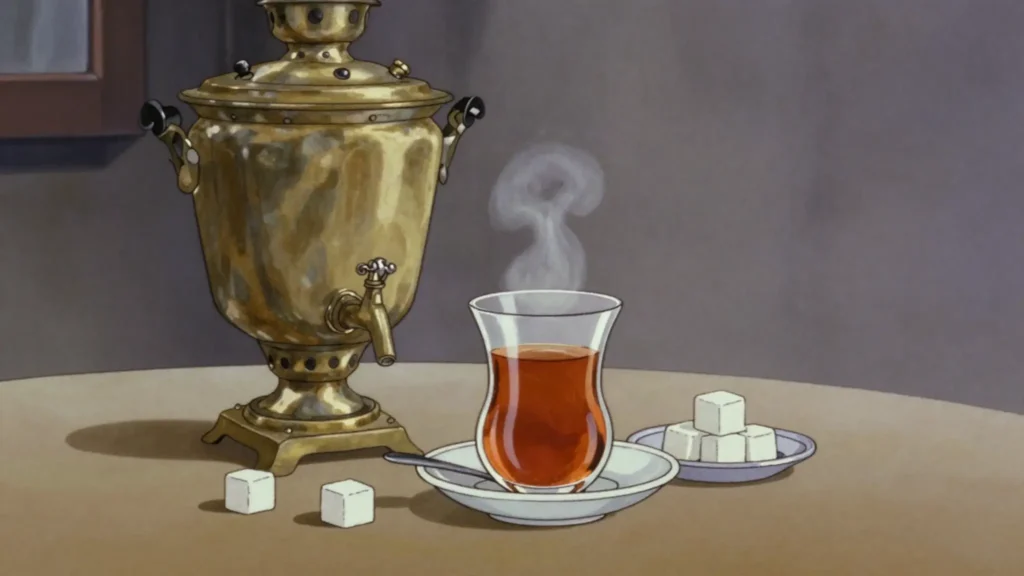
- The samovar system uses two vessels: a small teapot of very strong concentrate sitting over an urn of plain hot water, with each glass mixed from both. That is how strength is controlled — everyone takes a different one, and there are words for it, kamrang for light and porrang for dark. The tea also does not go bitter waiting. A kettle and small teapot reproduce it exactly at home.
- The concentrate steeps about fifteen minutes and must stay hot without boiling: boiling makes tea harsh and bitter and turns it cloudy, and clarity matters as much as strength — the colour is how the tea is judged and should be clear amber to deep red, never cloudy.
- Sugar is never in the glass but on the saucer beside it: a cube is held between the teeth and the tea sipped through it, sweetening each sip while the tea itself stays unsweetened. One cube lasts a whole glass.
Substitutions
- Nabat, Iranian rock sugar often grown on a saffron stick, is the other form; it is stirred in or held in the mouth.
- Crushed cardamom is the commonest addition to the pot, with cinnamon and rose petals also used; many households add nothing at all and plain tea is entirely standard.
Variations
- Tea planting began at Lahijan in Gilan around 1900, after Kashef al-Saltaneh brought seedlings out of British-controlled India where they were not freely exported. That account is the standard one, though details vary between tellings.
- The atlas also carries Azerbaijani novvat and Uzbek parvarda, both taken the same way — sweet held in the mouth with the tea drunk through it — a habit that runs right across the region.
- Use fresh cold water boiled once, since reboiled water has lost its dissolved air and tastes flat, and warm the pot first so it does not drop the brewing temperature.
History
Tea planting began at Lahijan around 1900 after Kashef al-Saltaneh smuggled seedlings from India; it is drunk through a sugar cube.
Frequently asked questions
What is Persian tea?
Persian tea is a drink from Iran: amber tea from the samovar, sipped through sugar cubes. Tea planting began at Lahijan around 1900 after Kashef al-Saltaneh smuggled seedlings from India; it is drunk through a sugar cube.
How long does Persian tea take to make?
Persian tea takes 10 minutes of preparation and 20 minutes of cooking. The recipe makes serves 6. It is rated easy to make.
What can I substitute in Persian tea?
Yes, within limits. Nabat, Iranian rock sugar often grown on a saffron stick, is the other form; it is stirred in or held in the mouth. Crushed cardamom is the commonest addition to the pot, with cinnamon and rose petals also used; many households add nothing at all and plain tea is entirely standard.
What is the most important thing to get right in Persian tea?
Set the pot over the hot samovar. Or set it somewhere warm instead. Keep it hot rather than boiling. Judging it takes a careful look. Pour a little concentrate into a glass.