
Ingredients
To buy it, which is the usual route
- 500 mlred palm oil
- unrefined, deep orange-red
- sold as dendê, zomi or epo pupa
- African, Brazilian and Caribbean grocers
To render it from fruit
- rarely done outside producing regions
- 2 kgripe oil palm fruit
- orange-red, from the bunch
- water, for boiling and separating
Equipment for rendering
- a large pot
- a mortar or a sturdy tub
- a coarse sieve
- a wide shallow pan
- clean jars
What it is used in
- calulu, the São Tomé fish stew
- moqueca and acarajé in Brazil
- egusi, banga and okra soups
- poured raw over yam or cassava
- as the frying fat for many dishes
Directions
- Warm the jar gently to melt it. Never heat palm oil until it smokes.
- Heat it gently and add the onions early. Do not leave it alone over high heat.
- Use a neutral oil for that. This needs stating carefully and honestly.
- Keep it in a cool dark place. Keep the lid tight. It keeps a year or more unopened.
- Discard it rather than cooking with it. This is rarely done outside producing regions.
- Keep the lid tight. Do not refrigerate it, which sets it hard.
- Discard it if it smells rancid.
Technique
- Never heat palm oil until it smokes. Some traditional recipes call for bleaching it that way — heating it until it turns from red to pale yellow — but overheating any oil past its smoke point degrades it, produces compounds that are not good to eat, and fills the kitchen with acrid irritating smoke. Heat it gently and get the onions in early. The atlas notes the bleaching tradition and deliberately gives no instructions for it.
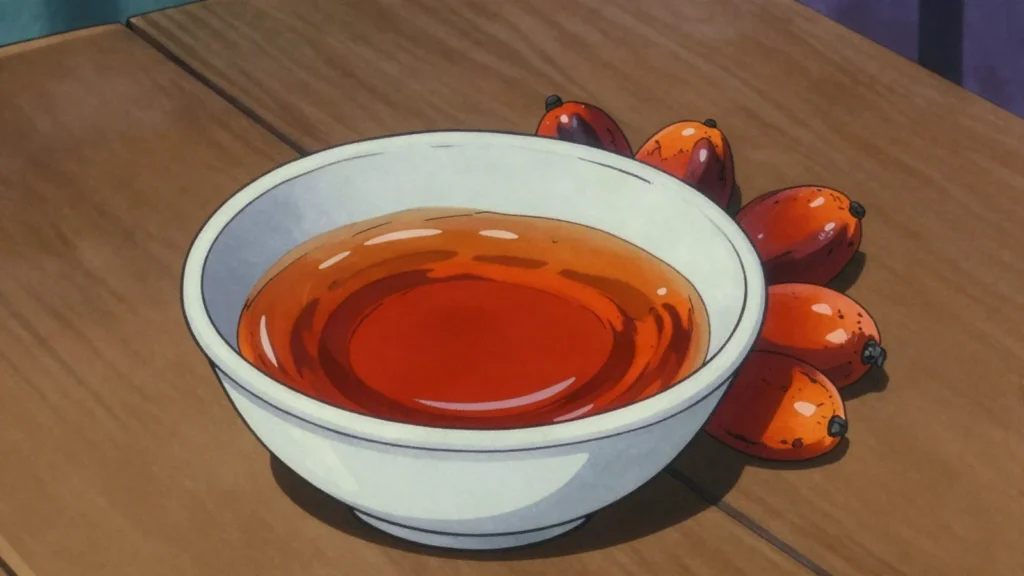
- Red palm oil and refined palm oil are different products. Refining bleaches and deodorises it into a near-tasteless industrial fat; the unrefined red oil is a cooking ingredient with a strong savoury, slightly floral flavour and a deep orange-red colour. They are not interchangeable in these recipes.
- Palm oil and palm kernel oil are also different. Palm oil comes from the orange fibrous flesh of the fruit; palm kernel oil comes from the seed inside and is pale.
- It stains hands, cloth and worktops stubbornly. Wipe surfaces immediately and wear an apron you do not mind marking.
- It is semi-solid at cool room temperature and melts at about 35 degrees, so it may arrive solid or liquid. Both are normal — warm the jar gently.
- It has a moderate smoke point and is not the oil for very high heat frying. Use a neutral oil for that.
- Good red palm oil is deep orange-red and smells strongly and pleasantly. Pale oil has been refined or is old, and oil that smells sharp and paint-like is rancid — discard it rather than cooking with it.
- Store it in a cool dark place with the lid tight. Light degrades the carotenoids that give it its colour. It keeps a year unopened and six months opened, and does not need refrigeration, which sets it hard.
- Oil rising and separating in a palm oil or peanut stew is wanted rather than a fault — it is the standard indicator across West African cooking that the base has cooked properly.
- Palm oil is genuinely associated with serious deforestation, and the great majority of world production comes from industrial plantations in Indonesia and Malaysia, where rainforest and peatland clearance, orangutan habitat loss and peat fires are all documented. Most of that oil is refined and goes into processed food, cosmetics and fuel. Much West and Central African red palm oil is small-scale, locally processed and grown for local consumption, and its scale and impact are different. That distinction is not absolute — industrial plantations exist and are expanding in Africa too, with documented land rights disputes around some. The atlas states the facts and does not tell anyone what to buy.
- There is no real substitute. Vegetable oil gives none of the colour or flavour, and annatto-coloured oil gives the colour without it — a dish made without red palm oil is a different dish, still good.
- It is used generously in the dishes that call for it. Four tablespoons in a pot is normal, and it is not a background fat there.
- Poured raw over hot roasted yam, boiled cassava or plantain, it keeps its full colour and flavour and is genuinely good that way.
Substitutions
- Vegetable oil replaces red palm oil, giving neither its colour nor its flavour.
- Annatto-coloured oil approximates the colour without the taste.
- Refined palm oil is not a substitute for the unrefined red kind in these dishes.
- Palm kernel oil is a different product and does not substitute.
- Coconut oil is used in some coastal cooking and behaves differently.
- For very high heat frying, use a neutral oil instead.
Variations
- Calulu, the São Tomé fish and vegetable stew, is the island dish built on it.
- Dendê is the Brazilian name, central to Bahian cooking.
- Moqueca and acarajé in Bahia both depend on it.
- Banga soup in Nigeria is made from fresh palm fruit pulp rather than the extracted oil.
- Mfumbwa and pondu in the Congo are built on it.
- Bleached palm oil, heated until pale, is used in certain traditional dishes.
Frequently asked questions
What is Oleo de palma?
Oleo de palma is a sauce & condiment from São Tomé and Príncipe: deep orange unrefined palm oil, the fat behind calulu and most island stews.
How long does Oleo de palma take to make?
Oleo de palma takes 20 minutes of preparation and 1 hour, if rendering from fruit of cooking. The recipe makes makes about 500 ml, if rendering. It is rated medium to make.
What can I substitute in Oleo de palma?
Yes, within limits. Vegetable oil replaces red palm oil, giving neither its colour nor its flavour. Annatto-coloured oil approximates the colour without the taste. Refined palm oil is not a substitute for the unrefined red kind in these dishes. Palm kernel oil is a different product and does not substitute. Coconut oil is used in some coastal cooking and behaves differently. For very high heat frying, use a neutral oil instead.
What is the most important thing to get right in Oleo de palma?
Warm the jar gently to melt it. Never heat palm oil until it smokes.