
Sticky fermented soybeans eaten over rice with mustard and soy — a breakfast that divides opinion more sharply than almost any other food. Legend ties it to eleventh-century warriors whose boiled soybeans fermented in straw horse-feed sacks; Mito in Ibaraki became the modern production centre.
It needs a specific Bacillus strain and a day held at 40°C (104°F) and high humidity; what colonises soybeans left warm without that starter and that control is generally not natto, and the failure looks and smells much the same at first.
What goes into it
- small soybeans
- Bacillus subtilis var. natto
- rice straw, in the traditional method
How it is made
Soybeans are soaked, steamed under pressure until soft, and inoculated while hot with Bacillus subtilis natto — in the old method by packing them into rice straw, which carries the organism naturally. They are held at around 40°C (104°F) at high humidity for a day, during which the bacterium produces the long sticky threads of polyglutamic acid, then chilled and ripened cold for a few days more.
How long it takes: about 24 hours of incubation, then several days of cold ripening
How it is eaten
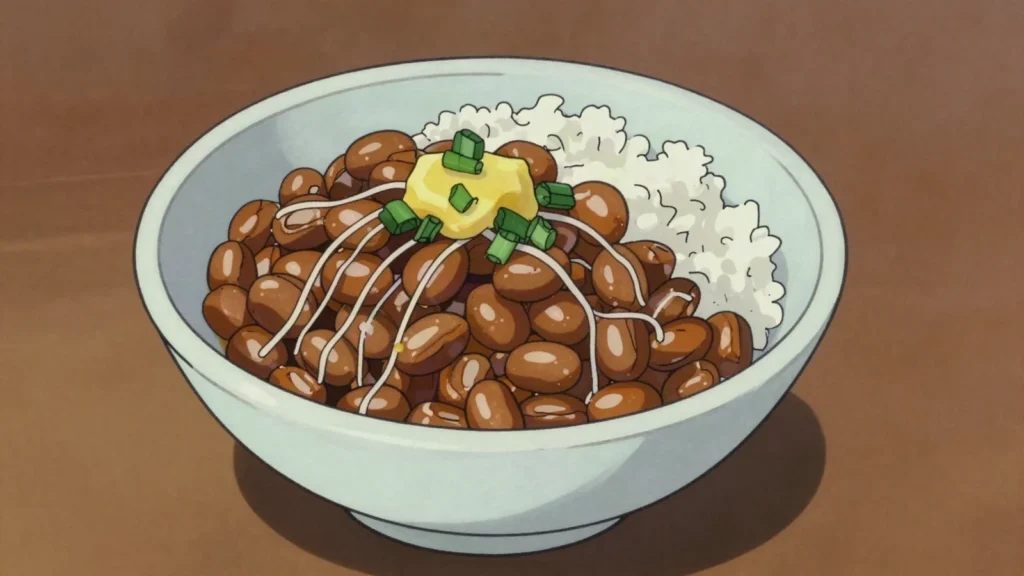
Stirred hard with mustard and soy until the threads build, then spooned over hot rice with spring onion.
History
Fermented soybeans, notable for their strong smell and distinctively sticky, stringy texture when stirred, documented across Japan for many centuries, with several competing historical legends attributing its discovery to samurai warriors who accidentally fermented boiled soybeans while transporting them in straw sacks during military campaigns. Its fermentation process, using a specific bacterium called Bacillus subtilis to convert boiled soybeans into natto over roughly a day, produces the dish’s characteristic smell and stringy texture, both of which make natto a notably polarizing food even within Japan itself, generally more popular in eastern Japan than in the west. Natto remains a significant traditional breakfast food across Japan, commonly eaten over rice.
Frequently asked questions
What is Natto?
Natto is a fermented & pickled from Japan: sticky fermented soybeans over rice with mustard and soy, polarizing breakfast. Fermented soybeans, notable for their strong smell and distinctively sticky, stringy texture when stirred, documented across Japan for many centuries, with several competing historical legends attributing its discovery to samurai warriors who accidentally fermented boiled soybeans while transporting them in straw sacks during military campaigns. Its fermentation process, using a specific bacterium called Bacillus subtilis to convert boiled soybeans into natto over roughly a day, produces the dish’s characteristic smell and stringy texture, both of which make natto a notably polarizing food even within Japan itself, generally more popular in eastern Japan than in the west. Natto remains a significant traditional breakfast food across Japan, commonly eaten over rice.
How is Natto made?
Soybeans are soaked, steamed under pressure until soft, and inoculated while hot with Bacillus subtilis natto — in the old method by packing them into rice straw, which carries the organism naturally. They are held at around 40°C (104°F) at high humidity for a day, during which the bacterium produces the long sticky threads of polyglutamic acid, then chilled and ripened cold for a few days more. It takes about 24 hours of incubation, then several days of cold ripening.
Can I make Natto at home?
No, and the atlas gives no method for it. It needs a specific Bacillus strain and a day held at 40°C (104°F) and high humidity; what colonises soybeans left warm without that starter and that control is generally not natto, and the failure looks and smells much the same at first.
What goes into Natto?
Small soybeans, bacillus subtilis var. natto, rice straw, in the traditional method.
How is Natto eaten?
Stirred hard with mustard and soy until the threads build, then spooned over hot rice with spring onion.