
Ingredients
Dough
- 700 gstrong white flour, plus more for rolling
- 1 tspfine salt
- about 420 ml warm water
- 100 gmature sourdough starter or 5 g fresh yeast (optional; traditional village lavash is often unleavened)
To finish
- water, for spraying
- 2 tbspwhite sesame or nigella seeds (optional)
Directions
- Mix the flour, salt, water and starter into a firm dough and knead 12 minutes until smooth and strongly elastic. It should be tighter than a bread dough, because it has to be rolled paper-thin without springing back.
- Cover and rest 1 hour, or up to 3 hours if using starter, until it has relaxed and swelled slightly but not doubled.
- Divide into 8 pieces, roll each into a ball, oil them lightly, cover and rest another 20 minutes. This second rest is what lets the gluten stretch instead of snapping.
- Heat a baking steel or heavy cast-iron pan in the oven at its maximum, 260–280°C (500–525°F), for at least 45 minutes, or heat a large cast-iron pan or an inverted wok on the hob until a drop of water skitters and vanishes instantly.
- On a lightly floured cloth or bench, roll one ball into an oval about 45 by 30 cm and 1 mm thick, turning it often. Traditionally it is then draped over a rabata, an oval straw cushion, and slapped against the wall of a tonir.
- Lift the sheet on a floured cloth or a peel and lay it flat on the hot surface. It should start to bubble within 10 seconds.
- Bake 40–60 seconds, until large blisters rise and take a few dark spots, then flip and give it 20–30 seconds more. It must stay pale and pliable, not brittle and biscuit-like.
- Stack the finished sheets under a cloth so they soften in their own steam. To store them the traditional way, dry them completely, stack them flat and keep them for months; sprinkle with water and cover for 15 minutes to bring them back to life before eating.
Technique
- Lavash was inscribed on the UNESCO list of intangible cultural heritage in 2014, as a bread whose making, meaning and appearance are central to Armenian culture. It is baked by groups of women working around a single tonir.
- The tonir is a clay well sunk into the ground, heated to around 350°C (650°F). A domestic oven cannot reach that, so a preheated baking steel at maximum heat is the honest compromise, giving similar blistering in slightly more time.
- Dried lavash keeps for six months or longer and is the reason the bread exists in this form: it was the winter bread of villages with no year-round baking.
- The sheet must be rolled thin enough to read through. Thick lavash bakes into a soft flatbread rather than the pliable, papery sheet used to wrap food.
Substitutions
- No baking steel? A heavy cast-iron frying pan or an inverted wok over high heat works well; expect a slightly less blistered sheet.
- Sourdough starter can be replaced by a pinch of yeast, or left out altogether for the traditional unleavened village version.
Variations
- Tonir lavash, blistered and smoky from the clay oven, the benchmark.
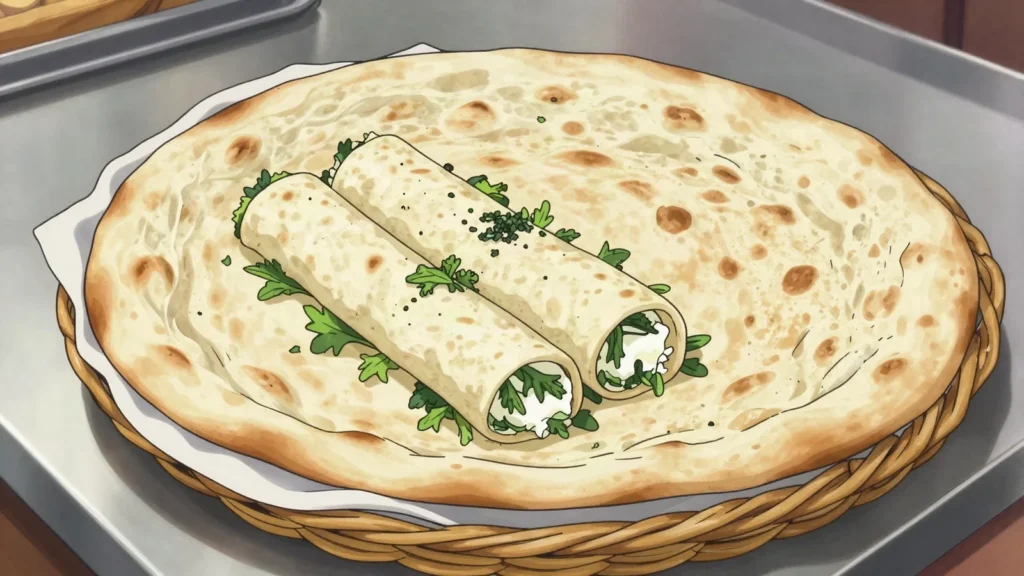
- Gata-style rolled lavash filled with herbs and cheese, folded and warmed until the filling melts.
- Thick lavash from the Syunik region, baked slightly heavier and eaten fresh.
History
A soft, thin flatbread, traditionally baked by slapping the stretched dough directly onto the hot inner wall of a tonir, a cylindrical clay oven set into the ground, a technique documented across Armenia and the wider Caucasus and Central Asian region for many centuries. Its preparation, requiring genuine skill to stretch the dough thin enough and slap it onto the hot oven wall without it falling into the fire below, is traditionally passed down through practiced, hands-on instruction within families and communities rather than through written recipes. UNESCO inscribed the traditional practice of lavash preparation, baking and sharing specifically as Armenian Intangible Cultural Heritage in 2014, recognizing not just the bread itself but the surrounding communal tradition of making and sharing it as culturally significant.
Frequently asked questions
What is Lavash?
Lavash is a bread & pastry from Armenia: thin tandoor flatbread, UNESCO-listed; wraps cheese, herbs and khorovats. A soft, thin flatbread, traditionally baked by slapping the stretched dough directly onto the hot inner wall of a tonir, a cylindrical clay oven set into the ground, a technique documented across Armenia and the wider Caucasus and Central Asian region for many centuries. Its preparation, requiring genuine skill to stretch the dough thin enough and slap it onto the hot oven wall without it falling into the fire below, is traditionally passed down through practiced, hands-on instruction within families and communities rather than through written recipes. UNESCO inscribed the traditional practice of lavash preparation, baking and sharing specifically as Armenian Intangible Cultural Heritage in 2014, recognizing not just the bread itself but the surrounding communal tradition of making and sharing it as culturally significant.
How long does Lavash take to make?
Lavash takes 30 min of preparation and 1 hr of cooking. The recipe makes 8 large sheets. It is rated medium to make.
What can I substitute in Lavash?
Yes, within limits. No baking steel? A heavy cast-iron frying pan or an inverted wok over high heat works well; expect a slightly less blistered sheet. Sourdough starter can be replaced by a pinch of yeast, or left out altogether for the traditional unleavened village version.
What is the most important thing to get right in Lavash?
Divide into 8 pieces, roll each into a ball, oil them lightly, cover and rest another 20 minutes. This second rest is what lets the gluten stretch instead of snapping.