
Ingredients
Dough
- 500 gstrong white flour
- 10 gfresh yeast
- 200 mlwarm milk
- 60 gsugar
- 2egg yolks
- 80 gbutter, melted
- 1 tspsalt
- zest of 1 lemon
To coat
- 150 gbutter, melted
- 200 ggranulated sugar
To finish
- ground walnuts
- cinnamon sugar
- ground almonds
- cocoa
Equipment
- wooden or metal spit rollers
- a charcoal fire or a rotisserie
Directions
- Make a soft enriched dough with the flour, yeast, warm milk, sugar, yolks, melted butter, salt and zest, and knead it 12 minutes.
- Knead it properly and knead it long. The dough is wound into a thin rope and stretched around a spit, and only well-developed gluten survives that.
- Prove for an hour until doubled.
- Roll the dough out and cut it into long strips about 2 cm wide.
- Grease the wooden roller heavily with melted butter.
- Wind a strip around the roller in a spiral, overlapping each turn slightly, from one end to the other.
- Overlap each turn by a few millimetres and press it gently. Butted edges separate as the dough rises and the cake comes apart into a spiral of loose ribbon.
- Roll the wound spit on the work surface, pressing lightly, to seal the coils into one smooth cylinder.
- Brush the outside with melted butter and roll it in granulated sugar until completely coated.
- Use granulated, not caster. Coarse crystals caramelise into the hard shiny shell that gives the cake its crackle, and fine sugar just melts away.
- Prove on the spit for 15 minutes.
- Set the spit over glowing charcoal, high enough that the sugar caramelises rather than burns, and turn it continuously.
- Turn it without stopping for 20 to 25 minutes. Any pause and the sugar on the lower side burns black in seconds.
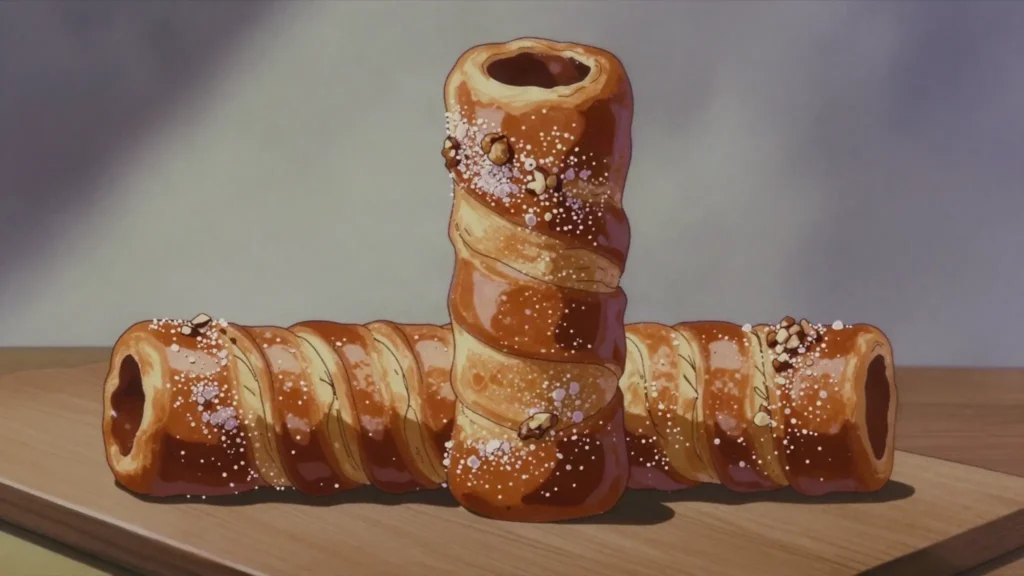
- It is ready when the cake is deep golden and the sugar has fused into a glassy caramel shell.
- Roll the hot cake immediately in ground walnuts, cinnamon sugar or cocoa.
- Coat it while the caramel is still tacky, or nothing sticks.
- Slide it off the roller with a twist while still warm, so it comes away as a hollow chimney.
- Do not let it cool on the roller. The caramel sets and welds the cake to the wood permanently.
- It is eaten by unwinding the spiral in strips with your fingers, which is the whole pleasure of it.
- It comes from the Székely Land in Transylvania and is now sold from stalls across Hungary and Central Europe.
Technique
- The hollow chimney is where the name comes from; kürtő means chimney.
- It is best within twenty minutes and goes tough within an hour.
- Electric kürtőskalács ovens are sold and work, though charcoal gives a better shell.
Substitutions
- A rotisserie attachment with foil-wrapped rolling pins.
- An oven at 190°C (375°F), turning the spits by hand every few minutes.
Variations
- Coated in ground walnut, which is the oldest finish.
- With cocoa and coconut.
- Filled with ice cream, which is a modern street version.
History
Székely chimney cake wound on a spit and rolled in sugar that caramelises; recorded in Transylvanian cookbooks from the eighteenth century.
Frequently asked questions
What is Kürtőskalács?
Kürtőskalács is a street food from Hungary: spit-roasted chimney cake rolled in caramelised sugar. Székely chimney cake wound on a spit and rolled in sugar that caramelises; recorded in Transylvanian cookbooks from the eighteenth century.
How long does Kürtőskalács take to make?
Kürtőskalács takes 30 min plus 1 hr 30 min rising of preparation and 25 min of cooking. The recipe makes 6 cakes. It is rated hard to make.
What can I substitute in Kürtőskalács?
Yes, within limits. A rotisserie attachment with foil-wrapped rolling pins. An oven at 190°C (375°F), turning the spits by hand every few minutes.
What is the most important thing to get right in Kürtőskalács?
Set the spit over glowing charcoal, high enough that the sugar caramelises rather than burns, and turn it continuously.