
Ingredients
The batter
- 300 gbuckwheat flour
- or half buckwheat and half wheat flour
- half a teaspoon salt
- about 500 ml water
- or milk and water mixed
- 1egg, optional
For the pan
- butter, or oil
- for greasing
To serve
- datshi, the fresh Bhutanese cheese
- or feta, crumbled
- ezay, the chilli relish
- butter
- honey, for a sweet version
- suja, the butter tea
Directions
- Put the flour and salt in a bowl. Add the egg if you are using it. Add water gradually while whisking. Whisk until completely smooth. It should be thin, like single cream.
- Cover it and rest it for thirty minutes. Whisk it and add water to loosen it. Whisk it before every pancake.
- Use a heavy frying pan or a griddle. A well-seasoned or non-stick pan helps a great deal. Heat it over a medium heat. Get it properly hot before the first pancake.
- Brush it with butter or oil. Grease it before every pancake. Do not rely on one greasing. Pour in enough batter to coat the base. Swirl the pan to spread it. It is closer to a small thick pancake.
- Cook it for about two minutes. The edges dry and lift slightly. Turn it in one confident movement. Give it about a minute. Adjust the heat and carry on. Stack them on a warm plate. Cover them with a cloth. They stay soft that way.
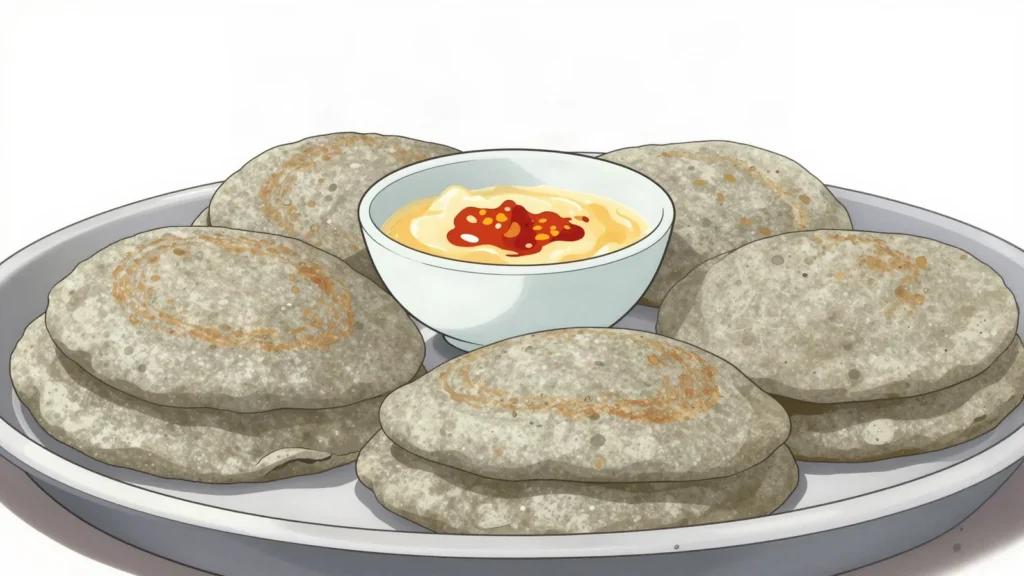
- Serve them hot with cheese and chilli. Datshi is a fresh soft Bhutanese cheese. Crumble it over the hot pancake. It is drunk in the cold valleys.
- Whisk it hard and thin it before using. Stack them with paper between and reheat in a pan.
Technique
- The atlas’s own description says buckwheat or wheat while its tags say millet, and those do not agree. Bumthang is strongly associated with buckwheat, which grows at altitude where rice will not, and millet is also grown in Bhutan — so the atlas gives the buckwheat method the description supports and notes the discrepancy rather than choosing silently.
- Buckwheat has no gluten, so a pure buckwheat batter is fragile and tears when turned. Mixing in half wheat flour, or adding an egg, gives enough structure; a pure buckwheat pancake with neither is traditional and genuinely difficult.
- Rest the batter thirty minutes. Buckwheat hydrates slowly and unrested batter tastes gritty; it also thickens noticeably as it rests, so start thinner than seems right and loosen it again afterwards.
- Whisk before every pancake. Buckwheat batter separates as it stands, the flour sinking and the water rising.
- Grease the pan before every pancake rather than relying on one greasing. Buckwheat sticks readily and that is where the trouble starts.
- Do not spread it paper thin. Khur-le is a thick pancake rather than a crêpe, and a thin buckwheat pancake tears immediately.
- Turn it confidently in one movement, after loosening the edges and sliding the spatula fully underneath. Hesitation is what tears these.
- The edges drying and lifting is the sign it is ready to turn, along with bubbles across the surface.
- The first pancake is usually a failure while the pan finds its temperature. Adjust and carry on.
- Buckwheat is earthy and distinctly bitter, a strong flavour rather than a neutral one. The cheese and chilli are what balance it.
- Buckwheat is not a wheat or even a grass — it is a seed related to rhubarb and sorrel, containing no gluten, growing fast in poor cold soil. That is why it matters at altitude.
- Buckwheat is often milled alongside wheat and cross-contamination is common. Buy certified gluten-free flour if it matters medically.
- Feta substitutes for datshi but is saltier, so use less. Ezay, the pounded chilli relish, has its own entry and is what goes on top.
Substitutions
- Half wheat flour in place of half the buckwheat makes a much easier batter and a softer pancake.
- An egg binds a pure buckwheat batter enough to turn reliably.
- Milk replaces some of the water for a richer pancake.
- Feta or any mild fresh curd replaces datshi.
- Honey and butter replace the cheese and chilli for the sweet version.
- Millet or wheat flour make the same pancake by the same method with a different flavour.
Variations
- Puta, the Bumthang buckwheat noodle, is the other great dish of the same grain.
- A sweet version with honey or sugar is eaten at breakfast.
- Hoentay, buckwheat dumplings from Haa, are stuffed with turnip greens and cheese.
- Ema datshi, chillies cooked in cheese, is served alongside as it is with everything.
- Galettes de sarrasin in Brittany are the distant European buckwheat relative.
- Some households make a thicker version closer to a flatbread.
Frequently asked questions
What is Khur-le?
Khur-le is a bread & pastry from Bhutan: buckwheat or wheat pancake from Bumthang, eaten with cheese and chilli.
How long does Khur-le take to make?
Khur-le takes 15 minutes plus 30 minutes resting of preparation and 25 minutes of cooking. The recipe makes makes about 8. It is rated easy to make.
What can I substitute in Khur-le?
Yes, within limits. Half wheat flour in place of half the buckwheat makes a much easier batter and a softer pancake. An egg binds a pure buckwheat batter enough to turn reliably. Milk replaces some of the water for a richer pancake. Feta or any mild fresh curd replaces datshi. Honey and butter replace the cheese and chilli for the sweet version. Millet or wheat flour make the same pancake by the same method with a different flavour.
What is the most important thing to get right in Khur-le?
Brush it with butter or oil. Grease it before every pancake. Do not rely on one greasing. Pour in enough batter to coat the base. Swirl the pan to spread it. It is closer to a small thick pancake.