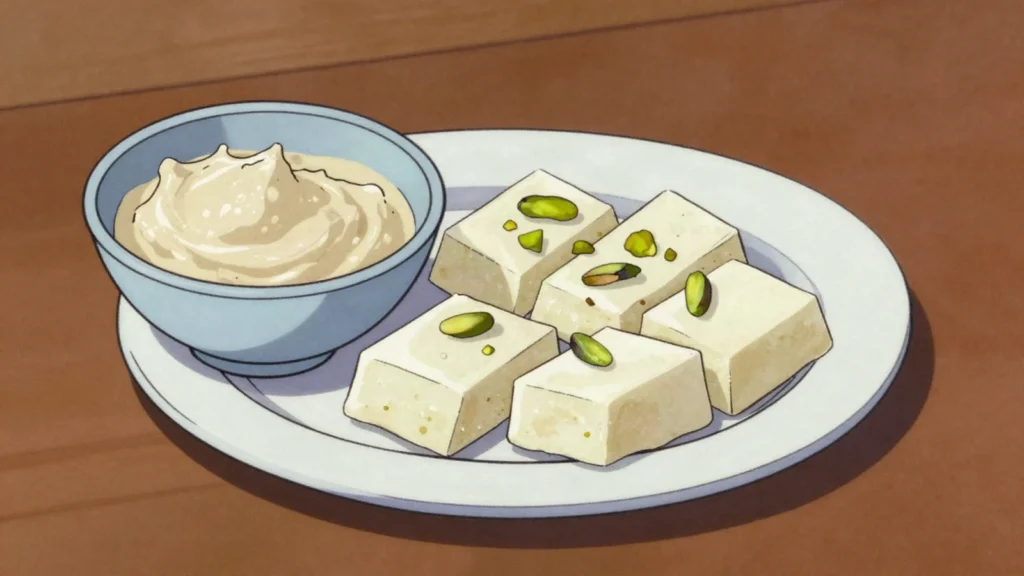

Ingredients
Khoa
- 2 litreswhole milk, the higher the fat the better
To use
- in barfi, gulab jamun or peda
- or in a curry gravy
Directions
- Pour the milk into the widest, heaviest pan you own. Width matters more than anything else here: evaporation happens at the surface, and a narrow pan takes twice as long and is twice as likely to catch.
- Bring to a boil, then reduce to a steady rolling simmer and stir with a flat-edged spatula, scraping the base and sides constantly.
- As the milk reduces, a skin will form at the edges. Scrape it back in each time rather than letting it dry onto the pan — those scrapings are part of the texture.
- After about 40 minutes the milk will have thickened to the consistency of condensed milk. From this point on it can catch and burn in under a minute, so do not leave the pan.
- Keep stirring for another 20 to 30 minutes as it thickens to a soft dough that leaves the sides of the pan in one mass and no longer looks wet.
- For soft khoa, stop here. For the firmer grating khoa used in barfi, cook a few minutes longer until it stiffens further.
- Turn out onto a plate, flatten, and cool completely. It sets firm as it cools.
- It keeps a week in the fridge and freezes well. Two litres of milk gives around 200 g, which surprises people the first time.
Technique
- Constant stirring and a wide pan. There is no way around either.
- The last ten minutes are where it burns. A single scorched patch stirred back through taints the whole batch and there is no fixing it.
- Full-fat milk gives noticeably better khoa. Buffalo milk, which is what much of India uses, is better still.
Substitutions
- Full-fat milk powder blended with a little cream and butter and cooked briefly — a common shortcut that is not the same but works in sweets.
- A microwave in short bursts with stirring between, which is faster and easier to burn.
Variations
- Batti khoa is cooked hardest and grates; chikna khoa is stopped softer for gulab jamun.
- Danedar khoa is deliberately curdled slightly with acid for a grainy texture.
Frequently asked questions
What is Khoa?
Khoa is a cheese & dairy from India: milk reduced over fire to a dense solid, the base of most Indian sweets.
How long does Khoa take to make?
Khoa takes 5 min of preparation and 1 hour 15 minutes of cooking. The recipe makes makes about 200 g from 2 litres. It is rated medium to make.
What can I substitute in Khoa?
Yes, within limits. Full-fat milk powder blended with a little cream and butter and cooked briefly — a common shortcut that is not the same but works in sweets. A microwave in short bursts with stirring between, which is faster and easier to burn.
What is the most important thing to get right in Khoa?
As the milk reduces, a skin will form at the edges. Scrape it back in each time rather than letting it dry onto the pan — those scrapings are part of the texture.