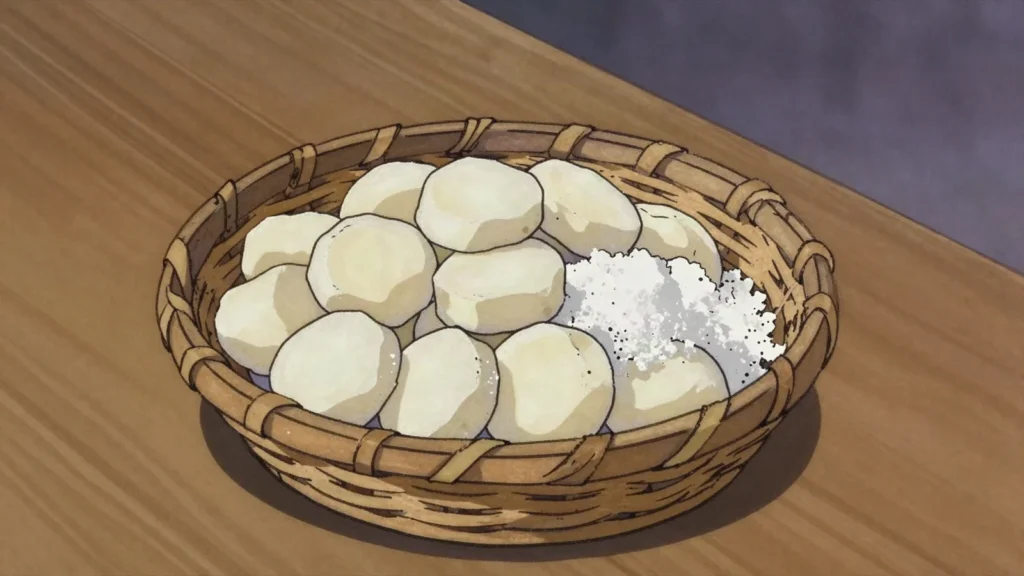

Ingredients
Curd
- 3 litreslaban or buttermilk left from churning butter
- 2 tbspfine salt
Equipment
- muslin
- trays or a rack
- netting, against flies
To use
- grated into jareesh or marqooq
- or soaked into a sauce
Directions
- Start from properly soured buttermilk — the liquid left after churning butter from laban. Sweet milk will not curdle cleanly and the yield is poor.
- Warm it gently to about 45°C (113°F) without stirring, until the curd draws together and separates from the whey. Do not let it go above 55°C (131°F) or the curd goes hard and grainy.
- Ladle the curd into a muslin-lined sieve and hang it to drain for a day, then press it under a weight for a second day until it is genuinely firm and dry.
- Work the salt through thoroughly. Iqt is heavily salted, which is part of what lets it keep for years in the desert.
- Shape it into balls or flat discs with wet hands, pressing them firm so there are no air pockets.
- Lay them on trays, cover with netting, and dry them in the sun. Turn them daily.
- Over one to two weeks they harden into stones — genuinely stone-hard, which is what iqt is meant to be. A piece still yielding in the middle will mould.
- Store in a cloth bag somewhere dry. To use, grate it on a coarse grater into jareesh or soak a piece in hot water and beat it into a sauce.
Technique
- Dry it until it is rock hard. This is what decides whether it keeps for years or moulds in a month.
- Salt properly. Under-salted iqt does not keep.
- Grate it rather than trying to cut it. It is hard enough to blunt a knife.
Substitutions
- Thick plain yoghurt thinned with water in place of churn buttermilk.
- Goat’s or camel’s milk laban, both of which are used in the Najd.
- A dehydrator at 50°C (122°F) where the weather will not oblige.
Variations
- The Central Asian kurt, Mongolian aaruul and Uzbek qurt are the same food.
- Ground to a powder and stirred into sauces rather than grated.
History
Najdi way of preserving milk: buttermilk is dried into stones that keep for years in desert conditions.
Frequently asked questions
What is Iqt?
Iqt is a cheese & dairy from Saudi Arabia: hard dried buttermilk, grated into wheat porridges such as jareesh. Najdi way of preserving milk: buttermilk is dried into stones that keep for years in desert conditions.
How long does Iqt take to make?
Iqt takes 30 min plus 2 days draining and 1 to 2 weeks drying of preparation and 20 min of cooking. The recipe makes makes about 400 g. It is rated easy to make.
What can I substitute in Iqt?
Yes, within limits. Thick plain yoghurt thinned with water in place of churn buttermilk. Goat’s or camel’s milk laban, both of which are used in the Najd. A dehydrator at 50°C (122°F) where the weather will not oblige.
What is the most important thing to get right in Iqt?
Warm it gently to about 45°C (113°F) without stirring, until the curd draws together and separates from the whey. Do not let it go above 55°C (131°F) or the curd goes hard and grainy.