
Ingredients
Cheese
- 4 Lsheep’s milk, or 2 L sheep’s and 2 L goat’s milk, unhomogenised
- 1 tsp(5 ml) liquid rennet, microbial or vegetarian, diluted in 50 ml cool water
- 20 gdried mint leaves, whole
Brine
- 1 Lof the reserved whey, cooled
- 120 gcoarse sea salt (about 12%)
Directions
- Warm the milk slowly in a heavy pan to 32–34°C (90–95°F), stirring gently so it does not scorch on the base.
- Off the heat, stir in the diluted rennet with 20 up-and-down strokes, still the surface, cover, and leave undisturbed 45 minutes at room temperature until the curd gives a clean break against a knife.
- Cut the curd into 1.5 cm cubes and rest 10 minutes, then stir slowly for 15 minutes while warming to 38°C (100°F); the cubes will shrink and firm.
- Ladle the curd into square moulds or a cloth-lined colander, pressing lightly. Save every drop of whey. Press under a 2 kg weight for 1 hour, until the blocks hold their shape and stop dripping.
- Cut into blocks about 10 x 10 x 2.5 cm. Heat the whey in a wide pan to 90°C (195°F), just below a simmer, and lower the blocks in.
- Poach 40–60 minutes. They sink, then rise and float when they are ready. Floating is the signal, and this hot-whey cooking is what gives halloumi its squeak and its refusal to melt.
- Lift out, sprinkle each hot block generously with salt, fold it over on itself with whole dried mint leaves tucked inside, and press flat.
- Cool completely, then submerge in the 12% cooled whey brine. Keep refrigerated; eat after 3 days, or brine for weeks for a saltier, firmer cheese.
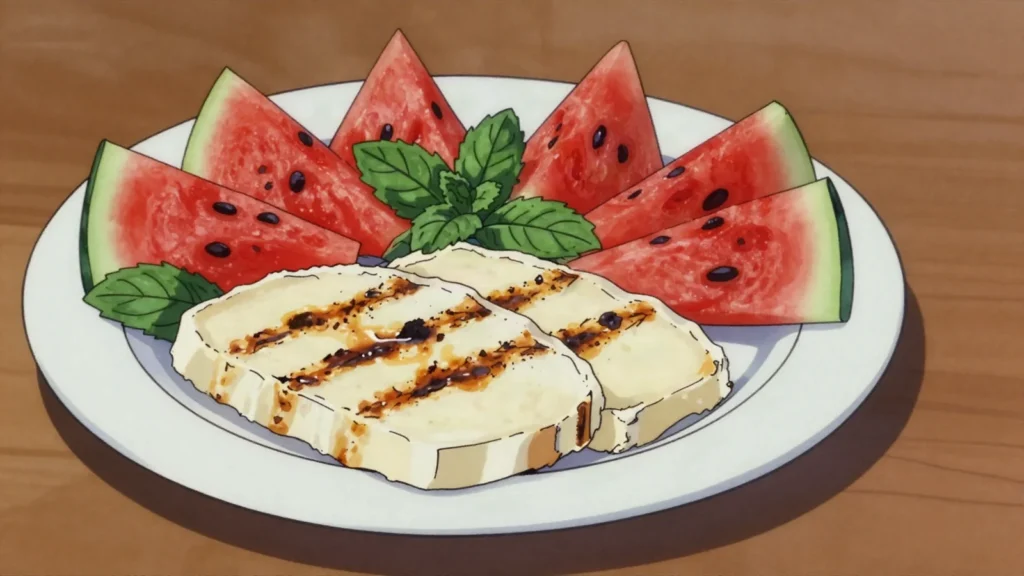
- To cook, dry-fry 1 cm slices in a hot pan or grill over charcoal 1–2 minutes a side, until dark bars form and the inside softens without running.
Technique
- Halloumi does not melt because the curd is cooked in hot whey at 90°C (195°F), which denatures the proteins and locks the structure. That heat step is non-negotiable.
- Traditional Cypriot halloumi is sheep and goat milk; the PDO granted in 2021 sets a minimum share of sheep or goat milk. All-cow halloumi is a modern industrial shortcut and tastes blander and rubberier.
- Brine in whey, not water. Salt water leaches calcium out and the cheese turns crumbly and chalky.
Substitutions
- No sheep’s or goat’s milk: full-fat cow’s milk works, but add 100 ml double cream per litre to make up the fat.
Variations
- Fresh halloumi eaten within a day, unbrined, with watermelon in summer.
- Aged halloumi, brined three or four months until hard and sharp, then grated over pasta.
History
A semi-hard cheese made from a mixture of goat and sheep milk, sometimes with cow milk added, whose defining property is a high melting point that lets it be grilled or fried without collapsing into liquid, a characteristic tied to its specific production method of heating the curd before shaping it. Documented in Cyprus for centuries, with some Cypriot accounts tracing it back to the medieval Byzantine period, halloumi’s association with the island runs deep enough that Cyprus secured European Union protected designation of origin status for the name in 2021, legally restricting genuine halloumi production to the island using its traditional milk-mixture recipe. It is traditionally folded and sometimes flavoured with dried mint before being lightly salted and brined for storage.
Frequently asked questions
What is Halloumi?
Halloumi is a cheese & dairy from Cyprus: squeaky brined cheese, grilled or fried, often with watermelon. A semi-hard cheese made from a mixture of goat and sheep milk, sometimes with cow milk added, whose defining property is a high melting point that lets it be grilled or fried without collapsing into liquid, a characteristic tied to its specific production method of heating the curd before shaping it. Documented in Cyprus for centuries, with some Cypriot accounts tracing it back to the medieval Byzantine period, halloumi’s association with the island runs deep enough that Cyprus secured European Union protected designation of origin status for the name in 2021, legally restricting genuine halloumi production to the island using its traditional milk-mixture recipe. It is traditionally folded and sometimes flavoured with dried mint before being lightly salted and brined for storage.
How long does Halloumi take to make?
Halloumi takes 45 min of preparation and 3 hr, plus 3 days brining of cooking. The recipe makes about 700 g cheese (4 blocks). It is rated hard to make.
What can I substitute in Halloumi?
Yes, within limits. No sheep’s or goat’s milk: full-fat cow’s milk works, but add 100 ml double cream per litre to make up the fat.