
Ingredients
Mate
- 100 gerva-mate, finely ground
- 1 litrewater at 70 to 80°C (160 to 175°F)
Equipment
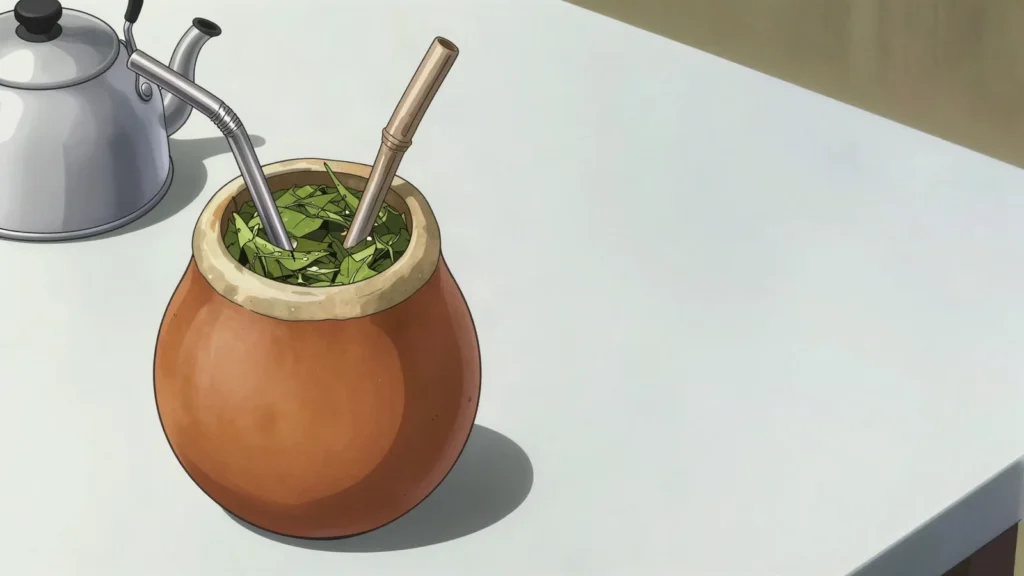
- a cuia, the gourd
- a bomba, the metal straw
Directions
- Cure a new gourd before its first use: fill it with used mate and hot water and leave it for 24 hours, do it twice, then scrape out the soft inner flesh. An uncured gourd tastes of raw squash and will grow mould.
- Fill the cuia about two thirds full with erva-mate.
- Cover the mouth with your palm, turn it upside down and shake it gently, then bring it upright again. This moves the finest powder to the top and away from where the bomba will sit, so it cannot clog.
- Tilt the gourd so the mate lies against one side at roughly 45 degrees, leaving a hollow down the other.
- Pour a little cool water into that hollow first and let it soak in for a minute. Cool water protects the leaf; hot water onto dry mate scalds it and the first several rounds come out bitter and stay that way.
- Push the bomba into the wet hollow with your thumb over the top, and press it right down to the bottom.
- Never stir with the bomba once it is in. Moving it lets the fine powder into the filter and blocks it, and a blocked bomba cannot be cleared without rebuilding the whole gourd.
- Heat the water to 70 to 80°C (160 to 175°F). Boiling water ruins mate and is the single most common mistake made with it.
- Pour into the hollow, always into the same spot, and drink the gourd down completely before refilling it.
- In a circle, whoever prepares it drinks the first and weakest gourd, then refills and passes it on. Saying obrigado means you have had enough and want no more, so do not say it early by accident.
- Keep refilling as long as the mate holds its flavour, which is usually fifteen or twenty rounds.
Technique
- Cool water first, never stir, never boil. Those three rules cover almost everything.
- Brazilian erva-mate for chimarrão is ground much finer than Argentine yerba and the two do not behave the same way in the gourd.
- It is a Guarani habit, spread by the Jesuit missions and carried on by gaucho herders in Rio Grande do Sul, where it is drunk from breakfast onwards.
Substitutions
- A wooden or ceramic cuia, which needs no curing and is easier to keep clean.
- Argentine yerba, accepting that it is coarser and gives a different drink.
Variations
- Tereré, the same leaf drunk with iced water, in Paraguay and Mato Grosso do Sul.
- With mint, lemon verbena or other herbs added to the gourd.
- Sweetened, which most southerners regard as an aberration.
History
Hot yerba mate sipped from a gourd in Rio Grande do Sul, a Guarani habit spread by Jesuit missions and carried on by gaucho herders.
Frequently asked questions
What is Chimarrão?
Chimarrão is a drink from Brazil: hot erva-mate sipped from a shared gourd, southern tradition. Hot yerba mate sipped from a gourd in Rio Grande do Sul, a Guarani habit spread by Jesuit missions and carried on by gaucho herders.
How long does Chimarrão take to make?
Chimarrão takes 10 min of preparation and no cooking at all. The recipe makes 1 gourd, many rounds. It is rated medium to make.
What can I substitute in Chimarrão?
Yes, within limits. A wooden or ceramic cuia, which needs no curing and is easier to keep clean. Argentine yerba, accepting that it is coarser and gives a different drink.
What is the most important thing to get right in Chimarrão?
Never stir with the bomba once it is in. Moving it lets the fine powder into the filter and blocks it, and a blocked bomba cannot be cleared without rebuilding the whole gourd.