
Ingredients
Sour mash
- 400 gfine white maize meal (mealie meal)
- 2 litreswarm water at 35°C (95°F)
Cooked porridge
- 600 gmaize meal
- 3 litreswater
Conversion and ferment
- 400 gsorghum malt (chimera in Zambia, chimera or rapoko malt in Zimbabwe), coarsely ground
To serve
- a 1 litre carton or plastic scud bottle
- cold water if you want it thinner
Directions
- Stir 400 g of maize meal into 2 litres of 35°C (95°F) water, cover loosely with a cloth and leave in a warm place for 48 hours; wild lactic bacteria on the grain sour it to a sharp, yoghurt-like smell and a pH around 3.5. This souring, not hops, is what defines opaque beer.
- Bring 3 litres of water to a boil, whisk in the remaining 600 g of maize meal and cook, stirring hard with a wooden spoon, for 20 minutes until it is a smooth thick porridge with no raw-flour taste.
- Stir the soured slurry into the hot porridge and let the mixture cool to 60°C (140°F), checking with a thermometer; hotter than 65°C (150°F) will kill the malt enzymes at the next step.
- Sprinkle in half the sorghum malt, stir well, cover and hold at 55 to 60°C (140°F) for 1 hour; the mash visibly thins and turns sweet as the enzymes convert the starch to sugar.
- Cool to 30°C (85°F), then stir in the remaining malt, which carries the wild yeast that will do the fermenting.
- Cover with a cloth, never a sealed lid, and ferment at room temperature for 24 to 48 hours. It will froth, hiss and smell of sour bread; taste it at 24 hours and stop when it is tart with a light alcoholic bite, around 3 to 4 per cent.
- Strain through a coarse cloth or a plastic sieve to take out the husk, leaving all the suspended solids in; opaque beer is meant to be a thin gruel you can chew, not a clear liquid.
- Pour into cartons or plastic bottles, leave a large air gap and keep the cap loose in a cool place. It is drunk within three days, at its best on day one or two.
- Shake the container hard before opening, because the maize settles into a sediment, then drink straight from the carton, passing it round the group.
Technique
- It never stops fermenting. Chibuku is sold and drunk live, which is why the commercial carton carries a vent and why a tightly capped bottle will burst. Always leave the closure loose.
- The brand began at the Chibuku Breweries in Zambia and became the mass-market version of a home brew that predates it by centuries; in Zimbabwe the same beer comes in the brown plastic bottle everyone calls a scud, and the shake-shake ritual is identical in both countries.
- Sorghum or finger-millet malt is not optional. Maize has no enzymes of its own, so without the malt the mash never converts and you get sour porridge instead of beer.
- Home brewing without a sound souring stage risks spoilage organisms. Keep everything clean, keep the mash warm and acidic, and discard any batch that smells of solvent or mould rather than sour bread.
Substitutions
- No sorghum malt: sprout whole sorghum or finger millet yourself for 3 days, dry it and grind it. Failing that, malted barley converts the starch but gives a cleaner, less earthy beer that Zambians would not recognise.
Variations
- Munkoyo, the non-alcoholic Zambian cousin, uses munkoyo root instead of malt and is drunk sweet within a day.
- Seven Days is the older village version fermented a full week to a stronger, sourer beer for ceremonies.
History
An industrial version of village brew produced across Southern Africa since the 1950s and drunk in Botswana’s shebeens and bottle stores.
Frequently asked questions
What is Chibuku?
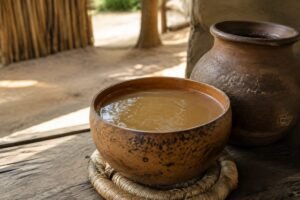
Chibuku is a wine & spirit from Botswana: opaque commercial sorghum beer sold by the carton, shaken before pouring. An industrial version of village brew produced across Southern Africa since the 1950s and drunk in Botswana’s shebeens and bottle stores.
How long does Chibuku take to make?
Chibuku takes 40 min of preparation and 2 days souring plus 1 to 2 days fermenting of cooking. The recipe makes 5 litres. It is rated medium to make.
What can I substitute in Chibuku?
Yes, within limits. No sorghum malt: sprout whole sorghum or finger millet yourself for 3 days, dry it and grind it. Failing that, malted barley converts the starch but gives a cleaner, less earthy beer that Zambians would not recognise.
What is the most important thing to get right in Chibuku?
Cover with a cloth, never a sealed lid, and ferment at room temperature for 24 to 48 hours. It will froth, hiss and smell of sour bread; taste it at 24 hours and stop when it is tart with a light alcoholic bite, around 3 to 4 per cent.