
Ingredients
Shells
- 600 ggood dark or milk couverture chocolate, minimum 32% cocoa butter
- polycarbonate praline moulds
Ganache
- 200 gdark chocolate, finely chopped
- 150 mldouble cream
- 30 gglucose syrup
- 40 gunsalted butter, softened
- 1 tbspliqueur (optional)
Praliné filling
- 100 ghazelnuts
- 100 gsugar
- 50 gmilk chocolate
Directions
- Melt two thirds to 45°C (115°F), then stir in the remaining third off the heat to bring it down to 27°C (80°F), then rewarm gently to 31°C (88°F) for dark or 30°C (86°F) for milk. Untempered chocolate sets soft and streaky, will not release from the mould and turns grey within days; tempered chocolate snaps, shines and shrinks slightly as it sets, which is what lets you unmould it at all.
- Fill each cavity with tempered chocolate, tap the mould firmly to release bubbles, then invert it over the bowl and let the excess run out, scraping the surface clean.
- Leave the shells to set 15 minutes. For the ganache, heat the cream and glucose to a simmer, pour over the chopped chocolate, wait 2 minutes, then stir from the centre outwards until smooth.
- Cool to 30°C (86°F) and beat in the soft butter and liqueur. Pipe the fillings into the shells, leaving 2 mm clear at the top, and rest 2 hours so a light skin forms.
- Warm the mould rim briefly, spread more tempered chocolate over to seal the bases, scrape clean, and chill 20 minutes. The pralines should drop out when the mould is inverted and tapped.
Technique
- Use couverture, not baking chocolate. The higher cocoa butter is what makes tempering and thin shells possible.
- Work in a cool room. Above about 22°C (72°F) tempered chocolate will not hold and everything becomes a fight.
- A shell that will not release has not crystallised. Chill it a little longer rather than forcing it.
Substitutions
- Silicone moulds are more forgiving but give a matt finish rather than the mirror shine.
- Callets or pistoles rather than a block, which melt more evenly.
Variations
- Manons, the cream-filled white chocolate praline.
- Gianduja, the hazelnut and chocolate paste filling.
History
Jean Neuhaus filled a hard chocolate shell in Brussels in 1912; his wife created the ballotin gift box three years later.
Frequently asked questions
What is Belgian pralines?
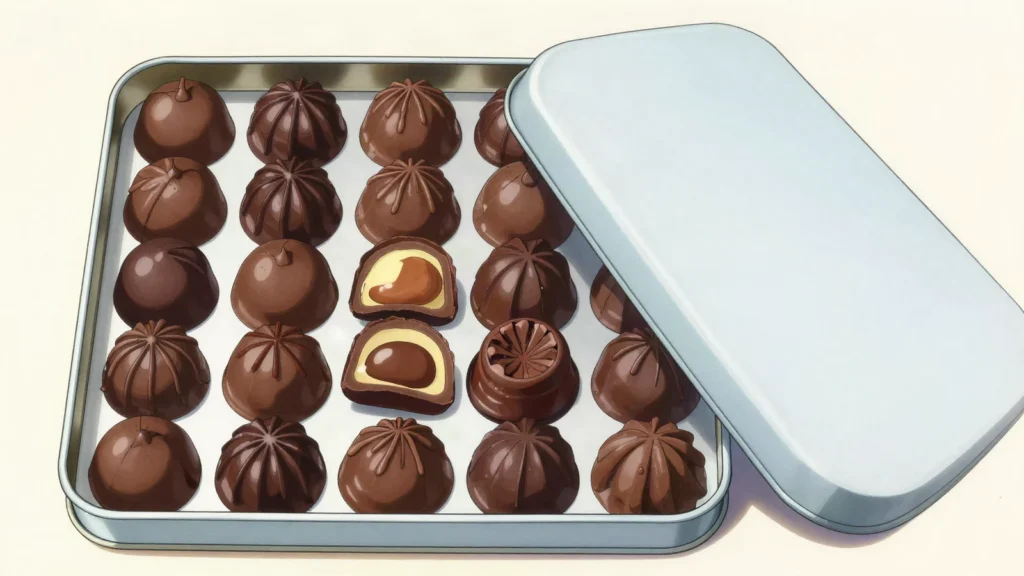
Belgian pralines is a dessert from Belgium: filled chocolates invented in Brussels; ganache and nougat centres. Jean Neuhaus filled a hard chocolate shell in Brussels in 1912; his wife created the ballotin gift box three years later.
How long does Belgian pralines take to make?
Belgian pralines takes 1 hr plus 2 hr setting of preparation and 20 min of cooking. The recipe makes about 40 pralines. It is rated hard to make.
What can I substitute in Belgian pralines?
Yes, within limits. Silicone moulds are more forgiving but give a matt finish rather than the mirror shine. Callets or pistoles rather than a block, which melt more evenly.
What is the most important thing to get right in Belgian pralines?
A shell that will not release has not crystallised. Chill it a little longer rather than forcing it.