
Ingredients
Cream
- 1 litrewhole milk
- 500 mldouble cream
- 2 tbspcornflour
- 2 tbspfine semolina
- 1 tbspsugar
- 2 tbsplemon juice
To perfume
- 1 tbsprose water
- 1 tbsporange blossom water
To serve
- chopped pistachios
- sugar syrup (attar)
- knafeh, or warm flatbread and honey
Directions
- Whisk the cornflour and semolina into 200 ml of the cold milk until completely smooth, with no lumps at all — lumps here will not disperse later.
- Bring the remaining milk, the cream and the sugar to a gentle simmer in a heavy pan, stirring so it does not catch.
- Pour in the cornflour slurry while whisking hard, and cook over low heat for 8 to 10 minutes, stirring constantly, until it thickens to the consistency of a loose custard.
- Take it off the heat and stir in the lemon juice. It will thicken and go very slightly grainy, which is what gives the traditional soft-curd texture rather than a smooth pastry cream.
- Cool for ten minutes, then stir in the rose water and orange blossom water. Adding them off the heat is essential: both are volatile and boiling drives the perfume straight out of the pan.
- Press clingfilm onto the surface and chill for at least four hours until thick and set.
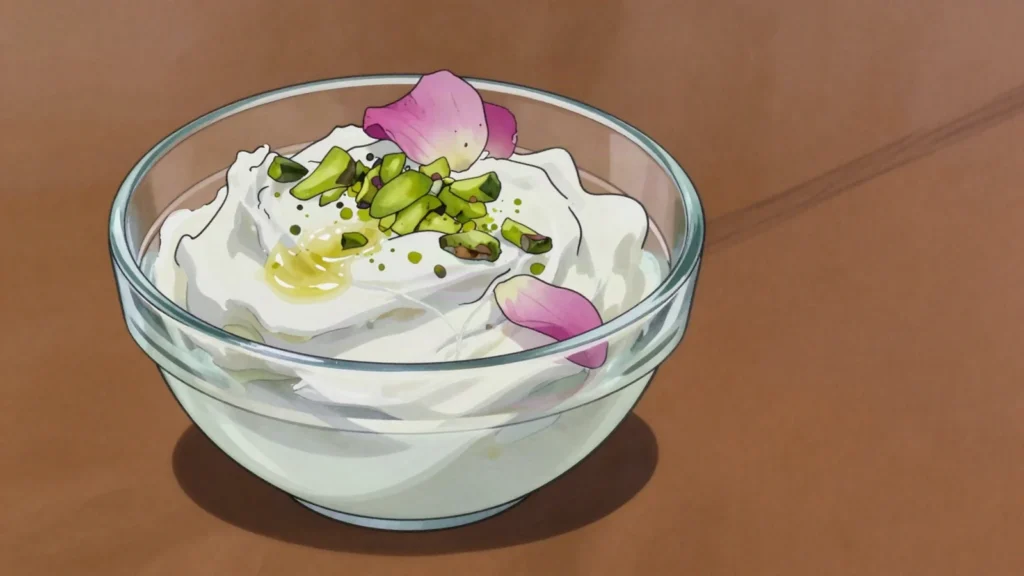
- Beat briefly to loosen before using. Serve topped with pistachios and a drizzle of syrup, or use it to fill knafeh, halawet el jibn and znoud el sit.
Technique
- Flower waters go in off the heat, always. This is the one step that ruins ashta and it happens silently.
- Go carefully with them — a tablespoon of each is plenty for this quantity, and too much tastes of soap.
- The traditional version skims the skin off scalded milk over several hours; this is the fast household method that Lebanese kitchens now use.
Substitutions
- Rice flour in place of cornflour, which gives a slightly softer set.
- White bread, crusts removed and blitzed, in place of the semolina — an old shortcut that works well.
- Skip the lemon juice for a smoother, more custard-like ashta.
Variations
- The skimmed version, made like kaymak from scalded milk, is richer and takes a day.
- Piped into atayef pancakes at Ramadan.
History
Scalded milk skimmed to a soft cream; the filling for knafeh, halawet el jibn and znoud el sit.
Frequently asked questions
What is Ashta?
Ashta is a cheese & dairy from Lebanon: thick clotted cream perfumed with rose and orange blossom. Scalded milk skimmed to a soft cream; the filling for knafeh, halawet el jibn and znoud el sit.
How long does Ashta take to make?
Ashta takes 15 min plus 4 hours chilling of preparation and 20 min of cooking. The recipe makes makes about 500 g. It is rated easy to make.
What can I substitute in Ashta?
Yes, within limits. Rice flour in place of cornflour, which gives a slightly softer set. White bread, crusts removed and blitzed, in place of the semolina — an old shortcut that works well. Skip the lemon juice for a smoother, more custard-like ashta.
What is the most important thing to get right in Ashta?
Take it off the heat and stir in the lemon juice. It will thicken and go very slightly grainy, which is what gives the traditional soft-curd texture rather than a smooth pastry cream.