
Ingredients
Milk
- 20 litresraw whole ewe’s milk, from Lacaune ewes, unhomogenised
Cultures
- ¼ tspmesophilic starter culture
- ⅛ tspPenicillium roqueforti spores, traditionally grown on rye loaves left to mould in the caves
Coagulant
- 2 mlliquid rennet, diluted in 100 ml cool unchlorinated water
Salt and equipment
- dry sea salt, about 3–4 percent of the cheese’s weight
- 2tall hoops 20 cm across
- draining mats, a long steel needle, oak shelves and foil
Directions
- Warm the ewe’s milk to 29–31°C (85–90°F). It carries around twice the fat and solids of cow’s milk, which is why this cheese ripens to such intensity.
- Add the starter and the P. roqueforti spores, stir gently through the milk, and ripen for 60 minutes.
- Stir in the diluted rennet, then leave the milk absolutely still, covered, for 60–90 minutes until it gives a clean break.
- Cut the curd to hazelnut size and stir gently for 20–30 minutes so the grains firm up and the whey runs. The curd is never heated; it stays at ambient temperature throughout.
- Drain the whey, then ladle the curd loosely into the hoops without any pressing, layering it so air pockets remain. Those pockets are where the blue will later grow, and pressed curd never blues properly.
- Drain at 18–20°C (65–70°F) for three to five days, turning several times a day and letting the cheese knit under its own weight alone. No press is used at any stage.
- Turn out and dry-salt the surface by hand over several days at about 3–4 percent of the weight, until it has all been taken up.
- After roughly a week, pierce each cheese 30–40 times right through with a long needle. Air travelling down those channels is what wakes the dormant mould.
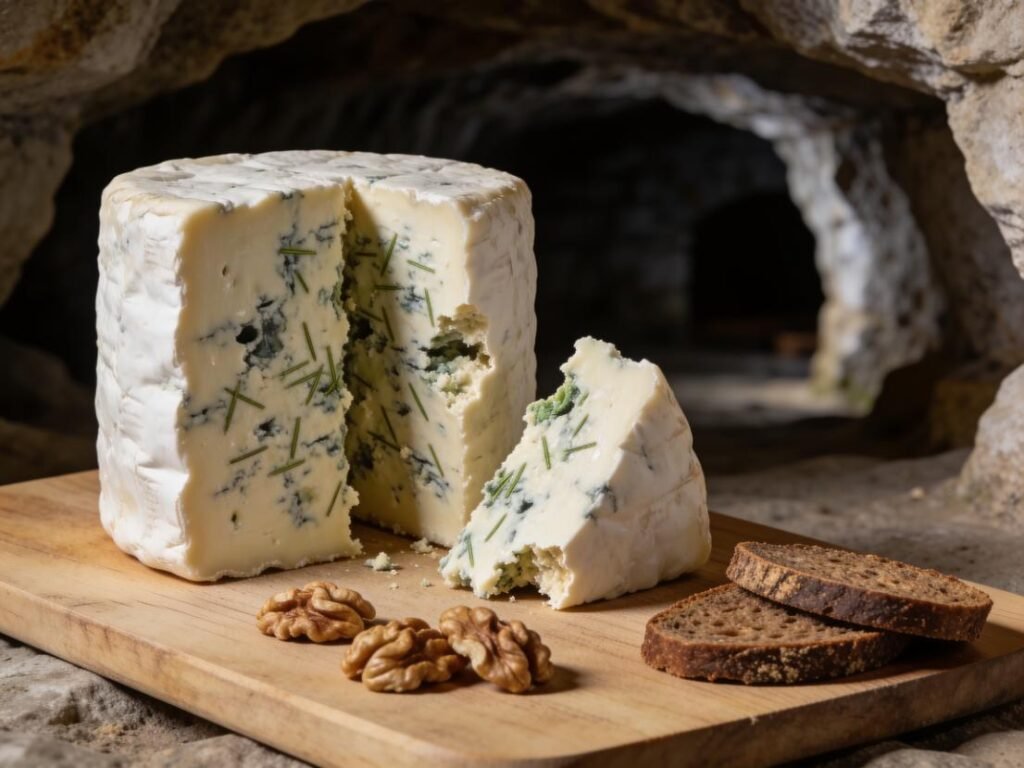
- Ripen on oak shelves in a cold damp cellar at 8–10C and 95 percent humidity. In Roquefort-sur-Soulzon that means the Combalou caves, where natural fissures called fleurines draw a constant cool draught through the collapsed rock. Blue veins appear within two to three weeks.
- After the legal minimum 14 days in the cave, wrap in foil to cut off the air and halt the mould, then hold at 4–6C. The minimum total age is 90 days and most is sold at four to five months. Serve at room temperature with walnuts and dark bread.
Technique
- Roquefort AOP must be made from raw Lacaune ewe’s milk and ripened in the Combalou caves. Nothing made elsewhere may carry the name, and the fleurines are the reason the caves work at all.
- The mould is classically cultivated on rye loaves left to grow blue in the caves, then dried and powdered, a practice several producers still keep.
- Never press the curd. The whole cheese depends on an open, crumbly interior, and the needle piercing that follows only works if air can actually travel.
- Food safety: raw-milk blue cheese is not for pregnant women or the immunocompromised, and the make must be scrupulously clean, since an open curd welcomes unwanted moulds as readily as the wanted one.
Substitutions
- Ewe’s milk is essential to the character; cow’s milk gives something closer to Bleu d’Auvergne, sharper and less buttery.
- Microbial rennet can replace traditional rennet at the same dose, setting a slightly softer curd.
Variations
- Bleu des Causses, the cow’s-milk cheese of the same region, ripened in comparable caves.
- Bleu de Brebis, made outside the AOP zone from ewe’s milk, similar in style but not in name.
History
Charles VI granted the caves of Roquefort-sur-Soulzon a monopoly in 1411, and it became France’s first appellation cheese in 1925.
Frequently asked questions
What is Roquefort?
Roquefort is a cheese & dairy from France: sharp blue ewe’s milk cheese ripened in limestone caves, eaten with walnuts. Charles VI granted the caves of Roquefort-sur-Soulzon a monopoly in 1411, and it became France’s first appellation cheese in 1925.
How long does Roquefort take to make?
Roquefort takes 1 hr 30 min over 2 days of preparation and 3–5 months ripening of cooking. The recipe makes 2 cheeses of about 1.2 kg. It is rated hard to make.
What can I substitute in Roquefort?
Yes, within limits. Ewe’s milk is essential to the character; cow’s milk gives something closer to Bleu d’Auvergne, sharper and less buttery. Microbial rennet can replace traditional rennet at the same dose, setting a slightly softer curd.
What is the most important thing to get right in Roquefort?
Warm the ewe’s milk to 29–31°C (85–90°F). It carries around twice the fat and solids of cow’s milk, which is why this cheese ripens to such intensity.