
Ingredients
Yoghurt
- 700 gfull-fat Greek yoghurt, or strained sheep’s milk yoghurt
Cucumber
- 1large cucumber
- 1 tspsalt
Flavour
- 3to 4 cloves garlic
- 2 tbspolive oil
- 1 tbspred wine vinegar or lemon juice
- 1 tbspchopped dill or mint
- salt and white pepper
To finish
- olive oil
- a few olives
- a sprig of dill
To serve
- with pitta, with grilled meat, as part of a meze
Directions
- Use full-fat yoghurt and strain it further. Line a sieve with muslin, tip the yoghurt in, and leave it over a bowl in the fridge for at least 4 hours.
- Strain it properly even if it is already thick. Greek yoghurt from a supermarket still releases a surprising amount of whey, and unstrained tzatziki goes watery within an hour.
- Grate the cucumber coarsely, or dice it very finely. Toss the grated cucumber with a teaspoon of salt and leave it in a sieve for 20 to 30 minutes. Squeeze it genuinely dry and be astonished by how much comes out.
- Crush it to a paste with a little salt rather than chopping it. Greek tzatziki is properly garlicky and it should be noticeable, and it strengthens considerably as it sits.
- Start with three cloves and remember it will get stronger. It is stirred through and it gives the richness and the smooth mouthfeel, and a good deal of it goes in. Add the vinegar or lemon, which sharpens it and keeps it from tasting flat. Use one or the other rather than both, and use it generously.
- Season with salt and white pepper. White pepper rather than black, which keeps the dip clean and white. Taste it again after chilling and adjust, since the salt and garlic will both have changed.
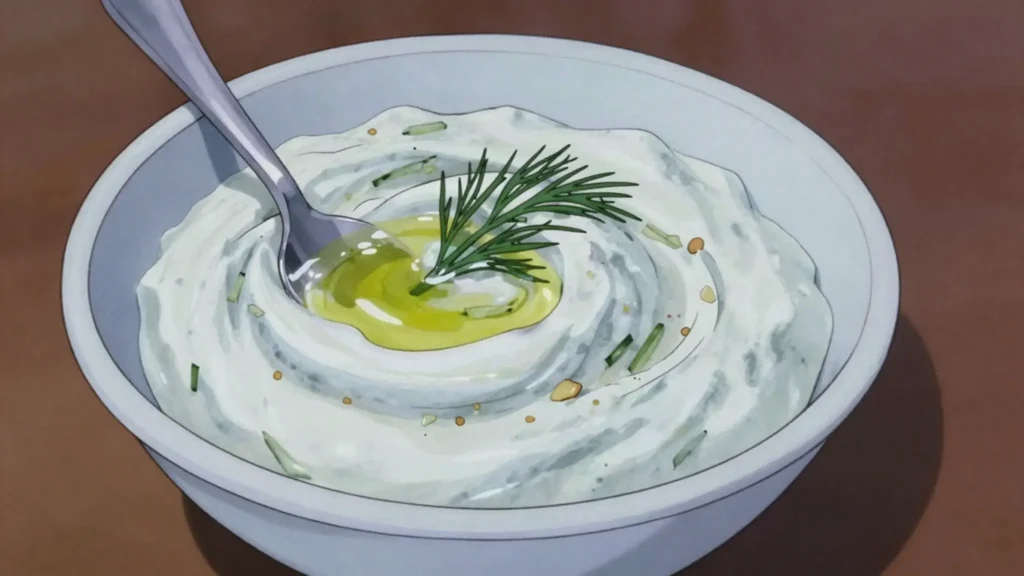
- Serve it cold in a shallow bowl with a pool of olive oil on top and a few olives. It keeps two days refrigerated, though it loosens slightly and the garlic grows stronger. Pour off any liquid that separates rather than stirring it back in.
Technique
- Cacık, mast-o-khiar and snezhanka are the regional relatives.
- Sheep’s milk yoghurt is traditional and is richer than cow’s.
- The garlic strengthens considerably as it sits.
Substitutions
- Thick Greek yoghurt, strained further.
- Mint in place of dill.
Variations
- Cacık, thinned with water and eaten with a spoon.
- Mast-o-khiar, with walnuts and raisins.
- With mint rather than dill.
History
A yoghurt, cucumber and garlic dip whose core technique, straining yoghurt and mixing it with a savory ingredient, traces back through Ottoman and earlier Persian and Central Asian dairy traditions, arriving in Greek cooking through centuries of Ottoman rule over the region. The Turkish cacık and Greek tzatziki remain close cousins with essentially the same ingredients, differing mainly in whether it’s served as a dip or thinned into a cold soup, and both likely descend from the same older regional dairy practice rather than one inventing it for the other. Fresh dill or mint, garlic and olive oil are the main points of local variation, and the dish’s cooling effect made it a natural pairing for the region’s grilled and spiced meats.
Frequently asked questions
What is Tzatziki?
Tzatziki is a sauce & condiment from Greece: strained yoghurt, cucumber and garlic dip. A yoghurt, cucumber and garlic dip whose core technique, straining yoghurt and mixing it with a savory ingredient, traces back through Ottoman and earlier Persian and Central Asian dairy traditions, arriving in Greek cooking through centuries of Ottoman rule over the region. The Turkish cacık and Greek tzatziki remain close cousins with essentially the same ingredients, differing mainly in whether it’s served as a dip or thinned into a cold soup, and both likely descend from the same older regional dairy practice rather than one inventing it for the other. Fresh dill or mint, garlic and olive oil are the main points of local variation, and the dish’s cooling effect made it a natural pairing for the region’s grilled and spiced meats.
How long does Tzatziki take to make?
Tzatziki takes 20 min plus 4 hr straining of preparation and no cooking at all. The recipe makes about 500 g. It is rated easy to make.
What can I substitute in Tzatziki?
Yes, within limits. Thick Greek yoghurt, strained further. Mint in place of dill.
What is the most important thing to get right in Tzatziki?
Crush it to a paste with a little salt rather than chopping it. Greek tzatziki is properly garlicky and it should be noticeable, and it strengthens considerably as it sits.