Ingredients
Dough
- 1 kgstrong white flour
- 14 gdried yeast
- 150 gsugar
- 2 tspsalt
- 400 mlwarm milk
- 150 mlwarm water
- 100 gbutter or margarine, softened
- 2eggs
- 1 tspgrated nutmeg
To finish
- melted butter or evaporated milk, for brushing
To serve
- torn open, with margarine, fried eggs, or Milo
- with tea, at breakfast
Directions
- Butter bread is enriched with a great deal of butter and has a tighter, richer crumb. Tea bread sits between them: lightly sweet, soft, with a fine even crumb and a thin pale crust. Use warm milk rather than cold, since cold liquid slows the yeast considerably. Grate it fresh, since pre-ground nutmeg loses most of its aroma within weeks. Now proving the yeast in warm water.
- Use liquid at body temperature, since anything above about fifty degrees kills the yeast outright. Mix the flour, remaining sugar, salt and nutmeg, then work in the yeast mixture, milk and eggs.
- Add the softened butter only after the dough has come together and been kneaded a few minutes. Now knead it thoroughly, for a full ten to twelve minutes. Knead it longer than you think necessary, since a soft pillowy crumb depends entirely on well developed gluten. It should become smooth, elastic and slightly tacky rather than sticky.
- Cover the dough and let it rise until doubled, which takes an hour to an hour and a half in a warm kitchen. Ghana’s climate does this quickly and a cool kitchen will need considerably longer. Press the air out gently and divide the dough between two greased loaf tins. Roll each portion into a tight smooth ball, seam side down, and set them touching in the tin.
- Cover and let them rise until the dough has risen well above the rim of the tin. Press it gently with a fingertip: the dent should spring back slowly rather than immediately. Now bake at 180°C for thirty to thirty-five minutes.
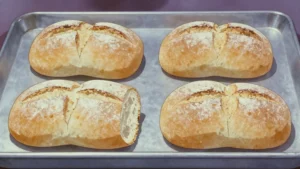
- Bake at a moderate temperature rather than high, since a high oven gives a thick dark crust which is not what this bread wants. The loaf should be pale golden rather than deep brown.
- Cover it loosely with foil if it colours too fast. It is done when it sounds hollow tapped underneath. Brush the top generously with melted butter or evaporated milk the moment it comes out. Now cool it in the tin for ten minutes before turning it out.
Technique
- It is not a fruited British teacake; the name means bread for tea.
- Sugar bread and butter bread are the two related Ghanaian loaves.
- The three-ball shaping is what lets it be torn rather than sliced.
Substitutions
- Margarine in place of butter, which is what most bakeries use.
- Evaporated milk diluted with water, in place of fresh milk.
Variations
- Sugar bread, sweeter and softer.
- Butter bread, richer with a tighter crumb.
- Made as small rolls rather than loaves.
Frequently asked questions
What is Tea bread?
Tea bread is a bread & pastry from Ghana: soft, faintly sweet white loaf torn open for tea, eggs or margarine.
How long does Tea bread take to make?
Tea bread takes 30 min plus 2 hr rising of preparation and 35 min of cooking. The recipe makes 2 loaves. It is rated medium to make.
What can I substitute in Tea bread?
Yes, within limits. Margarine in place of butter, which is what most bakeries use. Evaporated milk diluted with water, in place of fresh milk.
What is the most important thing to get right in Tea bread?
Butter bread is enriched with a great deal of butter and has a tighter, richer crumb. Tea bread sits between them: lightly sweet, soft, with a fine even crumb and a thin pale crust. Use warm milk rather than cold, since cold liquid slows the yeast considerably. Grate it fresh, since pre-ground nutmeg loses most of its aroma within weeks. Now proving the yeast in warm water.