
Ingredients
Cucumbers
- 2 kgsmall pickling cucumbers, firm and unwaxed
Brine
- 2 litreswater
- 100 gcoarse non-iodised salt — 5% of the water’s weight
Aromatics
- 1large bunch dill with flower crowns
- 1 piecehorseradish root, peeled and sliced
- 8blackcurrant or cherry leaves
- 6oak or grape leaves
- 1 headgarlic, cloves peeled
- 2 tbspmustard seed
- 1 tbspblack peppercorns
- 2onions, sliced
Directions
- Soak the cucumbers in ice-cold water for four hours. This firms them and is the first of the three things that keep them crisp.
- Trim a sliver off the blossom end of each. That end carries an enzyme that softens the whole jar, and it is the second.
- Dissolve the salt completely in the water. Weigh it: 5% is what protects the jar in the days before the acidity builds.
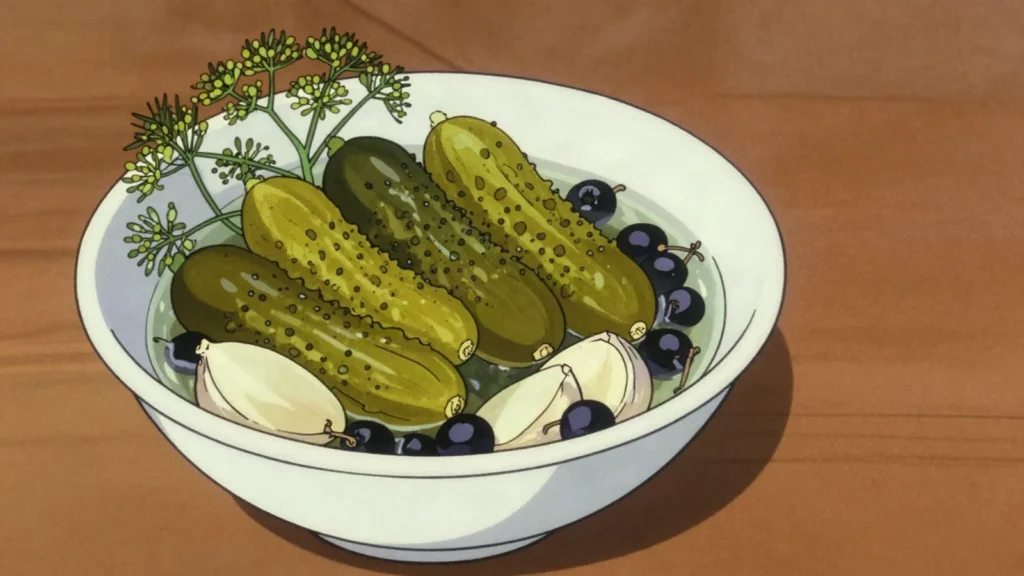
- Line the jar with half the dill, horseradish and leaves, pack the cucumbers upright, and tuck the garlic, onion, mustard seed, peppercorns and the remaining aromatics among them.
- The leaves are the third crispness measure — their tannins inhibit the enzymes that soften a pickle, and horseradish does the same job. Together with the cold soak and the trimmed ends they are why Spreewald gherkins are known for their snap.
- Pour over the brine so everything sits 3 cm below the surface and weight it down.
- Cover loosely and ferment at cool room temperature for one to two weeks, skimming any white film off the surface.
- They are ready when sour all the way through and olive rather than bright green inside. Move somewhere cold, where they keep for months.
Technique
- Cold soak, trimmed ends, tannin leaves. All three, every time.
- Everything below the brine. Anything that floats will mould.
- The PGI belongs to cucumbers actually grown and pickled in the Spreewald; this is the method, not the protected product.
Substitutions
- Grape, oak or horseradish leaves interchangeably — any of them supply the tannins.
- A splash of brine from a working jar to start it faster.
Variations
- A vinegar version, Gewürzgurken, is sweeter and keeps longer but lacks the sour depth.
- Senfgurken use the same brine tradition on peeled, deseeded overgrown cucumbers.
History
Grown and pickled in the Spreewald wetlands south of Berlin; Spreewälder Gurken won PGI protection in 1999 and became an eastern German icon.
Frequently asked questions
What is Spreewald gherkins?
Spreewald gherkins is a fermented & pickled from Germany: crisp brined cucumbers with dill and horseradish, eaten straight from the jar. Grown and pickled in the Spreewald wetlands south of Berlin; Spreewälder Gurken won PGI protection in 1999 and became an eastern German icon.
How long does Spreewald gherkins take to make?
Spreewald gherkins takes 40 min plus 1 to 2 weeks fermenting of preparation and no cooking at all. The recipe makes fills a 3-litre jar. It is rated easy to make.
What can I substitute in Spreewald gherkins?
Yes, within limits. Grape, oak or horseradish leaves interchangeably — any of them supply the tannins. A splash of brine from a working jar to start it faster.
What is the most important thing to get right in Spreewald gherkins?
Trim a sliver off the blossom end of each. That end carries an enzyme that softens the whole jar, and it is the second.