The cool, watery, faintly grassy fruit eaten raw across the world — in salads, in yoghurt, with rice, in sandwiches — and pickled in brine or vinegar into one of the oldest preserved foods.
Where it comes from
The cucumber was domesticated in India three thousand years ago and reached Greece, Rome and China in antiquity; the Romans grew it under glass for the emperor Tiberius, who wanted it daily. It travelled with the Arabs and the Spanish, and became the raw vegetable of hot climates everywhere — in Persian and Turkish yoghurt dishes, Indian raita, Greek tzatziki, Chinese smashed cucumber and the Japanese sunomono — because it cools and because it needs no cooking.
Pickling cucumbers may be older than eating them fresh. The small, thick-skinned pickling varieties are fermented in salt brine with dill and garlic across Eastern Europe, the Jewish diaspora and Russia, or put up in sweetened vinegar as gherkins and bread-and-butter pickles. The long, thin-skinned salad cucumber, mostly water and bred to be seedless, is the one in Western shops.
Varieties
- English (hothouse) cucumber — Long, slim, thin-skinned, nearly seedless, often sold wrapped. Mild and watery; the salad cucumber.
- Persian and Lebanese cucumber — Short, thin-skinned, crisp and sweet, with tiny seeds. The best raw cucumber and the one for tzatziki and Middle Eastern salads.
- Kirby / pickling cucumber — Short, knobbly, thick-skinned, dense-fleshed. For fermented dill pickles and gherkins.
- Japanese (kyuri) — Slim, ridged, dark, crisp with almost no seeds; for sunomono and sushi.
- Armenian cucumber — Long, pale, ridged — actually a melon; crisp and mild, eaten with the skin.
- Ridge (outdoor) cucumber — Shorter, spiny, thicker-skinned than hothouse; more flavour.
In the kitchen
Salt it first. Sliced or diced cucumber tossed with salt and left to drain for twenty minutes loses much of its water and gains crispness and flavour — essential before it goes into yoghurt, or a dressing turns to soup. Smashing it with the flat of a knife, the Chinese way, opens the flesh to soak up a dressing of garlic, vinegar and sesame oil.
Cucumber pairs with yoghurt, dill, mint, garlic, vinegar, sesame and chilli. It is almost never cooked in Western kitchens but is braised or stir-fried in China, and the old English recipes for stewed cucumber are worth reviving.
Choosing and keeping
Firm all along, with no soft or yellow patches, and heavy for its size. Small is better than large: big cucumbers are watery and seedy. Thin-skinned kinds keep a few days; thick-skinned pickling kinds a week or more. Keep them in the fridge but not the coldest part.
Peeling is a matter of variety — thin-skinned cucumbers need none, thick waxed ones do. The seeds of a large cucumber are watery and bitter and are scooped out with a spoon.
Dishes with cucumber
 VampiroTequila lengthened with spiced tomato sangrita and grapefruit soda, chile-salt rim
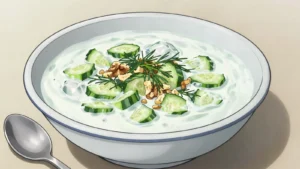 Taratorcold yoghurt soup with cucumber, dill, walnuts
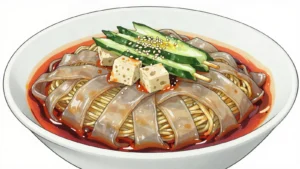 LiangpiCold wheat-starch noodles dressed with chilli oil, vinegar and garlic water.
 OlímpicoTriple-decker toasted sandwich with ham, cheese, egg, lettuce and tomato
 Cigánska pečienkaGrilled pork steak in bread with mustard, onion and horseradish
 Okssusu GuksuChewy corn noodles in cold or hot broth, a mountain-province staple
 Kvashanyya agurkiCucumbers fermented in brine with dill, horseradish and oak leaves.
 Micicaseless grilled sausages of mixed meats, garlic; with mustard
Cucumber is tagged on 209 dishes from 95 countries in the atlas. These notes are written from general knowledge and carry no per-fact citation — see About.