
Ingredients
Cheese
- 800 gNabulsi cheese, sliced 1 cm thick and soaked in several changes of cold water for 2–4 hr to draw out the salt
- 200 gfresh akkawi or low-moisture mozzarella, to help the stretch (optional)
Knafeh na’ameh (fine crust)
- 400 gfine semolina, or 400 g kataifi pastry shredded very fine in a food processor for the khishneh style
- 150 gghee, melted
- ½ tsporange-red natural food colouring, or 1 tsp ground annatto steeped in 2 tbsp hot water
- 2 tbspfine breadcrumbs (optional, for the base)
Syrup (attar)
- 400 gsugar
- 250 mlwater
- 1 tbsplemon juice
- 2 tbsporange blossom water
- 1 tsprosewater
To finish
- 80 gpistachios, ground to a coarse green rubble
- extra ghee, for the tray
Directions
- Make the syrup first so it can cool: boil the sugar and water 8–10 minutes until it coats a spoon lightly, add the lemon juice, then take off the heat and stir in the orange blossom and rosewater. It should be thin enough to pour, not sticky.
- Soak the sliced Nabulsi in cold water, changing it every 45 minutes, until a nibbled corner tastes only faintly salty. Drain hard, pat dry and either grate coarsely or slice thin.
- Rub the melted ghee into the semolina with your fingertips until every grain is coated and the mixture feels like damp sand, then work in the colouring so it turns a uniform sunset orange.
- Brush a 30 cm shallow round tray – a copper sidr if you have one – generously with ghee and dust with breadcrumbs.
- Press two-thirds of the semolina mixture firmly and evenly over the base and 2 cm up the sides, packing it down hard with the back of a spoon so it will hold together when flipped.
- Spread the drained cheese in an even layer, leaving a 1 cm margin, then cover with the remaining semolina and press again.
- Bake at 200°C (400°F) for 30–35 minutes, until the edges bubble, the crust smells toasted and a knife slid down the side shows a deep russet-brown base. In Nablus the tray is cooked over direct flame on a rotating burner.
- Take it out and immediately pour the cooled syrup evenly over the hot knafeh – hot pastry, cool syrup, always this way round, or the crust goes soggy. Listen for the hiss.
- Rest 3 minutes, then run a knife round the edge, lay a larger tray on top and flip the whole thing over in one confident movement so the crisp orange base becomes the top.
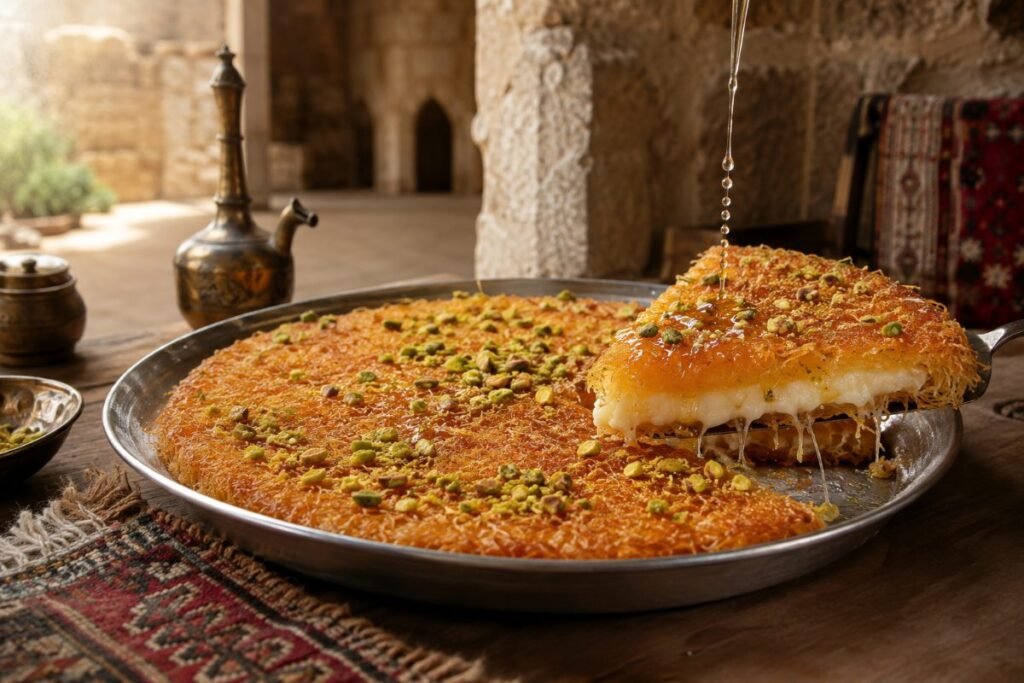
- Scatter thickly with ground pistachio and serve immediately, cut in squares or wedges, while the cheese still pulls in long strings.
Technique
- Knafeh must be eaten hot. The whole dish depends on the cheese being molten and stretchy – reheated knafeh is a different and much sadder food.
- Desalting the Nabulsi is the step people skip and regret. Under-soaked cheese makes the dessert inedibly salty; over-soaked cheese loses its stretch, so taste as you go.
- Nablus is the acknowledged home of knafeh na’ameh, the fine semolina-crust version. The coarse shredded-pastry version, khishneh, is what most of the rest of the region makes.
Substitutions
- No Nabulsi? Use fresh akkawi soaked the same way, or a mixture of low-moisture mozzarella and ricotta – the flavour is blander but the stretch is right.
- Kataifi pastry, blitzed briefly, gives the khishneh crust and is far easier to find outside the Levant.
Variations
- Knafeh na’ameh, the smooth-crust Nablus original.
- Knafeh khishneh, made with shredded kataifi for a rougher, crunchier top.
- Knafeh with ashta cream instead of cheese, served in Lebanon and Syria.
History
Amman’s Habibah sweet shop, open since 1951, made the syrup-drenched Nabulsi style a national habit.
Frequently asked questions
What is Knafeh?
Knafeh is a dessert from Jordan: syrupy cheese pastry with crunchy topping, sold by the slab. Amman’s Habibah sweet shop, open since 1951, made the syrup-drenched Nabulsi style a national habit.
How long does Knafeh take to make?
Knafeh takes 30 min of preparation and 35 min of cooking. The recipe makes 10 servings (one 30 cm round tray). It is rated medium to make.
What can I substitute in Knafeh?
Yes, within limits. No Nabulsi? Use fresh akkawi soaked the same way, or a mixture of low-moisture mozzarella and ricotta – the flavour is blander but the stretch is right. Kataifi pastry, blitzed briefly, gives the khishneh crust and is far easier to find outside the Levant.
What is the most important thing to get right in Knafeh?
Rest 3 minutes, then run a knife round the edge, lay a larger tray on top and flip the whole thing over in one confident movement so the crisp orange base becomes the top.