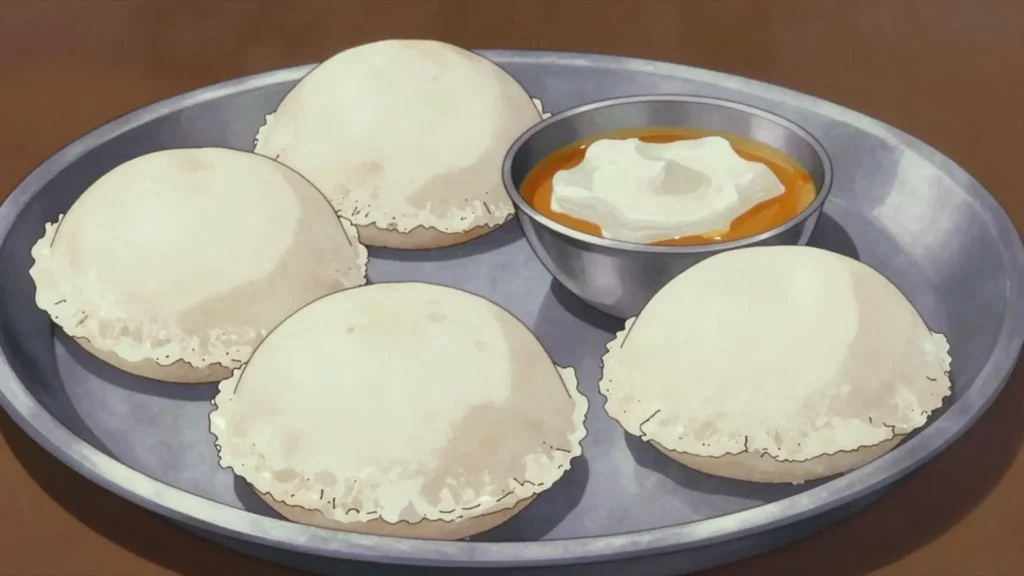

Ingredients
Batter
- 300 gidli rice
- 100 gurad dal
- 1 tspfenugreek seed
- 100 gthick poha
- 1 tspnon-iodised salt
- water
To serve
- sambar
- coconut chutney
- podi with ghee
Directions
- Wash and soak the rice with the poha in one bowl, and the urad dal with the fenugreek in another, for 5 to 6 hours.
- Soak them separately and grind them separately. Urad dal has to be whipped light and airy while rice is ground to a fine grit, and the two cannot be done together.
- Grind the urad dal first, adding ice-cold water a little at a time, until it is white, fluffy and doubled in volume.
- Cold water and a slow grind. The dal has to trap air, and that trapped air plus the fermentation is what makes an idli spongy rather than dense.
- Test it by dropping a little into water: properly ground dal floats.
- Grind the rice to a fine but slightly grainy paste, about the texture of fine semolina rather than silk.
- Combine the two batters in a large vessel and mix them together with your hand for a couple of minutes.
- Mix with your hand rather than a spoon. It is the standard South Indian instruction, and the warmth and wild yeasts on the skin are widely held to help the ferment start.
- Add the salt and leave the batter covered in a warm place for 8 to 12 hours.
- Use non-iodised salt and leave real headroom in the vessel, because the batter doubles and will climb out of a full one.
- It is ready when it has risen, smells pleasantly sour and is full of bubbles.
- In a cold kitchen it can take 16 hours or more, in a warm one only 6. Judge it by the rise and the smell and never by the clock.
- Stir the risen batter only gently, or you knock out the gas you have spent all night waiting for.
- Grease the idli plates, fill each mould about three quarters full, and steam over boiling water for 10 to 12 minutes.
- Test with a skewer, which should come out clean, then let them stand 2 minutes before turning them out with a wet spoon.
- Rest them briefly. Idlis lifted immediately tear apart, and after a couple of minutes they release cleanly.
- Serve hot with sambar, coconut chutney and podi.
- Idli-like dishes appear in Kannada writing by around 920 CE, and the historian K. T. Achaya argued for an Indonesian link in the steaming technique.
Technique
- Roughly three parts rice to one part dal by volume is the standard ratio and it is worth measuring.
- Leftover batter makes dosa the next day and is better for the extra sourness.
- Idli rice, a short parboiled grain, is worth seeking out over ordinary rice.
Substitutions
- Idli rava, coarse rice semolina, in place of ground rice.
- A wet grinder rather than a blender, which is better though not essential.
Variations
- Rava idli, made with semolina and no fermentation at all.
- Kanchipuram idli, spiced with pepper and cumin.
- Podi idli, tossed in spice powder and ghee.
History
A steamed, fermented rice-and-lentil cake, whose fermentation process, soaking and grinding rice and urad dal together before letting the batter sit overnight to rise naturally, is considered one of the older and more technically distinct fermentation traditions in South Asian cooking. Some food historians trace idli’s specific development to South India, with early written references appearing by around the 900s to 1000s, though whether the technique originated independently there or arrived through earlier trade contact with Indonesia, where a related steamed rice cake tradition exists, is genuinely debated. Naturally low in fat and gentle on digestion, idli became closely associated with South Indian breakfast culture specifically, typically served with a lentil-and-vegetable stew called sambar and a coconut-based chutney.
Frequently asked questions
What is Idli?
Idli is a breakfast from India: steamed fermented rice cakes with sambar and coconut chutney. A steamed, fermented rice-and-lentil cake, whose fermentation process, soaking and grinding rice and urad dal together before letting the batter sit overnight to rise naturally, is considered one of the older and more technically distinct fermentation traditions in South Asian cooking. Some food historians trace idli’s specific development to South India, with early written references appearing by around the 900s to 1000s, though whether the technique originated independently there or arrived through earlier trade contact with Indonesia, where a related steamed rice cake tradition exists, is genuinely debated. Naturally low in fat and gentle on digestion, idli became closely associated with South Indian breakfast culture specifically, typically served with a lentil-and-vegetable stew called sambar and a coconut-based chutney.
How long does Idli take to make?
Idli takes 30 min plus 6 hr soaking and 12 hr fermenting of preparation and 12 min of cooking. The recipe makes about 24. It is rated medium to make.
What can I substitute in Idli?
Yes, within limits. Idli rava, coarse rice semolina, in place of ground rice. A wet grinder rather than a blender, which is better though not essential.
What is the most important thing to get right in Idli?
Cold water and a slow grind. The dal has to trap air, and that trapped air plus the fermentation is what makes an idli spongy rather than dense.