
Ingredients
Yoghurt
- 1 litrewhole milk, ideally sheep’s or full-fat cow’s
- 3 tbsplive plain yoghurt, as starter
To serve
- Greek honey
- walnuts
- or as tzatziki, with cucumber, garlic and dill
Directions
- Heat the milk to 85°C (185°F) and hold it there for 10 minutes, stirring occasionally. This denatures the whey proteins so they set into the curd instead of draining away, and it is what makes the difference between thick yoghurt and thin.
- Cool to 45°C (113°F) — warm on the wrist, not hot. Above 46°C (115°F) the culture dies.
- Loosen the starter with a ladle of the warm milk, stir it back through, then pour into a bowl, cover and wrap in a towel. Leave undisturbed somewhere warm for 8 hours.
- It is ready when it has set firm and pulls cleanly from the side of the bowl. Chill it for four hours before straining — cold yoghurt strains far more cleanly than warm.
- Line a sieve with muslin, set it over a bowl, and tip in the chilled yoghurt. Refrigerate and let it drain for four hours for a thick spoonable yoghurt, or eight for something close to a cheese.
- Do not squeeze the cloth. Pressing forces solids through and gives a grainy, chalky result rather than a smooth one.
- Keep the whey — it is good in bread, in smoothies, or for cooking grains.
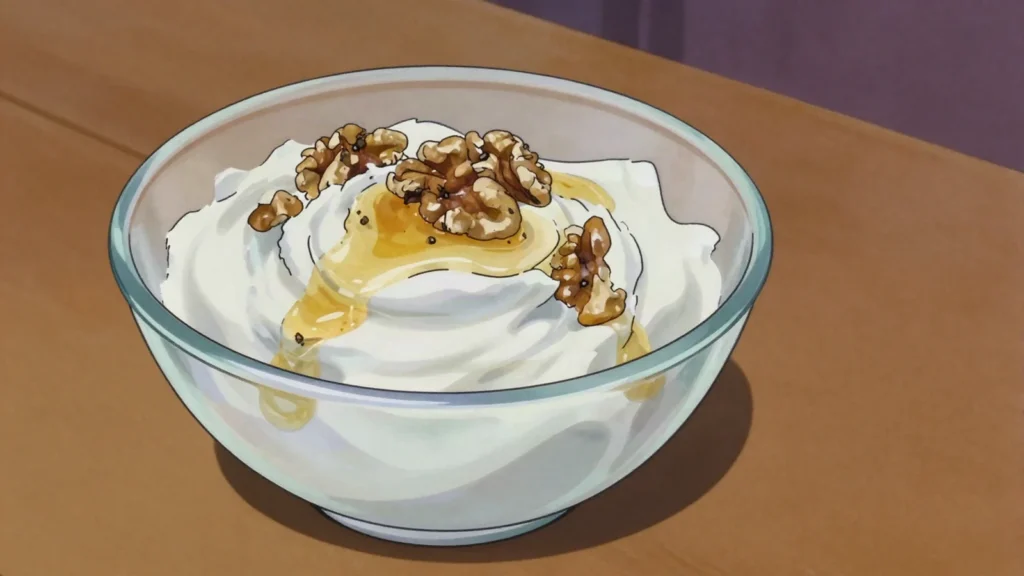
- Serve cold with honey and walnuts, or use it as the base for tzatziki.
Technique
- Strain cold, never warm. This is the single thing that decides whether it comes out silky or grainy.
- A litre of milk gives about 600 g of strained yoghurt and 400 ml of whey. That ratio surprises people the first time.
- Save three spoonfuls to start the next batch; the culture runs indefinitely.
Substitutions
- Sheep’s milk, which is what much traditional Greek yoghurt is made from and which is far richer.
- A coffee filter or a clean thin tea towel in place of muslin.
- Any live yoghurt as a starter.
Variations
- Strained eight hours or more it becomes a soft cheese for spreading on bread.
- Whisked with cold water, salt and mint it becomes a drink, close to Turkish ayran.
History
Straining removes the whey and thickens the yoghurt; Greek exports turned strained yoghurt into a global dairy category after the 2000s.
Frequently asked questions
What is Greek yogurt?
Greek yogurt is a cheese & dairy from Greece: strained yoghurt, thick and tart, eaten with honey and walnuts. Straining removes the whey and thickens the yoghurt; Greek exports turned strained yoghurt into a global dairy category after the 2000s.
How long does Greek yogurt take to make?
Greek yogurt takes 10 min plus 8 hours setting and 4 hours straining of preparation and 15 min of cooking. The recipe makes makes about 600 g from 1 litre. It is rated easy to make.
What can I substitute in Greek yogurt?
Yes, within limits. Sheep’s milk, which is what much traditional Greek yoghurt is made from and which is far richer. A coffee filter or a clean thin tea towel in place of muslin. Any live yoghurt as a starter.
What is the most important thing to get right in Greek yogurt?
Heat the milk to 85°C (185°F) and hold it there for 10 minutes, stirring occasionally. This denatures the whey proteins so they set into the curd instead of draining away, and it is what makes the difference between thick yoghurt and thin.