
Ingredients
Dough
- 500 gplain flour
- 2 tspbaking powder
- 1 tspsalt
- 1 tspsugar
- 300 mlwarm water
Layering
- 100 gghee or butter, softened
- 3 tbspplain flour, for dusting
To cook
- 100 mloil or ghee
Directions
- Mix the flour, baking powder, salt and sugar, then add the warm water gradually and bring it together into a soft dough. It should be noticeably softer and stickier than a bread dough.
- Knead for 5 minutes, oil the surface, cover it and rest for 30 minutes. That rest is what lets the dough stretch thin later without tearing.
- Divide into four and roll each piece into a large thin round about 30 cm across.
- Brush the surface generously with softened ghee and dust it with flour, spreading both right out to the edges.
- Cut a single straight line from the centre to the edge, then roll the round up on itself from that cut, working all the way around, so it forms a cone.
- Press the point down and tuck the base underneath to make a stubby cylinder, then stand it upright. This coil is what creates the layers, and it is the entire reason a paratha shreds instead of tearing into pieces.
- Rest the coils for another 30 minutes.
- Press each coil flat with your palm and roll it out gently to about 25 cm, working from the centre outward and never pressing hard enough to squash the layers back together.
- Heat a tawa or heavy flat pan over a medium heat, not high.
- Lay the roti on, cook for 1 minute, brush with oil, flip it, brush again, and cook for 1 to 2 minutes a side until pale brown spots appear and it puffs up in places.
- Take it off the heat and beat it immediately, either by clapping it between two wooden spatulas or by gathering it into a clean cloth and crushing it hard between your hands several times.
- It should collapse into soft ragged shreds. That is the burst-up shirt the name describes, and a roti that stays flat was cooked too long or on too high a heat.
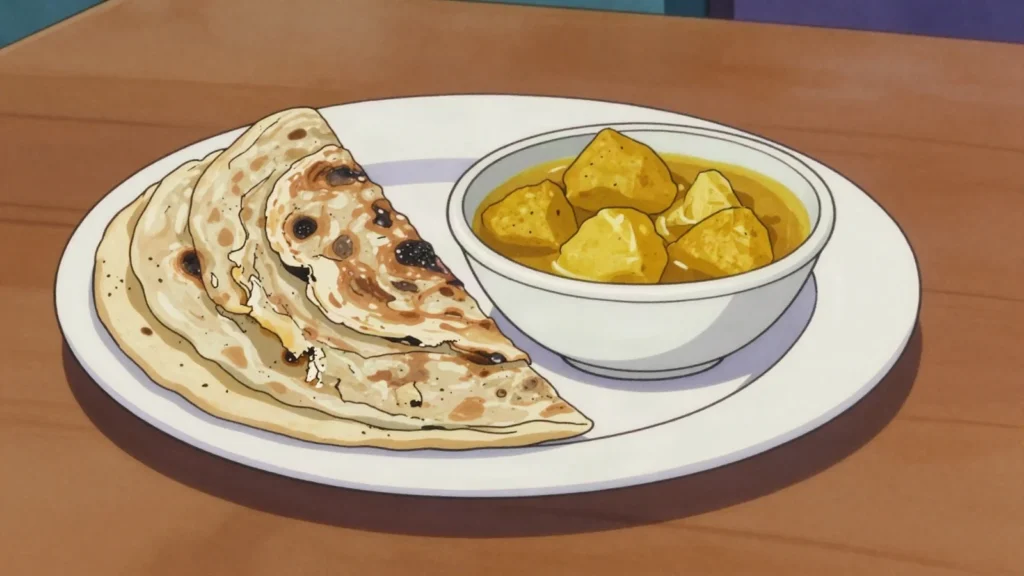
- Serve at once, torn by hand, with curry channa and aloo, curry goat or curry duck.
Technique
- Beat it while it is hot. Left to cool for even a couple of minutes it stiffens and will not shred.
- Medium heat throughout. High heat dries the layers and welds them together.
- The name is Trinidadian English for a burst-up shirt, which is exactly what a torn one looks like on the plate.
Substitutions
- Butter in place of ghee, which browns faster so watch the heat.
- Oil alone for a lighter roti, at some cost to the flavour.
Variations
- Dhalpuri, the same dough filled with seasoned ground split peas.
- Sada roti, plain and unlayered, made in minutes.
- Aloo puri, filled with spiced potato.
History
Paratha roti beaten until it falls into soft shreds, its name describing a burst-up shirt, served with curries.
Frequently asked questions
What is Buss up shut?
Buss up shut is a bread & pastry from Trinidad and Tobago: shredded ‘busted shirt’ paratha roti for mopping curries. Paratha roti beaten until it falls into soft shreds, its name describing a burst-up shirt, served with curries.
How long does Buss up shut take to make?
Buss up shut takes 30 min plus 1 hr resting of preparation and 20 min of cooking. The recipe makes 4 large roti. It is rated medium to make.
What can I substitute in Buss up shut?
Yes, within limits. Butter in place of ghee, which browns faster so watch the heat. Oil alone for a lighter roti, at some cost to the flavour.
What is the most important thing to get right in Buss up shut?
Press the point down and tuck the base underneath to make a stubby cylinder, then stand it upright. This coil is what creates the layers, and it is the entire reason a paratha shreds instead of tearing into pieces.