
Ingredients
Dough
- 500 gplain flour
- 2large eggs, beaten
- 7 gfast-action dried yeast
- 1 tspfine salt
- 1 tspcaster sugar
- 280 mlwarm water
Layering
- 300 gsamn (Yemeni clarified butter) or ghee, melted and kept warm
To finish
- 150 gSidr (doani) honey, warmed until pourable
- 2 tspnigella seeds (habbat al-baraka)
- 30 gextra samn for the hot pan
Directions
- Whisk the yeast and sugar into the warm water and leave 10 minutes until it foams; dead yeast gives a leathery dough that will not stretch thin.
- Mix in the eggs, then the flour and salt, and knead 10 to 12 minutes until the dough is soft, tacky and pulls into a windowpane you can see light through.
- Oil the bowl, cover and prove 1 hour at room temperature, until doubled and domed.
- Divide into 10 equal balls, roll them in melted samn, cover and rest 20 minutes so the gluten relaxes and stops springing back.
- On a well-buttered work surface, press and stretch each ball out with your palms into a disc about 30 cm across and thin enough to read print through; small tears are normal and disappear in the stack.
- Brush a 28 cm round tin with samn, lay in the first disc, douse it with a ladle of melted samn, then stack the next disc directly on top. Repeat for all ten, buttering generously between every layer.
- Bake at 200°C (400°F) for 30 to 35 minutes, until the top is deep amber, the edges have pulled from the tin and the layers have puffed apart at the rim.
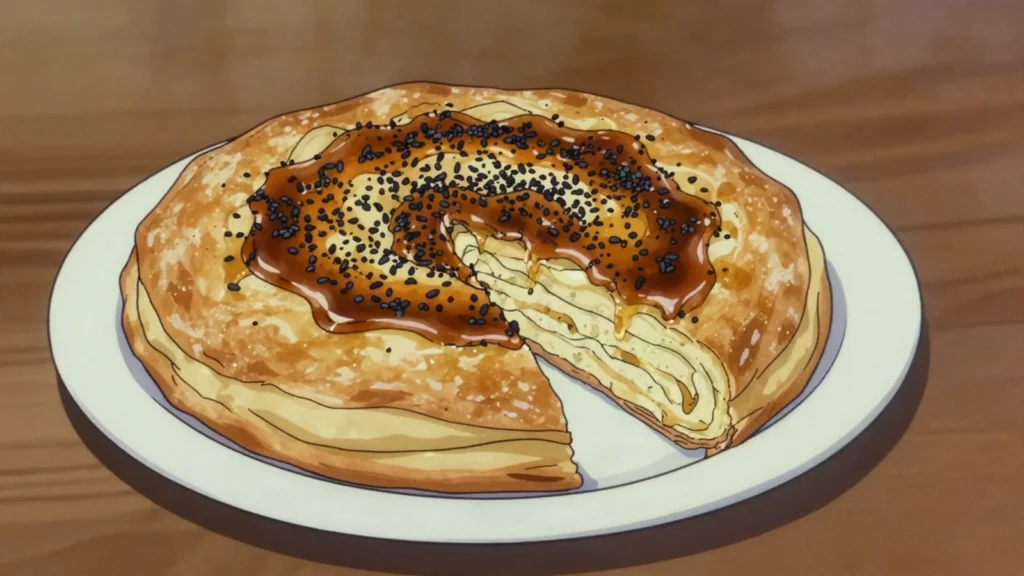
- Take it out, pour over the warm Sidr honey while the bread is still hissing so it soaks down between the layers, and scatter the nigella seeds over the top.
- Rest 10 minutes, then cut into wedges and eat with your hands, pulling the layers apart.
Technique
- Sidr honey from the Hadhramaut and Doan valleys is the point of the dish: dark, resinous and faintly bitter, it plays against the butter. A pale floral honey makes the bread merely sweet.
- Do not skimp on the samn. Yemeni cooks pour it on until it pools; that fat is what separates ten sheets of dough into a hundred flakes.
- The name means daughter of the plate. It is served at weddings, at Eid and for the Prophet’s birthday, always as the sweet end of a lunch, torn rather than sliced.
Substitutions
- No samn: use ghee, or clarify unsalted butter yourself by simmering until the milk solids brown and straining. Buckwheat honey is the nearest supermarket stand-in for Sidr’s dark bitterness.
Variations
- Sabaya is the same idea baked in a deeper tin with a cream or milk soak poured over before baking.
- Some Sanaa cooks scatter black seed under each layer as well as on top, so the whole bread is speckled.
History
Layered honey bread brushed with ghee and served with black seed honey at weddings and festivals.
Frequently asked questions
What is Bint al-sahn?
Bint al-sahn is a dessert from Yemen: layered flaky bread drenched in Sidr honey and nigella seeds. Layered honey bread brushed with ghee and served with black seed honey at weddings and festivals.
How long does Bint al-sahn take to make?
Bint al-sahn takes 45 min plus 1 hr proving of preparation and 35 min of cooking. The recipe makes 8 servings, one 28 cm round. It is rated medium to make.
What can I substitute in Bint al-sahn?
Yes, within limits. No samn: use ghee, or clarify unsalted butter yourself by simmering until the milk solids brown and straining. Buckwheat honey is the nearest supermarket stand-in for Sidr’s dark bitterness.
What is the most important thing to get right in Bint al-sahn?
Sidr honey from the Hadhramaut and Doan valleys is the point of the dish: dark, resinous and faintly bitter, it plays against the butter. A pale floral honey makes the bread merely sweet.