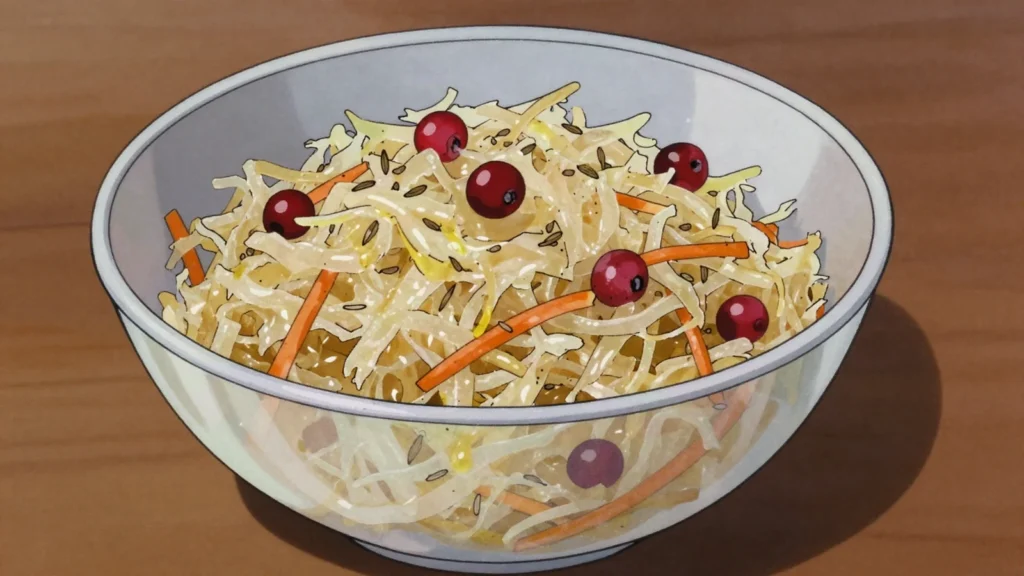

Ingredients
Cabbage
- 3 kgwhite cabbage, shredded fine
- 60 gcoarse non-iodised salt — 2% of the cabbage weight
- 2carrots, grated
- 1 tbspcaraway seed
Optional
- 6juniper berries, crushed
- 1apple, quartered
- a handful of cranberries
Directions
- Shred the cabbage finely and weigh it, then take exactly 2% of that weight in salt. Weighing rather than guessing is the difference between a crock that works and one that goes soft or stalls.
- Toss with the salt, grated carrot, caraway and juniper and leave 30 minutes.
- Work it hard by the handful for ten minutes, squeezing until the cabbage collapses to about half its volume and sits in a pool of its own liquid. This is the whole labour and there is no way past it.
- Pack it into the crock a handful at a time, pressing each layer down firmly so the brine rises above the cabbage, tucking the apple and cranberries in as you go.
- Lay whole outer leaves over the top, then a plate and a stone, so every shred sits below the liquid.
- Cover loosely and ferment at cool room temperature, 16 to 20°C (61 to 68°F), for about four weeks, skimming any white film off the surface as it appears.
- Taste from week three. When it is sour enough, move it somewhere cold. It keeps for months.
- Eat cold with oil and onion, or stew it slowly with pork ribs for Kūčios, the Lithuanian Christmas Eve table.
Technique
- Two percent by weight, on a scale.
- Everything below the brine. That one rule prevents nearly every problem.
- Cool and slow. Fermented warm it is ready in ten days and comes out flabby.
Substitutions
- Cranberries or lingonberries stirred through, which is common in the Baltic.
- Grated beetroot for a pink crock.
- A splash of brine from a working crock to speed the start.
Variations
- The Latvian skābēti kāposti and Estonian hapukapsas are the same preserve.
- Stewed with pork ribs, bacon and juniper as a winter main.
History
Fermented in wooden barrels weighted with stones, it supplied vitamin C through winter and still accompanies Lithuanian Christmas Eve dishes.
Frequently asked questions
What is Rauginti kopūstai?
Rauginti kopūstai is a fermented & pickled from Lithuania: barrel sauerkraut eaten cold with oil or stewed with pork ribs. Fermented in wooden barrels weighted with stones, it supplied vitamin C through winter and still accompanies Lithuanian Christmas Eve dishes.
How long does Rauginti kopūstai take to make?
Rauginti kopūstai takes 40 min plus 4 weeks fermenting of preparation and no cooking at all. The recipe makes fills a 5-litre crock. It is rated easy to make.
What can I substitute in Rauginti kopūstai?
Yes, within limits. Cranberries or lingonberries stirred through, which is common in the Baltic. Grated beetroot for a pink crock. A splash of brine from a working crock to speed the start.
What is the most important thing to get right in Rauginti kopūstai?
Shred the cabbage finely and weigh it, then take exactly 2% of that weight in salt. Weighing rather than guessing is the difference between a crock that works and one that goes soft or stalls.