
Ingredients
Fermented starch
- 1 kgwhite or yellow maize (or 700 g maize plus 300 g sorghum)
- water to cover, changed daily
- 1 tbspcloves and a few grains of alligator pepper, tied in muslin (optional, traditional)
To cook, per serving
- 100 gwet ogi starch
- 60 mlcold water
- 250 mlboiling water
- sugar and evaporated milk, to taste
Directions
- Rinse the maize, put it in a large bowl or clay pot and cover with 3–4 cm of cool water. Leave to steep at room temperature (28–32°C (80–90°F) is ideal) for 2–3 days, changing the water each morning; the grains swell, soften and start to smell pleasantly sour.
- The maize is ready when a grain crushes to paste between your fingers and the steeping water smells like sourdough, not putrid.
- Drain and wet-mill the grain with just enough fresh water to keep the mill turning, to a fine slurry. A blender works; run it long enough that no grit remains between your fingers.
- Sieve the slurry through a fine cloth or chiffon sieve in batches, working it with your hand and rinsing with water, until only the bran and germ are left in the cloth. Discard those.
- Let the sieved liquid stand undisturbed 12–24 hours in a cool place. The starch settles into a dense white cake with sour water on top.
- Pour off the sour water, or leave a finger’s depth over the starch to keep it from drying – this is how ogi is stored in the market, refrigerated, for up to a week.
- To cook, slake 100 g of the starch with 60 ml cold water into a smooth cream with absolutely no lumps.
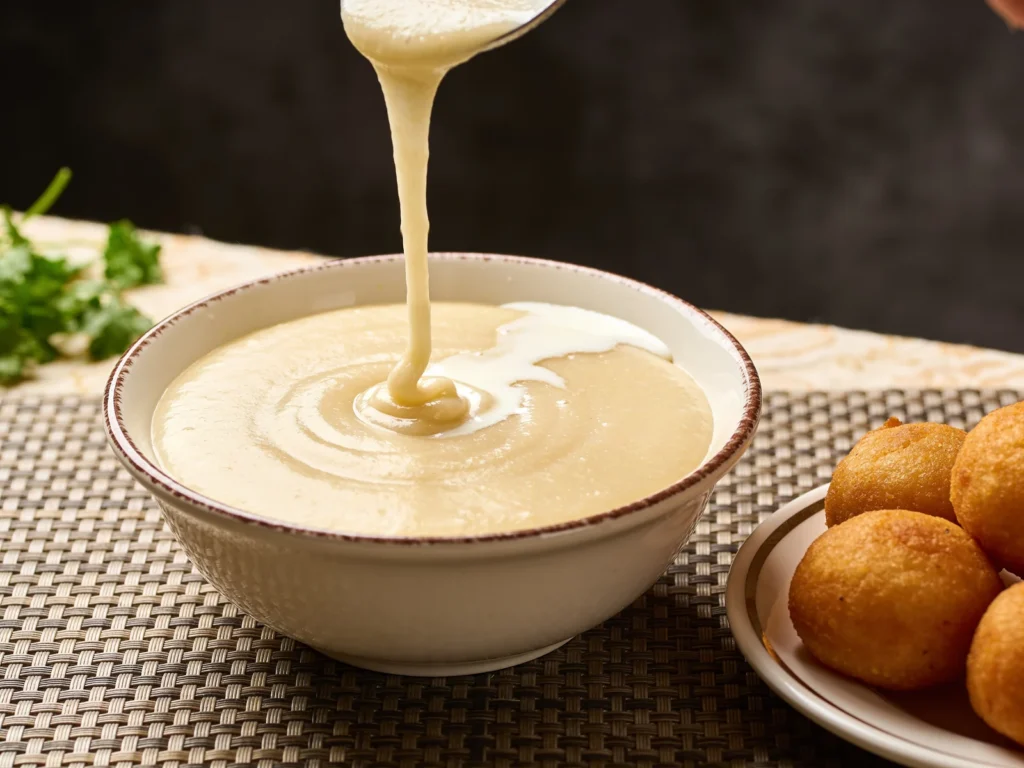
- Pour 250 ml furiously boiling water into the cream in a thin stream while whisking hard. The mixture will thicken and turn glossy and translucent almost at once. If it stays milky and thin, return it to the pan and cook 2 minutes, whisking.
- Sweeten to taste, thin with a little evaporated milk and serve hot with akara or moin moin.
Technique
- The water must be at a true rolling boil when it hits the starch. Merely hot water gives a raw, chalky pap that will not gel.
- A sour, yoghurt-like smell during steeping is correct – lactic acid bacteria dominate. Slimy ropiness, pink colour or a rotten smell means the batch has gone wrong; throw it out and start again with cleaner water.
- Yellow maize gives ogi its golden colour and slightly sweeter flavour; white maize gives the paler, sharper pap. Sorghum makes ogi baba, the reddish-brown version.
Substitutions
- In a hurry, fine maize meal soured overnight with 3 tbsp live yoghurt gives an approximation, though it lacks the clean acidity of a true three-day steep.
- Millet can replace up to a third of the maize for a nuttier ogi.
Variations
- Akamu or koko, the same food under its Igbo and northern names.
- Ogi baba, made from red sorghum, darker and more tannic.
- Cold set ogi (eko or agidi), poured into leaf-lined moulds and allowed to set firm, then sliced.
History
Maize is steeped for days, milled and sieved until it sours; ogi is Nigeria’s classic breakfast and weaning food.
Frequently asked questions
What is Ogi?
Ogi is a fermented & pickled from Nigeria: soured fermented maize starch cooked to a smooth pap, eaten with akara or moin moin. Maize is steeped for days, milled and sieved until it sours; ogi is Nigeria’s classic breakfast and weaning food.
How long does Ogi take to make?
Ogi takes 20 min of preparation and 3 days steeping, plus 10 min cooking of cooking. The recipe makes 6 servings of pap (from about 700 g wet starch). It is rated medium to make.
What can I substitute in Ogi?
Yes, within limits. In a hurry, fine maize meal soured overnight with 3 tbsp live yoghurt gives an approximation, though it lacks the clean acidity of a true three-day steep. Millet can replace up to a third of the maize for a nuttier ogi.
What is the most important thing to get right in Ogi?
The water must be at a true rolling boil when it hits the starch. Merely hot water gives a raw, chalky pap that will not gel.