
Ingredients
Vineyard
- 1hectare of Sauvignon Blanc on free-draining stony Wairau or Awatere valley soils
- About 12–14 tonnes of fruit per hectare, cropped for flavour rather than maximum yield
- Cool nights of 8–12 C through ripening, the key to retaining aroma and acid
Winery
- 1tonne of fruit picked at 21–23 Brix, machine-harvested overnight at 10–14°C (50–55°F)
- 40 mgper litre sulphur dioxide at the press, to protect the aromatic precursors
- 1pneumatic press, run gently to about 0.8 bar
- 20 gper hectolitre of a thiol-releasing aromatic yeast
- Nitrogen nutrient additions in two doses during fermentation
- Bentonite for protein stability, and a sterile membrane filter
To serve
- 1bottle, chilled to 8–10 C
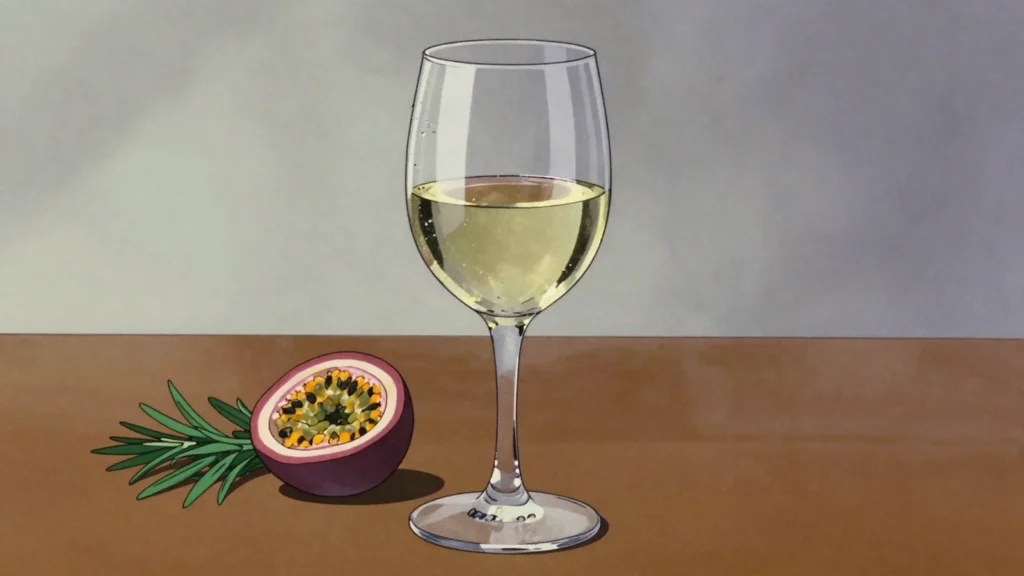
- 1tulip white wine glass
- Goat’s cheese, asparagus, tomato salad or green herbs, to eat alongside
Directions
- Pick on flavour, not just sugar, usually late March into April, when the fruit tastes of passionfruit but still snaps with acid, at 21–23 Brix and a pH near 3.2. Harvest at night by machine so the fruit arrives at the winery cold.
- Warm fruit oxidises and loses the thiols that carry the passionfruit aroma.
- Chill and give a short skin contact of 2–12 hours in the press for some parcels; the thiol precursors sit in the skins, and this is one of the choices that separates a pungent Marlborough style from a restrained one.
- Press gently to about 0.8 bar and keep the free-run and pressing fractions separate, then cold settle the juice at 8–10 C for 24–48 hours and rack off the solids.
- Cool fermentation preserves the esters; above 18°C (65°F) the wine turns generic and loses the varietal signature. Do not put it through malolactic fermentation.
- Leave it on fine lees for 2–3 months with occasional stirring for a little texture, then blend across parcels, since almost every commercial Marlborough Sauvignon is a blend of sites from both valleys. Fine with bentonite for protein stability, cold stabilise, sterile filter and bottle under screwcap, which New Zealand adopted early and almost universally to protect exactly these aromas.
- Serve at 8–10 C in a tulip glass; over-chilling below 6°C (45°F) mutes the aromatics that are the whole point.
Technique
- The style was made by an accident of place: the Wairau valley’s long cool ripening season, big day-night temperature swings and stony free-draining soils produce unusually high levels of the thiols 3MH and 3MHA alongside green methoxypyrazines, and that combination of tropical fruit and cut grass simply does not occur at this intensity elsewhere.
- Screwcap is not a shortcut. These wines depend on low oxygen ingress, and cork variability was destroying exactly the aromatics that define the region.
- This is a wine to buy, not to make; the point is the vineyard and the region. Serving it correctly matters more than anything you can do at home.
- Marlborough went from its first commercial plantings in 1973 to being the dominant force in New Zealand wine within a generation, and Sauvignon Blanc is now the great majority of the country’s wine exports.
Substitutions
- If you cannot find Marlborough, Awatere valley bottlings are the leaner, more mineral and herbal end of the same region, while Wairau is the riper, more tropical end.
- The nearest wines in style are cool-climate Sauvignon from Chile’s Casablanca and Leyda valleys, or from South Africa’s Elgin, though both are usually less pungent.
- Loire Sancerre and Pouilly-Fume are the same grape in a completely different idiom: flintier, more restrained, less overtly fruity.
Variations
- Wild-ferment and barrel-aged Sauvignon, made in old oak with indigenous yeast, textural and much less overtly aromatic.
- Awatere valley style, cooler and higher, with a more marked tomato-leaf and mineral character.
- Late-harvest and botrytised Marlborough Sauvignon, sweet and marmalade-like, made in small quantities.
History
Montana planted the first Marlborough vines in 1973; Cloudy Bay’s mid-1980s vintages made the style New Zealand’s defining export.
Frequently asked questions
What is Marlborough Sauvignon Blanc?
Marlborough Sauvignon Blanc is a wine & spirit from New Zealand: pungent grassy white with passionfruit and cut-grass aromas, poured cold everywhere. Montana planted the first Marlborough vines in 1973; Cloudy Bay’s mid-1980s vintages made the style New Zealand’s defining export.
How long does Marlborough Sauvignon Blanc take to make?
Marlborough Sauvignon Blanc takes A season in the vineyard of preparation and 3 weeks fermenting plus 2–3 months on lees of cooking. The recipe makes about 750 bottles per tonne of fruit. It is rated hard to make.
What can I substitute in Marlborough Sauvignon Blanc?
Yes, within limits. If you cannot find Marlborough, Awatere valley bottlings are the leaner, more mineral and herbal end of the same region, while Wairau is the riper, more tropical end. The nearest wines in style are cool-climate Sauvignon from Chile’s Casablanca and Leyda valleys, or from South Africa’s Elgin, though both are usually less pungent. Loire Sancerre and Pouilly-Fume are the same grape in a completely different idiom: flintier, more restrained, less overtly fruity.
What is the most important thing to get right in Marlborough Sauvignon Blanc?
Cool fermentation preserves the esters; above 18°C (65°F) the wine turns generic and loses the varietal signature. Do not put it through malolactic fermentation.