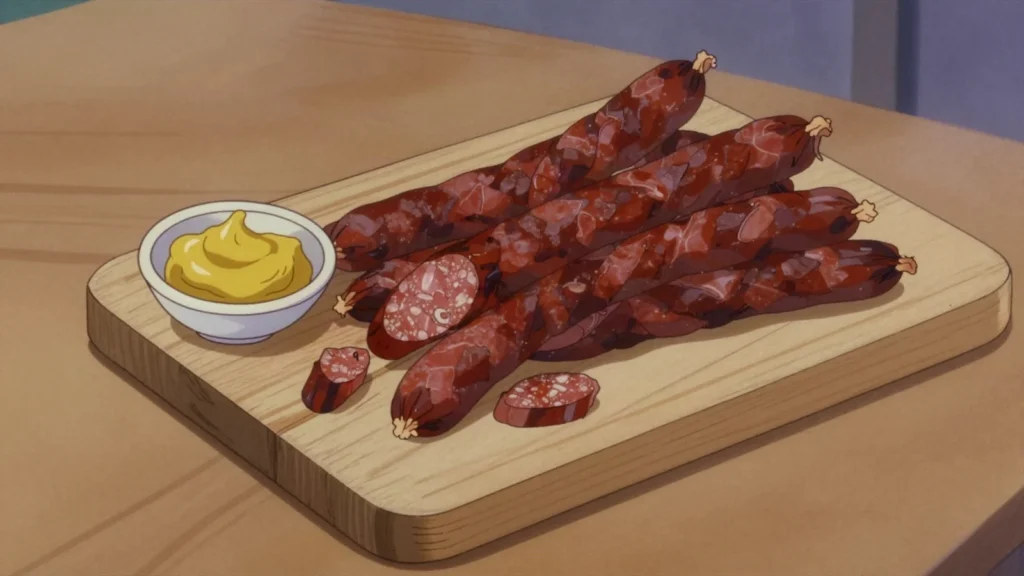

Long thin dried pork sticks, smoky and snappy, eaten as a snack. They were made from pork fed on potatoes — the kabany of old Polish farms — and won EU traditional speciality protection in 2011.
It is a cured raw-meat product where safety depends on measured nitrite and on hitting a water-activity target, and the smoking and baking stages need a controlled chamber.
What goes into it
- pork, with a small proportion of fat
- salt and curing salt
- black pepper, nutmeg and caraway
- narrow sheep casings
- beech or alder smoke
How it is made
Finely minced pork is cured with salt and nitrite, stuffed into very narrow sheep casings and hung to dry. They are then warm-smoked, briefly baked, and finally dried for several days more, losing over half their weight. The thin diameter is the specification: it is what gives the snap and what lets them dry through quickly.
How long it takes: about a week from mincing to finished stick
How it is eaten
Snapped and eaten as they are, with beer or vodka, or cut into bigos and scrambled eggs.
History
A thin, long, dry-cured and smoked pork sausage, developed in Poland as a portable, long-keeping snack sausage rather than one intended for cooking into a larger dish, with its thinness and dryness specifically suited to eating on its own, similar in that portable, ready-to-eat role to some jerky traditions found elsewhere, though produced through a distinctly Polish curing and smoking technique. Its production is regulated under a Polish traditional specialty guarantee, recognizing kabanosy’s specific traditional recipe and process, generally originating from the breed of pig historically called kabanos, from which the sausage’s name is derived. Kabanosy remain a popular snack food across Poland and among Polish diaspora communities internationally, sold widely in delis and supermarkets rather than treated as a rare specialty item.
Frequently asked questions
What is Kabanosy?
Kabanosy is a charcuterie & cured from Poland: long thin dried pork sticks, smoky and snappy, eaten as a snack. A thin, long, dry-cured and smoked pork sausage, developed in Poland as a portable, long-keeping snack sausage rather than one intended for cooking into a larger dish, with its thinness and dryness specifically suited to eating on its own, similar in that portable, ready-to-eat role to some jerky traditions found elsewhere, though produced through a distinctly Polish curing and smoking technique. Its production is regulated under a Polish traditional specialty guarantee, recognizing kabanosy’s specific traditional recipe and process, generally originating from the breed of pig historically called kabanos, from which the sausage’s name is derived. Kabanosy remain a popular snack food across Poland and among Polish diaspora communities internationally, sold widely in delis and supermarkets rather than treated as a rare specialty item.
How is Kabanosy made?
Finely minced pork is cured with salt and nitrite, stuffed into very narrow sheep casings and hung to dry. They are then warm-smoked, briefly baked, and finally dried for several days more, losing over half their weight. The thin diameter is the specification: it is what gives the snap and what lets them dry through quickly. It takes about a week from mincing to finished stick.
Can I make Kabanosy at home?
No, and the atlas gives no method for it. It is a cured raw-meat product where safety depends on measured nitrite and on hitting a water-activity target, and the smoking and baking stages need a controlled chamber.
What goes into Kabanosy?
Pork, with a small proportion of fat, salt and curing salt, black pepper, nutmeg and caraway, narrow sheep casings, beech or alder smoke.
How is Kabanosy eaten?
Snapped and eaten as they are, with beer or vodka, or cut into bigos and scrambled eggs.