
Ingredients
Herring
- 8whole new-season North Sea herring, caught between late May and early July, with a fat content of at least 16 percent, about 1.2 kg
Brine cure
- 500 gcoarse sea salt
- 2 litrescold water, for the brine (about 20 percent salt)
- 1food-grade barrel, bucket or deep tub with a lid
To serve
- 2onions, very finely diced
- 8small sweet-sour gherkins (augurken), sliced
- 4soft white buns (broodje), split, if not eating them by the tail
- 1lemon, in wedges
- 1small glass of jenever, alongside
Directions
- Rinse the cavity in cold water, then pack the fish in layers in the tub, salting heavily between each layer, and cover with the cold 20 percent brine so every fish is submerged.
- Hold at 0–4 C for 5 days. For safety, the fish must then be frozen: at least 24 hours at minus 45°C (-49°F) in a commercial blast freezer, or a minimum of 4 days at minus 20°C (-4°F) in a domestic freezer, to kill Anisakis larvae.
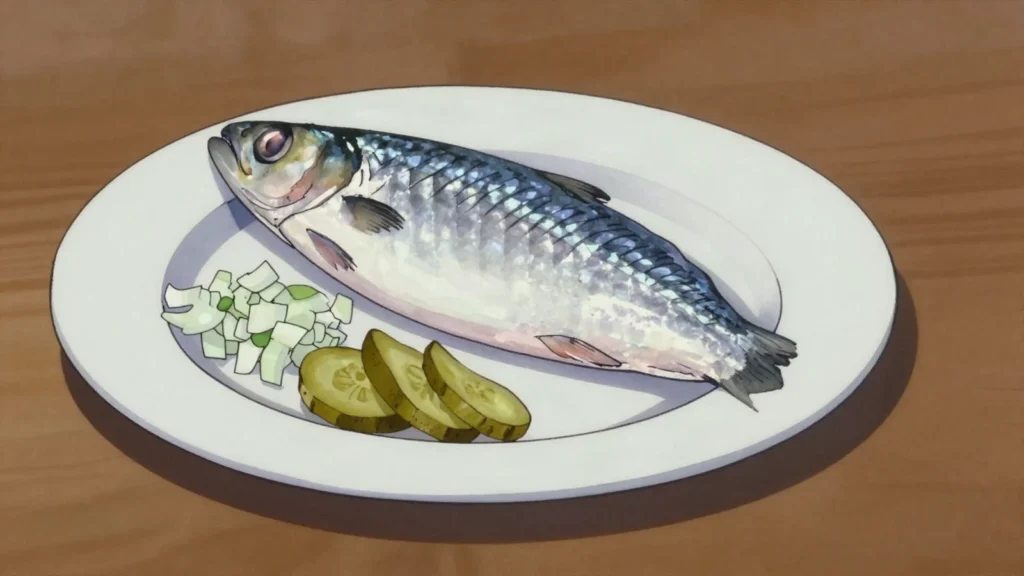
- Rinse briefly and pat dry. Good maatjes should smell clean and faintly of the sea, be soft enough to cut with a fingernail and taste sweet and lightly salty, never sharp or ammoniac.
- Serve the classic way: dip the fillet in finely chopped raw onion, hold it by the tail, tilt your head back and lower it into your mouth. Or lay it in a soft bun with onion and gherkin as a broodje haring.
Technique
- The pancreas is deliberately left in during gibbing. Its enzymes ripen the flesh, and that enzymatic maturation, not the salt alone, is what gives maatjes their softness and sweetness. Fully gutted herring simply salt-cures and stays firm.
- Freezing is a food-safety requirement, not a preference. Raw marine fish can carry Anisakis worms; do not skip or shorten it, and never eat home-cured herring that has not been frozen properly.
- The season opens with Vlaggetjesdag in Scheveningen, and the first barrel is auctioned for charity. Fish sold as Hollandse Nieuwe outside the season has been frozen from that catch.
- Onion is not a Dutch-wide rule. Amsterdam serves it with chopped onion as standard; parts of Rotterdam and the north eat it plain and consider onion a distraction.
Substitutions
- Curing your own is genuinely risky without a blast freezer. Buy ready maatjesharing fillets, which are already gibbed, ripened and frozen to regulation, and serve them as above; this is what almost every Dutch household does.
- Out of season, vacuum-packed frozen maatjes from a Dutch fishmonger are the same product and thaw well.
- No jenever: a very cold pilsner is the other standard accompaniment.
Variations
- Broodje haring, in a soft white bun with onion and gherkin, the street version.
- Haring met uitjes op een bord, served on a plate cut into pieces with cocktail flags, the sit-down version.
- Zure haring or rolmops, a different preparation entirely, pickled in vinegar with onion rather than enzyme-ripened.
History
Gibbing, gutting herring but leaving the enzyme-rich pancreas, was described in the fourteenth century and built the Dutch herring trade; the season opens on Vlaggetjesdag.
Frequently asked questions
What is Hollandse Nieuwe?
Hollandse Nieuwe is a street food from Netherlands: raw brined new herring with chopped onion, eaten whole. Gibbing, gutting herring but leaving the enzyme-rich pancreas, was described in the fourteenth century and built the Dutch herring trade; the season opens on Vlaggetjesdag.
How long does Hollandse Nieuwe take to make?
Hollandse Nieuwe takes 20 min of preparation and 5 days ripening plus 48 hr freezing of cooking. The recipe makes 4 servings. It is rated hard to make.
What can I substitute in Hollandse Nieuwe?
Yes, within limits. Curing your own is genuinely risky without a blast freezer. Buy ready maatjesharing fillets, which are already gibbed, ripened and frozen to regulation, and serve them as above; this is what almost every Dutch household does. Out of season, vacuum-packed frozen maatjes from a Dutch fishmonger are the same product and thaw well. No jenever: a very cold pilsner is the other standard accompaniment.
What is the most important thing to get right in Hollandse Nieuwe?
Hold at 0–4 C for 5 days. For safety, the fish must then be frozen: at least 24 hours at minus 45°C (-49°F) in a commercial blast freezer, or a minimum of 4 days at minus 20°C (-4°F) in a domestic freezer, to kill Anisakis larvae.