
Ingredients
The paste
- 500 gtahini, well stirred
- a good quality one
Syrup
- 500 gsugar
- 150 mlwater
- 2 tablespoonshoney
- 1 teaspoonlemon juice
Nuts
- 150 gwhole almonds
- or 150 g pistachios
- lightly toasted
Sometimes added
- 1 teaspoonvanilla
- the zest of 1 lemon
- 2 tablespoonscocoa, for a marbled version
Directions
- Stir it thoroughly before you measure it. Taste it first if you are unsure of it. The sugar syrup must reach the right temperature.
- Keep children well away from the pan. Have cold water nearby in case of a splash. Warm the tahini gently in a large bowl. Warm tahini combines far more easily. Set out the nuts ready to add.
- Line a tin with baking paper first. Making the syrup takes attention. Put the sugar and water in a heavy pan. Add the honey and the lemon juice. Warm it until the sugar dissolves completely. Then stop stirring it entirely. Brush the pan sides down with wet pastry brush. Let it boil steadily without stirring.
- Take it to about one hundred and twenty degrees. That is the soft ball stage in old terms. Drop a little syrup into cold water. It should form a soft pliable ball. Take the syrup off the heat entirely. Pour it slowly into the warm tahini.
- Stir it steadily with a wooden spoon. Stir it just until it comes together. Stop the moment it holds together. Fold in most of the toasted nuts. Keep some of them back for the top. Work quickly, since it stiffens fast. Setting it takes several hours.
- Tip the mixture into the lined tin. Press it down firmly and evenly. Press the remaining nuts into the surface. Cover it and leave it at room temperature. Give it at least four full hours.
- Turn the block out onto a board. Cut it into thick slabs or squares. Serving it is done in small pieces. Keep it away from strong smells.
Technique
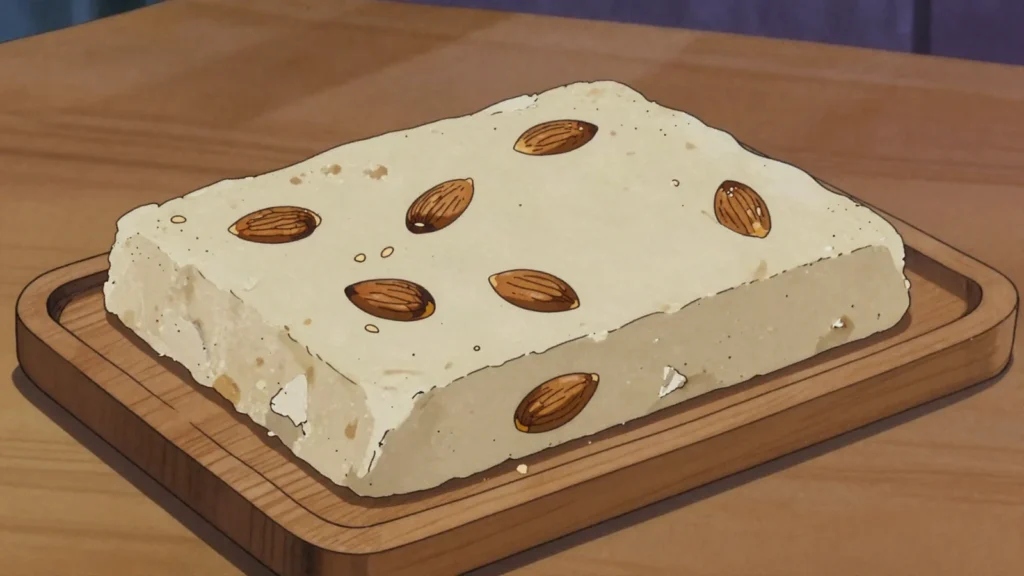
- This is a sesame halva made from tahini and sugar syrup, quite different from the flour halvas and the starch halvas; the three families share a name and little else.
- Sesame halva should be crumbly and flaky rather than smooth and dense, and a dense block has been overworked; stop stirring the moment it comes together.
- The syrup must reach about one hundred and twenty degrees, the soft ball stage, since too low and it never sets firm while too high and it turns hard and brittle; hot sugar syrup burns skin extremely badly.
Substitutions
- Pistachios can replace almonds, as can a mixture of nuts.
- A tablespoon of cocoa folded through part of the mixture gives the marbled version.
Variations
- A marbled version with cocoa swirled through is widely sold.
- Some makers add vanilla or lemon zest to the paste.
- Similar sesame halva is made across Greece, Turkey and the Levant.
History
Maltese halva whose name means the Turk’s sweet, a legacy of Ottoman-era trade across the Mediterranean.
Frequently asked questions
What is Helwa tat-Tork?
Helwa tat-Tork is a dessert from Malta: crumbly sesame paste block studded with almonds, cut in slabs. Maltese halva whose name means the Turk’s sweet, a legacy of Ottoman-era trade across the Mediterranean.
How long does Helwa tat-Tork take to make?
Helwa tat-Tork takes 30 minutes of preparation and 20 minutes of cooking. The recipe makes one block, about 30 pieces. It is rated hard to make.
What can I substitute in Helwa tat-Tork?
Yes, within limits. Pistachios can replace almonds, as can a mixture of nuts. A tablespoon of cocoa folded through part of the mixture gives the marbled version.
What is the most important thing to get right in Helwa tat-Tork?
Stir it thoroughly before you measure it. Taste it first if you are unsure of it. The sugar syrup must reach the right temperature.