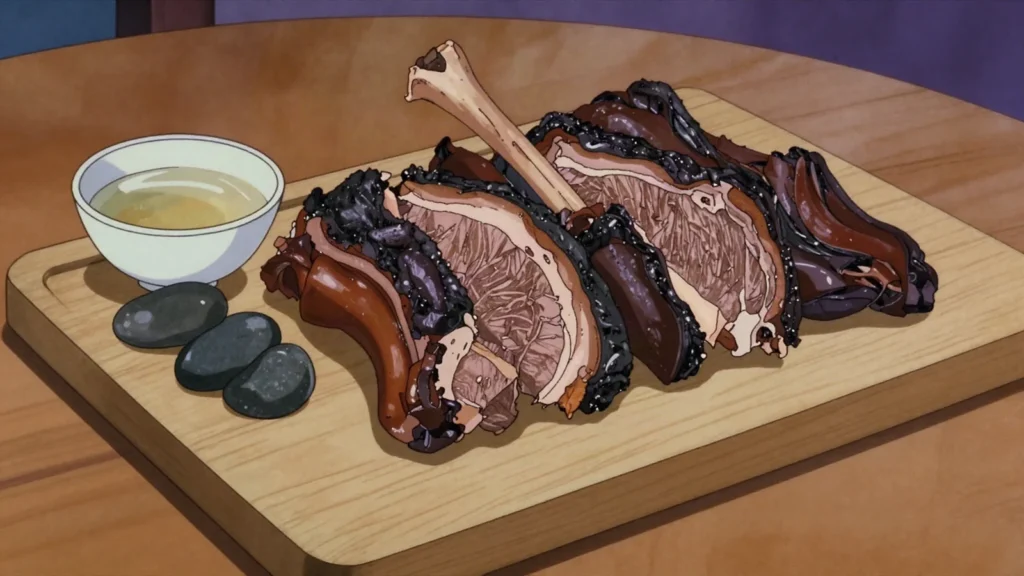

Ingredients
Meat
- 1young goat or lamb, about 12 kg, emptied through the neck by a butcher with the hide left on
- 3 tbspsalt
- 1 litrewater
Aromatics
- 3onions, quartered
- 1 headgarlic, halved
- wild steppe onion, if you have it
Stones and fire
- 20to 25 smooth dry river stones, about the size of a fist
- hardwood for the fire
- long tongs
- a blowtorch
- wire
Directions
- Use only smooth, dry river stones: porous or damp stones hold water, and that water turns to steam and shatters them violently.
- Salt the inside of the cavity, then pack it in layers. A handful of meat cut from the legs, then a hot stone lifted in with tongs, then onion and garlic, then another stone, working steadily until the cavity is full.
- Pour in the water and close the neck with wire, deliberately leaving a gap. Never seal the carcass completely: the steam has to escape somewhere, and a sealed hide will burst.
- Lay the carcass on its side over low embers or on hot ground and scorch the outside of the hide all over with the blowtorch, turning as you go, until the hair has burned off and the skin is dark and taut.
- Keep turning and torching for 2 hours, going back over any part of the skin that begins to slacken. It is ready when the skin is evenly dark and drum-tight and the leg joints move freely in their sockets.
- Pour off the broth that has collected inside and drink it. Pass the stones from hand to hand while they are still warm, which is customary and said to be good for the health, but use a cloth because they are hot enough to burn.
- Carve and eat plain, with the broth, and without sauce.
Technique
- This entry covers the goat and lamb version only. The marmot version is not given here: Mongolia periodically bans marmot hunting after outbreaks of bubonic plague, most recently in 2019 when a couple died in Bayan-Ölgii province, because marmots carry Yersinia pestis and both handling and eating them transmit it.
- This is outdoor cooking that needs open ground, a hardwood fire and room to stand back. It cannot be scaled down to a kitchen.
- Check the deepest meat with a thermometer before serving. Stones cook unevenly and the parts furthest from them lag well behind.
Substitutions
- Khorkhog, which uses the same hot stones with jointed mutton in a sealed milk churn, is the far more practical version and is cooked far more often.
Variations
- Khorkhog, in a milk can over a fire.
- The marmot version, which is traditional and is excluded here for the reason given above.
History
Marmot boodog is periodically banned after bubonic plague cases, most recently in 2019, because the rodents carry the disease.
Frequently asked questions
What is Boodog?
Boodog is a main from Mongolia: goat or marmot roasted from within by hot stones placed inside the carcass. Marmot boodog is periodically banned after bubonic plague cases, most recently in 2019, because the rodents carry the disease.
How long does Boodog take to make?
Boodog takes 2 hr of preparation and 2 hr of cooking. The recipe makes 10 servings. It is rated hard to make.
What can I substitute in Boodog?
Yes, within limits. Khorkhog, which uses the same hot stones with jointed mutton in a sealed milk churn, is the far more practical version and is cooked far more often.
What is the most important thing to get right in Boodog?
Pour in the water and close the neck with wire, deliberately leaving a gap. Never seal the carcass completely: the steam has to escape somewhere, and a sealed hide will burst.