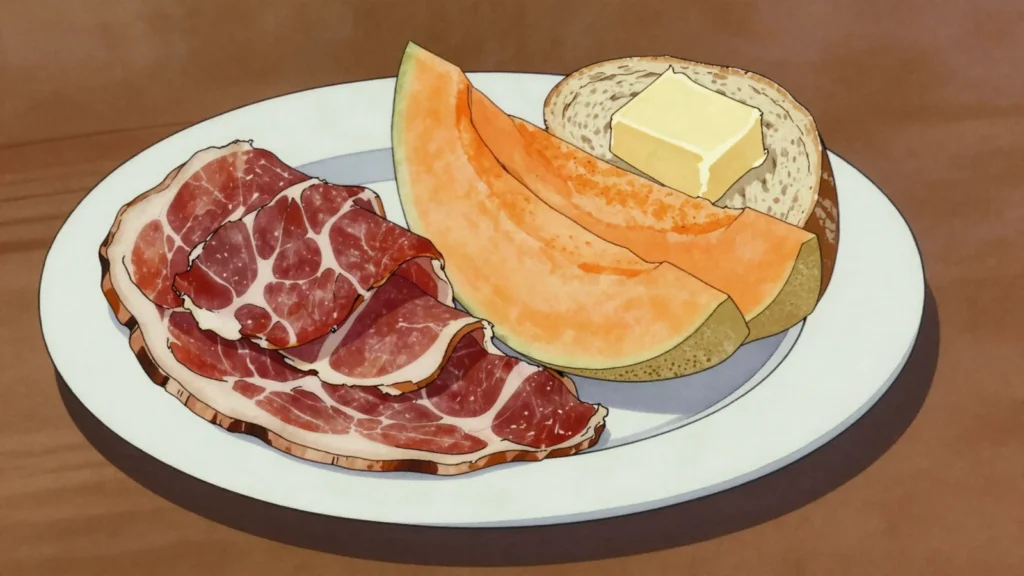

Ingredients
What to buy
- Jambon d’Ardenne
- carrying the PGI mark
- see the note
- whole, in a piece, or machine sliced
- from a Belgian butcher or a good delicatessen
- see the note on why no method is given
To serve cold
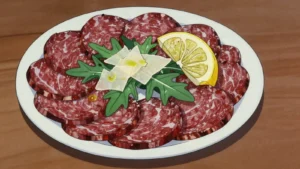
- sliced paper thin
- ripe melon
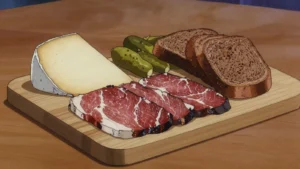
- good butter and rustic bread
- pickled onions and gherkins
- a handful of salad leaves
- black pepper
To cook with
- wrapped around chicory before baking
- diced into an omelette
- the bone, for pea soup
To drink
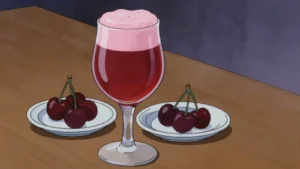
- a Trappist dubbel
- or a saison
- or a dry white wine
Directions
- Salt must penetrate the full thickness. That carries the fuller account of cold smoking and its hazards.
- Slice it paper thin. Thick slices are chewy and salty.
- Chill the piece for half an hour.
- Use the sharpest knife you have. Slice across the grain.
- Take it out of the refrigerator twenty minutes before. Cold cured ham tastes of almost nothing.
- Lay the slices loosely rather than stacking them. Sweet and cold against salt and fat.
- Heat dries it further and toughens it. Do not salt the pot until the end.
Technique
- The atlas gives no curing method: nitrite salts in small precise quantities, cold smoking that holds meat for hours or days in exactly the range where bacteria grow, months of drying in which salt must reach the bone, and a product eaten raw with nothing later to correct an error. The kumpiak entry carries the fuller account of cold smoking.
- Jambon d’Ardenne is a protected name, holding PGI status since 1996, so a ham made identically elsewhere may not use it. PGI ties at least one stage of production to the region; PDO requires the whole process there. People use the two marks as if they were the same and the atlas keeps them separate.
- Slice it paper thin — this matters more than anything else you do with it. The ham is lean and dense, so thick slices are chewy and salty while thin ones melt and release the aroma. Chill it half an hour and use the sharpest knife you have, or better, ask the shop to machine-slice it, since no domestic knife matches a slicer.
- Take it out twenty minutes before serving. Cold cured ham tastes of almost nothing until the fat softens.
- Lay the slices loosely rather than stacking them. Stacked slices stick together and tear.
- It is often compared with prosciutto and serrano, and differs in one respect that matters: it is smoked and they are not. That smoke is the whole difference.
- Judge it by deep red to burgundy flesh, white or cream fat, firm dry texture and a clean smoky smell. Yellowing fat means it is oxidising — rancidity beginning, tasting of old paint. A very dark hard rim around a softer centre is case hardening. Sliminess, coloured or fuzzy mould, or a sour or ammoniac smell all mean leave it.
- The melon must be properly ripe or the pairing fails — an unripe one is just watery. It should smell sweet at the stem end, give very slightly there, and feel heavy.
- It is not really cooked; heat dries it further and toughens it. Chicons au gratin usually uses cooked ham rather than this, because raw Ardennes ham dries out in the oven.
- A smoked ham bone gives pea soup its whole character, but do not salt the pot until the end — the ham releases a great deal of salt.
- Store a whole piece wrapped in paper rather than plastic. Paper lets it breathe where plastic makes it sweat.
- Cured meats contain nitrites and processed meat has documented health associations, with public health bodies advising moderation. The atlas records that as fact and makes no dietary recommendation.
- Advice on ready-to-eat cured meats in pregnancy varies by country, concerning listeria and toxoplasma; cooking thoroughly addresses both. The atlas leaves that to a doctor or midwife.
Substitutions
- Prosciutto, serrano or Bayonne ham substitute, without the smoke.
- Black Forest ham is the closest smoked equivalent.
- Speck from the Tyrol is smoked and dry-cured in the same spirit.
- Kumpiak, the Belarusian ham, is the eastern counterpart.
- Ripe fig or pear replaces melon.
- A cooked ham is what chicons au gratin actually wants.
Variations
- Sliced with melon is the classic summer serving.
- On buttered rustic bread with a gherkin is the everyday one.
- Ardennes pâté is the other famous product of the region, and is a different thing.
- Chicons au gratin wraps chicory in ham under cheese sauce.
- Salade liégeoise uses bacon rather than this ham.
- A juniper-smoked version is made by some houses.
History
Salted and smoked over Ardennes hardwood in the forested south; Jambon d’Ardenne won PGI protection in 1996.
Frequently asked questions
What is Ardennes ham?
Ardennes ham is a charcuterie & cured from Belgium: salted, cold-smoked raw ham from the Ardennes, sliced thin with melon or bread. Salted and smoked over Ardennes hardwood in the forested south; Jambon d’Ardenne won PGI protection in 1996.
How long does Ardennes ham take to make?
Ardennes ham takes 10 minutes of preparation and none of cooking. The recipe makes buy 60 g per person. It is rated easy to make.
What can I substitute in Ardennes ham?
Yes, within limits. Prosciutto, serrano or Bayonne ham substitute, without the smoke. Black Forest ham is the closest smoked equivalent. Speck from the Tyrol is smoked and dry-cured in the same spirit. Kumpiak, the Belarusian ham, is the eastern counterpart. Ripe fig or pear replaces melon. A cooked ham is what chicons au gratin actually wants.
What is the most important thing to get right in Ardennes ham?
Salt must penetrate the full thickness. That carries the fuller account of cold smoking and its hazards.