
Ingredients
In the plantation
- Vanilla planifolia vines, trained on gliricidia or jatropha shade trees
- A sliver of bamboo or a thorn for pollination
- 25 kgmature green pods, 15–22 cm long, picked when the tip begins to yellow
Curing kit
- A vat of water held at 63–65°C (145–150°F)
- Wool blankets and wooden sweating boxes
- Drying racks and mats
- Wax paper and lidded wooden or tin conditioning boxes
To use
- 1pod flavours 500 ml of milk or cream
- Airtight glass jar for storage
Directions
- Let the pods mature on the vine for 8–9 months. Picked early they never develop vanillin; left too long they split.
- Drain and pack them straight into wool-lined wooden boxes to sweat (étuvage) for 24–48 hours at around 45–50°C (115–120°F). Sun-dry in the mornings for 2–3 hours on mats, returning the pods to the blankets each afternoon to sweat again.
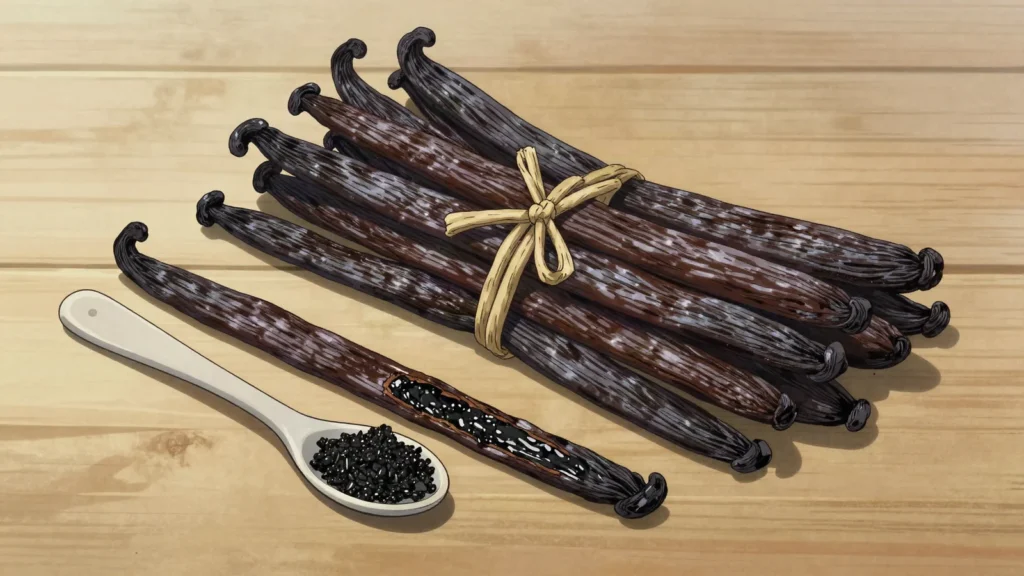
- Repeat this daily cycle for 1–2 weeks, watching for any mould. Move to slow shade-drying on racks in a ventilated room for 1–2 months, until the pods lose about 70–80% of their green weight and become supple, dark and oily, wrapping round a finger without cracking.
- Use by splitting the pod lengthways, scraping the seeds into warm milk, cream or a syrup and steeping the empty pod with them; store the rest in an airtight jar, never in the fridge, where they mould.
Technique
- Hand-pollination was invented in 1841 by Edmond Albius, an enslaved twelve-year-old on Réunion. The whole Indian Ocean vanilla industry, Comoros included, rests on his technique.
- Comorian vanilla is a Bourbon-type vanilla, and the Comoros were once the world’s second-largest producer. It is the country’s key export crop alongside ylang-ylang and clove.
- Curing is where value is made or destroyed: rush the drying and the pods mould, overdry them and they turn brittle and lose aroma. Six months of daily attention stands behind every pod.
- Store cured pods in an airtight container at room temperature. Refrigeration causes condensation and mould; a dried-out pod can be revived by steeping in warm liquid.
Substitutions
- For cooking, 1 pod is roughly equal to 1 tbsp of good vanilla extract or 1 tsp of vanilla paste. Synthetic vanillin has one note and none of the 250-plus aroma compounds of a cured pod.
- Scraped pods should not be thrown away: dry them and bury them in sugar, or steep them in rum to make an island-style vanilla rum.
Variations
- Madagascan Bourbon vanilla is cured identically and is the closest relative; Tahitian vanilla (V. tahitensis) is fruitier and floral, and Mexican vanilla is smokier.
- In the Comoros the pods scent everything from tea and cakes to the celebratory coconut sauces of the islands.
History
The Comoros were among the world’s leading vanilla exporters in the twentieth century, using the hand-pollination method devised on Réunion in 1841.
Frequently asked questions
What is Vanille des Comores?
Vanille des Comores is a sauce & condiment from Comoros: hand-pollinated cured vanilla pods, a mainstay of the island economy. The Comoros were among the world’s leading vanilla exporters in the twentieth century, using the hand-pollination method devised on Réunion in 1841.
How long does Vanille des Comores take to make?
Vanille des Comores takes Daily hand-pollination through the flowering season of preparation and 8–9 months on the vine, then 3–6 months of curing of cooking. The recipe makes about 5 kg of cured black pods from 25 kg of green pods. It is rated hard to make.
What can I substitute in Vanille des Comores?
Yes, within limits. For cooking, 1 pod is roughly equal to 1 tbsp of good vanilla extract or 1 tsp of vanilla paste. Synthetic vanillin has one note and none of the 250-plus aroma compounds of a cured pod. Scraped pods should not be thrown away: dry them and bury them in sugar, or steep them in rum to make an island-style vanilla rum.
What is the most important thing to get right in Vanille des Comores?
Let the pods mature on the vine for 8–9 months. Picked early they never develop vanillin; left too long they split.